
Demand generation is a full-funnel marketing and sales system designed to create awareness, build brand trust, and convert market interest into qualified sales pipeline. Unlike simple lead capture, it spans the entire buyer journey, from the first time a prospect encounters your brand to the moment they become a sales-ready opportunity. Salesforce and Leadfeeder both define demand gen as broader than lead capture, with pipeline contribution as its primary success metric. For business professionals and marketers, understanding this distinction is the starting point for building a revenue engine that actually compounds over time.
Demand generation explained: how it differs from lead generation
The most common misconception in B2B marketing is treating demand generation and lead generation as interchangeable. They are not. Lead generation focuses on capturing contact information and driving immediate conversions. Demand generation focuses on creating the conditions that make lead generation possible in the first place.
Think of it this way: lead generation harvests existing demand. Demand generation creates it.

The table below shows where each discipline diverges across goals, tactics, and metrics.
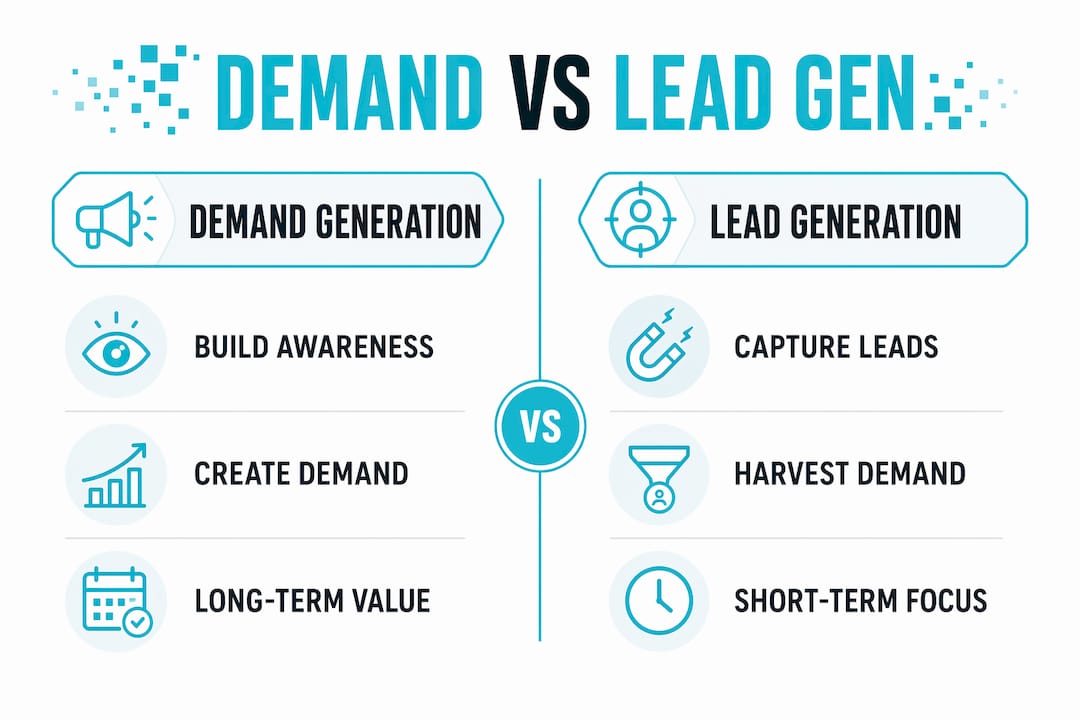
| Dimension | Demand generation | Lead generation |
|---|---|---|
| Primary goal | Build awareness, trust, and pipeline | Capture contact information |
| Content approach | Mostly ungated, educational assets | Gated content behind forms |
| Key metrics | Pipeline contribution, conversion rates | MQL volume, cost per lead |
| Time horizon | 6 to 12 months for full impact | Immediate to short-term |
| Sales alignment | Deeply integrated | Often siloed |
Demand generation also extends beyond new prospects. Marketing to existing customers through upsell and cross-sell campaigns improves Customer Lifetime Value (CLV) and generates efficient pipeline from accounts already in your system. Lead generation rarely accounts for this.
The practical implication is that your team needs both disciplines working together. Demand generation fills the top and middle of the funnel with educated, trust-primed prospects. Lead generation then converts that primed audience into contacts your sales team can act on. Running lead generation without demand generation is like fishing in an empty pond.
Key components of an effective demand generation strategy
Building a demand generation engine requires more than running a few paid campaigns. It requires a structured approach across four interconnected areas.
-
Validate your Ideal Customer Profile (ICP) before scaling. Every dollar spent on demand generation amplifies your targeting assumptions. If your ICP is wrong, you scale the wrong audience. Audit your best current customers by revenue, retention, and expansion potential before you build campaigns around them.
-
Build your attribution infrastructure first. You cannot optimize what you cannot measure. Set up UTM parameters, CRM pipeline tracking, and multi-touch attribution reporting before expanding into new channels. Salesforce emphasizes pipeline contribution as the primary demand gen metric, which requires clean data flowing from marketing into your CRM from day one.
-
Run demand creation and demand capture in parallel. Effective B2B demand generation requires simultaneous upstream awareness work and downstream intent-capture tactics. Demand creation includes content marketing, webinars, organic social, and brand advertising. Demand capture includes paid search, retargeting, and account-based marketing (ABM) targeting accounts already showing intent signals.
-
Sequence your content to match buyer intent. Early-stage prospects need education, not a product demo request. Mid-funnel prospects need proof and comparison content. Late-stage prospects need case studies and ROI calculators. Aligning content format to buyer stage prevents your sales team from receiving low-intent leads disguised as MQLs.
-
Plan for a 6 to 12 month timeline. A complete demand generation engine typically takes 6 to 12 months to show significant sales pipeline impact. Tactical wins like increased branded search volume or webinar registrations may appear sooner, but sustainable pipeline contribution requires patience and consistent execution.
Pro Tip: Avoid gating all your content early in the funnel. Over-gating educational assets limits discovery and reduces the organic reach that fuels top-of-funnel demand. Reserve forms for mid-to-late funnel content where the exchange of information feels proportional to the value offered.
The channel mix matters too. Content marketing, email nurture sequences, LinkedIn Ads for B2B targeting, paid search, community engagement, and ABM each play a different role at different funnel stages. No single channel carries the full load. Your job is to sequence them so each one reinforces the next.
How to measure demand generation success
Measuring demand generation is harder than measuring lead generation, and that difficulty is exactly why most teams do it poorly. The metrics that matter most are not the easiest to track.
The primary metrics for any demand gen program are marketing-sourced pipeline, pipeline influenced, and conversion rates between funnel stages. Marketing-sourced pipeline tells you how much of your total sales pipeline originated from marketing activity. Pipeline influenced tells you how many deals marketing touched at some point, even if sales sourced the initial contact. Salesforce highlights these pipeline metrics as the clearest indicators of demand gen performance, distinguishing them from MQL volume, which can be gamed by lowering qualification thresholds.
The table below outlines the core measurement framework.
| Metric | What it measures | Why it matters |
|---|---|---|
| Marketing-sourced pipeline | Revenue opportunities created by marketing | Proves direct revenue contribution |
| Pipeline influenced | Deals marketing touched at any stage | Shows broader impact beyond sourcing |
| MQL to SQL conversion rate | Quality of leads passed to sales | Identifies ICP and content alignment gaps |
| Customer Acquisition Cost (CAC) | Total spend divided by new customers | Tracks efficiency of the full funnel |
| Customer Lifetime Value (CLV) | Revenue generated per customer over time | Validates long-term demand gen ROI |
Beyond these standard metrics, the most rigorous teams use incrementality testing. Conversion lift measurement uses holdout groups to compare conversion rates between audiences exposed to a campaign and those who were not. This approach proves causal impact rather than correlation, which is the only honest way to evaluate whether a campaign actually drove pipeline or simply ran alongside organic growth.
Where direct attribution falls short, brand lift and marketing mix modeling provide proxies for measuring demand gen impact. These methods are particularly useful for upper-funnel programs like brand advertising and content marketing, where the path from impression to pipeline spans weeks or months.
Pro Tip: Set up your attribution and measurement infrastructure before you expand into new channels. Retrofitting tracking after the fact produces incomplete data and makes it nearly impossible to prove which channels drove pipeline.
What digital tools and platforms power demand generation today
Modern demand generation runs on a stack of platforms, each optimized for a different part of the funnel. Knowing which tool does what prevents both underinvestment and redundant spending.
-
Google Demand Gen campaigns reach over 3 billion users across YouTube, YouTube Shorts, Discover, Gmail, and the Display Network. These campaigns use AI-driven optimization to serve visual and video creative across multiple surfaces simultaneously. Demand Gen campaigns excel at creating interest through immersive visuals rather than capturing existing keyword intent, making them ideal for awareness and consideration stages.
-
LinkedIn Ads remain the most precise B2B targeting platform available. Job title, company size, industry, and seniority filters let you reach decision-makers at specific account types without wasting budget on irrelevant audiences. LinkedIn works best for mid-funnel content like webinars, case studies, and product education.
-
Marketing automation platforms such as HubSpot and Marketo handle email nurture sequences, lead scoring, and CRM integration. They allow your team to deliver the right content to the right prospect at the right stage without manual intervention at scale.
-
Content formats that perform include long-form blog posts, video explainers, live and recorded webinars, free tools or calculators, and original research reports. Each format serves a different intent level and channel context.
-
Emerging trends shaping demand gen in 2026 include AI-driven personalization at scale, dark social sharing (where content spreads through private channels like Slack and WhatsApp without trackable referral data), and video-first content strategies driven by YouTube and LinkedIn video growth.
One cost consideration worth noting: Demand Gen campaign CPCs are typically lower than paid search, offering cost-efficient reach with visual creative formats. This makes them a strong complement to higher-intent search campaigns rather than a replacement.
Key takeaways
Demand generation succeeds when it combines ICP validation, attribution infrastructure, parallel demand creation and capture, and a 6 to 12 month commitment to pipeline-focused measurement.
| Point | Details |
|---|---|
| Demand gen vs. lead gen | Demand generation creates the conditions that make lead generation possible; they are not the same discipline. |
| Attribution comes first | Build pipeline tracking and UTM infrastructure before expanding channels or you cannot prove ROI. |
| Gate content strategically | Reserve forms for mid-to-late funnel assets; ungated early content maximizes discovery and reach. |
| Measure pipeline, not just MQLs | Marketing-sourced pipeline and conversion rates between funnel stages are the metrics that reflect true demand gen performance. |
| Plan for 6 to 12 months | Full pipeline impact from a demand generation engine takes medium-term commitment, not a single campaign sprint. |
Where most demand gen programs actually break down
I have reviewed dozens of demand generation programs across B2B companies at various growth stages, and the failure pattern is almost always the same. The team launches campaigns before the measurement infrastructure is in place, runs them for 90 days, sees no clear pipeline attribution, and cuts the budget. The program never had a chance.
The second most common failure is treating demand generation as a top-of-funnel awareness play and nothing else. Salesforce is explicit that demand gen builds long-term brand authority and trust to accelerate pipeline. That means it touches every stage of the funnel, including existing customers. Teams that ignore the expansion revenue opportunity inside their current customer base are leaving some of the most efficient pipeline they will ever find on the table.
What actually works is less glamorous than most marketing content suggests. It is consistent content that genuinely helps your ICP solve real problems. It is a webinar series that runs every month for a year, not a one-off event. It is a paid media strategy that runs awareness and retargeting simultaneously, not sequentially. And it is a sales and marketing alignment meeting every two weeks where both teams review pipeline quality together, not just lead volume.
The future of demand generation will be shaped by AI personalization and content decentralization. As more buying research happens in private channels and AI-generated summaries, the brands that built genuine authority through years of helpful content will be the ones that get cited, shared, and trusted. Start building that authority now, not when the algorithm forces you to.
— Matthew
Build your demand generation engine with Viralmarketingstudio
Demand generation requires the right strategy, the right content, and the right measurement setup working together from the start. Viralmarketingstudio builds full-scale demand generation programs for B2B companies, covering campaign strategy, content creation, marketing automation, and attribution infrastructure.
Whether your team needs a complete demand gen strategy built from scratch or support scaling an existing program, Viralmarketingstudio delivers the marketing, web development, and branding capabilities to make it work. From Google Demand Gen campaigns to LinkedIn Ads to automated email nurture sequences, the team handles the full stack so your pipeline grows without the guesswork.
FAQ
What is demand generation in simple terms?
Demand generation is a full-funnel marketing system that creates awareness, builds trust, and converts market interest into qualified sales pipeline. It covers the entire buyer journey, not just lead capture.
How does demand generation differ from lead generation?
Lead generation captures contact information from existing demand. Demand generation creates that demand in the first place through education, brand building, and multi-channel nurture programs.
How long does demand generation take to show results?
A complete demand generation engine typically takes 6 to 12 months to produce significant pipeline impact, though leading indicators like branded search growth and engagement rates may appear sooner.
What metrics should I track for demand generation?
The primary metrics are marketing-sourced pipeline, pipeline influenced, and MQL to SQL conversion rates. Customer Acquisition Cost (CAC) and Customer Lifetime Value (CLV) provide longer-term efficiency benchmarks.
What tools are used for demand generation?
Common tools include Google Demand Gen campaigns for multi-surface visual advertising, LinkedIn Ads for B2B targeting, and marketing automation platforms like HubSpot or Marketo for email nurture and lead scoring.