
Growth marketing is defined as a full-funnel, data-driven practice that optimizes every stage of the customer lifecycle, from first click to repeat purchase, to drive sustainable business growth. Unlike traditional marketing, which focuses on brand awareness and lead generation, growth marketing treats acquisition, activation, retention, referral, and revenue as one connected system. The industry standard model for this system is the AARRR framework, developed by Dave McClure, which gives growth marketers a clear map of where customers drop off and where to focus next. Businesses that adopt this approach stop chasing one-time campaigns and start building compounding growth engines. Viralmarketingstudio works with business owners and marketers at exactly this intersection, where marketing strategy meets product, automation, and data.
Growth marketing explained: frameworks and core components
Growth marketing is built on two foundational structures: the AARRR framework and growth loops. Understanding both is the starting point for any serious growth strategy.
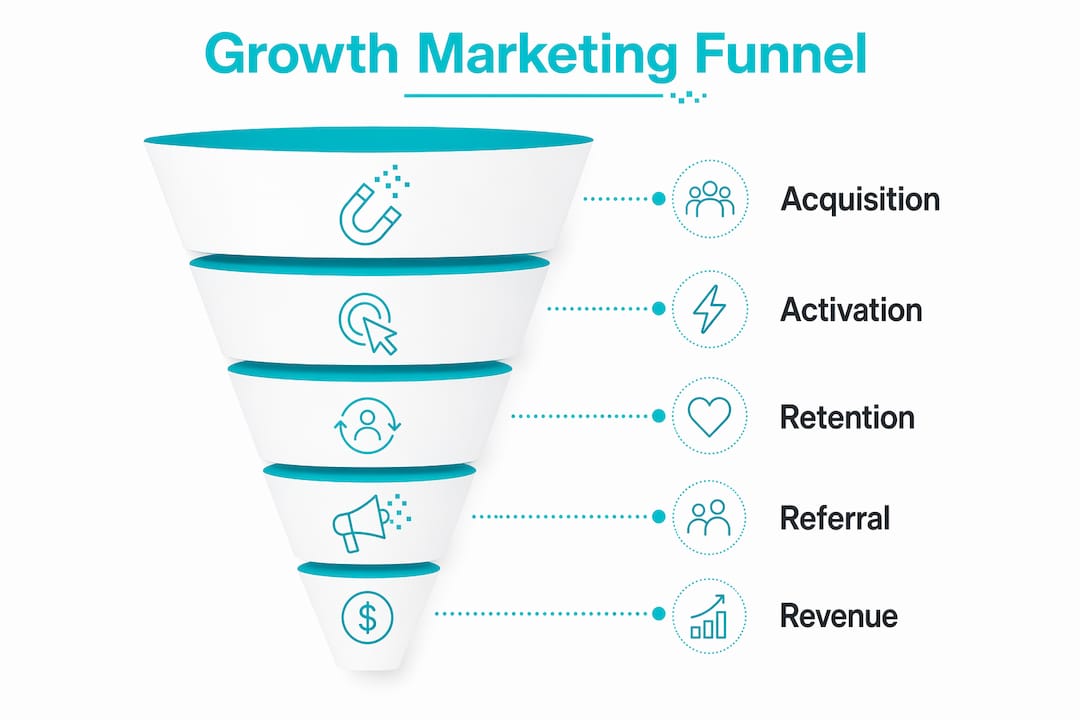
The AARRR framework breaks the customer journey into five measurable stages:
- Acquisition: How customers find you, through paid ads, SEO, social, or referrals.
- Activation: The moment a new customer experiences real value, such as completing onboarding or making a first purchase.
- Retention: Whether customers come back. This is where most businesses leak revenue silently.
- Referral: Whether satisfied customers bring in new ones, organically reducing your cost per acquisition.
- Revenue: The monetization layer, including upsells, expansions, and lifetime value.
Each stage has its own metrics and failure modes. A business with strong acquisition but weak activation is paying to fill a leaky bucket. Fixing activation before scaling acquisition spend is the smarter move.
Growth loops are the architectural upgrade beyond the AARRR funnel. A growth loop uses the output of one acquisition cycle as the direct input for the next, creating self-reinforcing momentum. A referral program is a classic example: a new customer refers a friend, that friend becomes a customer, and the loop repeats without additional paid media. Content loops work similarly, where published content attracts organic traffic, which generates leads, which produce case studies, which attract more traffic.

| Loop Type | Mechanism | Example |
|---|---|---|
| Viral loop | Users invite others directly | Referral programs, invite flows |
| Content loop | Content attracts users who create more content | User reviews, community posts |
| Product loop | Product usage generates data that improves the product | Recommendation engines |
Pro Tip: Audit your AARRR stages and find the one with the steepest drop-off. That single stage is your biggest growth lever. Fixing it will produce more return than adding budget to acquisition.
How does growth marketing differ from traditional marketing?
Traditional marketing and growth marketing are not opposites. They are different tools for different jobs, and the best businesses use both.
Traditional marketing focuses on top-of-funnel brand awareness. It builds recognition, trust, and cultural presence through advertising, PR, and content. Brand awareness feeds the top of the funnel that growth marketing then converts into revenue. Without brand marketing laying the groundwork, growth marketing has nothing to work with.
Growth marketing takes over where brand marketing stops. Its job is to convert awareness into customers, keep those customers active, and turn them into referral sources. The key differences are:
- Scope: Traditional marketing owns the top of funnel. Growth marketing owns the entire funnel.
- Method: Traditional marketing runs quarterly campaigns. Growth marketing runs weekly experiments.
- Metrics: Traditional marketing measures reach and impressions. Growth marketing measures activation rates, retention cohorts, and revenue per user.
- Speed: Traditional marketing iterates slowly. Growth marketing runs fast experiments with 1-2 week test cycles.
"Brand building feeds the top of funnel awareness, while growth marketing drives customer acquisition, retention, and revenue expansion." — Mountain Blog
The most common mistake businesses make is treating growth marketing as a replacement for brand building. It is not. A business with no brand recognition will struggle to activate or retain customers, no matter how well its funnel is instrumented. The two disciplines work best when they run in parallel, with brand marketing building the audience and growth marketing converting it.
Pro Tip: If your retention rate is below 30% after 90 days, do not increase your acquisition budget. Fix retention first. Pouring new customers into a leaky product is the fastest way to burn cash.
What are the most effective growth marketing strategies?
The most effective growth marketing strategies share one trait: they are hypothesis-driven, not assumption-driven. Every campaign starts with a specific, testable claim about customer behavior.
Rapid experimentation
Growth teams run 50 or more experiments per month, testing small changes across landing pages, onboarding flows, email sequences, and pricing. Each test has a clear hypothesis, a defined metric, and a fixed timeline. This pace of learning compounds over time. A team running 50 tests per month learns faster than a team running 4 quarterly campaigns, even if the individual test results are modest.
Product-led growth
Product-led growth (PLG) turns the product itself into the primary acquisition channel. Free trials, freemium tiers, and in-product referral prompts all fall under PLG. The logic is simple: mastering growth loops requires architecting the product to facilitate viral or content loops, effectively turning users into acquisition channels. Dropbox's referral program, which gave storage space for inviting friends, is the textbook example of a product-led viral loop.
Retention and referral programs
Retention is cheaper than acquisition, and the data consistently supports prioritizing it. Happy customers buy more, churn less, and refer others. A structured referral program with clear incentives converts satisfied customers into a low-cost acquisition channel. Email retention campaigns, loyalty programs, and proactive customer success outreach all serve this goal.
Data-driven funnel optimization
Growth marketers instrument every funnel stage with metrics like cohort retention rates, channel customer acquisition cost (CAC), and payback periods. This instrumentation reveals exactly where customers drop off and which channels produce the highest lifetime value. Budget then follows the data, not gut instinct.
| Strategy | Primary Funnel Stage | Key Metric |
|---|---|---|
| Paid acquisition | Acquisition | CAC, ROAS |
| Onboarding optimization | Activation | Day-7 activation rate |
| Email retention campaigns | Retention | 30-day and 90-day cohort retention |
| Referral programs | Referral | Viral coefficient, referral CAC |
| Upsell and expansion | Revenue | Net revenue retention, LTV |
Pro Tip: Allocate at least 20% of your growth budget to retention and referral experiments. Most businesses spend over 80% on acquisition and wonder why their growth plateaus.
How to implement growth marketing in your business
Implementing growth marketing is a process, not a single campaign. It requires the right team structure, the right metrics, and a cultural commitment to testing.
Step 1: Instrument your funnel. Before running any experiment, set up tracking for every AARRR stage. You need to know your activation rate, your 30-day retention rate, your referral rate, and your revenue per customer. Without this baseline, you are guessing.
Step 2: Build a cross-functional team. Growth marketing requires collaboration across marketing, product, and engineering. A marketer alone cannot fix onboarding. A product manager alone cannot run paid acquisition tests. The team needs all three disciplines working from the same data.
Step 3: Run your first experiments. Start with the AARRR stage that shows the biggest drop-off. Design a small, fast test with a clear hypothesis. Run it for one to two weeks. Document the result and move to the next test. Speed of learning matters more than the size of any single test.
Step 4: Prioritize retention before scaling acquisition. Most businesses over-invest in acquisition and underinvest in retention, which limits long-term growth. Fix the retention leaks first. Then scale acquisition with confidence that new customers will stick.
Step 5: Build growth loops into your product. Identify one loop, either viral or content-based, that your product can support. Design the mechanics, instrument it, and test it. A single working growth loop can reduce your dependence on paid media significantly over time.
The most common challenge during implementation is attribution. Attribution models often obscure what marketing actually caused versus what would have happened anyway. Separate your marketing-driven growth from your organic baseline before drawing conclusions about what is working.
Key Takeaways
Growth marketing produces compounding, sustainable results when businesses optimize the full customer lifecycle rather than focusing only on acquisition.
| Point | Details |
|---|---|
| AARRR framework is the foundation | Map all five stages and find your biggest drop-off before spending on acquisition. |
| Growth loops outperform linear funnels | Build loops that turn existing customers into new acquisition sources to reduce paid media dependence. |
| Retention beats acquisition on ROI | Fix retention leaks before scaling spend; retained customers refer others and expand revenue. |
| Rapid experimentation drives learning | Run short, hypothesis-driven tests weekly rather than large campaigns quarterly. |
| Cross-functional teams are required | Marketing, product, and engineering must share data and goals for growth marketing to work. |
Why most businesses get growth marketing backwards
Growth marketing gets misrepresented constantly. The loudest version of it online is all about acquisition hacks, viral tricks, and paid channel arbitrage. That version burns out fast and leaves businesses with high CAC and no retention to show for it.
The businesses I have seen grow consistently over multiple years share one habit: they obsess over retention before they scale acquisition. They know their 90-day cohort retention rate the way a CFO knows gross margin. They treat a drop in retention as a five-alarm fire, not a footnote in a monthly report.
The shift from funnels to growth loops is real, and it matters. But most businesses are not ready for loops because they have not fixed their funnel yet. A loop built on a broken activation experience just cycles bad customers faster. The sequence matters: fix activation, fix retention, then build the loop.
The other thing I would push back on is the idea that growth marketing replaces brand building. It does not. I have worked with businesses that went all-in on performance marketing and growth experiments while neglecting brand. Their CAC crept up year over year because they had no organic pull. Brand awareness is the fuel. Growth marketing is the engine. You need both.
Treat rapid experimentation as a cultural value, not a tactic. The teams that win are the ones that have made testing a habit, not a project. That mindset shift is harder than any technical implementation, and it is the one that actually separates compounding growth from flat lines.
— Matthew
How Viralmarketingstudio supports your growth marketing strategy
Growth marketing works best when your product, website, and systems are built to support experimentation and retention from day one.

Viralmarketingstudio builds the infrastructure that growth marketing runs on. From web design and development optimized for activation and conversion, to app development that supports product-led growth loops, the team brings together marketing, product, and engineering under one roof. If you are ready to move from one-off campaigns to a system that compounds, Viralmarketingstudio is built for exactly that kind of work.
FAQ
What is growth marketing in simple terms?
Growth marketing is a data-driven approach that optimizes every stage of the customer journey, from acquisition through retention and referral, to produce sustainable business growth rather than one-time campaign results.
How does the AARRR framework work?
The AARRR framework breaks the customer lifecycle into five stages: Acquisition, Activation, Retention, Referral, and Revenue. Marketers measure each stage separately to find where customers drop off and where to focus improvement efforts.
What is a growth loop and why does it matter?
A growth loop uses the output of one customer cycle as the input for the next, creating compounding growth. Referral programs and content loops are common examples that reduce dependence on paid media over time.
How is growth marketing different from digital marketing?
Digital marketing typically focuses on driving traffic and leads through online channels. Growth marketing extends beyond traffic to optimize activation, retention, and referral, treating the entire customer lifecycle as a single system.
How do I start implementing growth marketing?
Start by instrumenting your AARRR funnel with clear metrics, identify the stage with the biggest drop-off, and run small hypothesis-driven experiments on that stage for one to two weeks before scaling any changes.