
Email marketing is a direct communication channel that delivers an average ROI of $36 for every $1 spent, making it the highest-return digital channel available to small businesses. To launch an email marketing campaign that actually performs, you need more than a list and a send button. You need a structured workflow covering platform selection, list building, content planning, compliance, and measurement. This guide walks you through every stage, drawing on frameworks from HubSpot, Dotdigital, and monday.com so you can move from zero to a live, optimized campaign with confidence.
What tools do you need to launch an email marketing campaign?
The platform you choose determines what your campaign can do. HubSpot, Dotdigital, and monday.com each serve different business sizes and use cases, so picking the right one early saves significant rework later.
HubSpot combines email marketing with a full CRM, making it the strongest choice if you want to tie email behavior directly to sales pipeline data. Its free tier covers up to 2,000 email sends per month, and paid plans scale with contact volume. The built-in segmentation and A/B testing tools are accessible without technical training.

Dotdigital specializes in multichannel marketing automation. Its strength is segmentation and personalization, particularly for e-commerce businesses that need to trigger emails based on purchase history or browsing behavior. Pricing starts at the mid-market level, so it fits businesses with growing lists.
monday.com approaches email differently. Its value is in automated campaign workflows, where you map customer journeys, define triggers, and set entry and exit rules once. The system then runs continuously without manual intervention. This is the right pick if your team is small and you need automation to do the heavy lifting.
| Platform | Best For | Key Strength | Starting Price |
|---|---|---|---|
| HubSpot | CRM-connected campaigns | Segmentation + analytics | Free tier available |
| Dotdigital | E-commerce automation | Personalization + multichannel | Mid-market pricing |
| monday.com | Workflow-driven teams | Trigger-based automation | Per-seat pricing |
Pro Tip: Choose a platform you will actually use daily. A tool with advanced features you never touch is worse than a simpler tool you master completely.
How do you build and segment a high-quality email list?
A quality list beats a large list every time. Collecting emails without clear consent creates legal exposure and tanks deliverability. Start with opt-in forms on your website, checkout pages, and social profiles, and pair each form with a lead magnet that gives subscribers a real reason to sign up.
Lead magnets that convert well include free guides, discount codes, checklists, and webinar registrations. The goal is to attract subscribers who genuinely want what you sell, not anyone with an email address. Segmentation by location, purchase history, or engagement level reduces unsubscribes and improves relevance from the first send.
Once your list grows, segment it before you send anything. Sending the same message to every contact is the fastest way to train your audience to ignore you. Common segmentation criteria include:
- Engagement level: Active openers vs. subscribers who have not opened in 90 days
- Purchase history: First-time buyers vs. repeat customers vs. prospects
- Demographics: Age, location, or industry when relevant to your offer
- Signup source: Website form vs. in-store vs. event registration
- Stage in the customer journey: New lead, active evaluator, or post-purchase
Pro Tip: Create a welcome sequence for every new subscriber. It is the highest-engagement window you will ever have with that contact. Use it to set expectations and deliver immediate value.
What are the steps to plan and execute your first campaign?
HubSpot's 9-step framework covers the full lifecycle from audience definition through ongoing optimization. Dotdigital's beginner guide adds testing before sending as a non-negotiable step. Combined, they produce a workflow you can apply directly to your first send.
- Define your audience. Identify who receives this specific campaign, not your entire list.
- Set a measurable goal. Decide whether success means purchases, demo bookings, or form fills before you write a single word.
- Choose your campaign type. Promotional, nurture, transactional, or re-engagement each require different content approaches. Reviewing email campaign types before you plan saves time.
- Build or clean your list. Remove invalid addresses and segment appropriately.
- Plan your content. Focus each email on one main message. Multiple asks in one email split attention and reduce conversions.
- Write subject lines and preview text. These two elements determine whether your email gets opened. Test at least two versions.
- Design for mobile. More than half of emails are opened on mobile devices. Single-column layouts with large tap targets perform best.
- Test before sending. Send to a test inbox, check rendering across Gmail, Outlook, and Apple Mail, and verify all links work.
- Deploy, measure, and iterate. Send, review your KPIs within 48 hours, and document what you will change next time.
Defining what conversion means before your first send is a step most small businesses skip. Measurement planning before launch ensures you optimize for the right metric, not just the easiest one to track.
| Step | Action | Output |
|---|---|---|
| 1. Audience | Define segment | Target contact list |
| 2. Goal | Set conversion metric | KPI benchmark |
| 3. Content | Write one focused message | Draft email copy |
| 4. Testing | A/B subject lines, render check | Approved send version |
| 5. Measure | Review opens, clicks, conversions | Optimization notes |
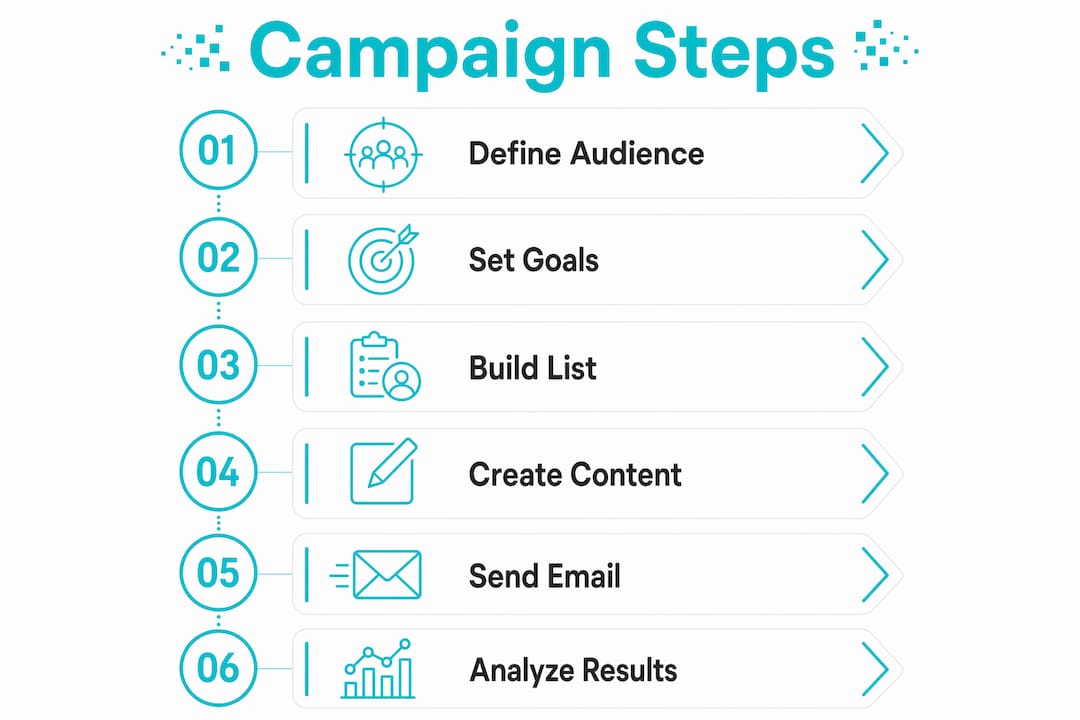
Lifecycle-triggered automated sequences outperform single broadcast emails because they match message intent to customer behavior. A welcome sequence, an abandoned cart email, and a post-purchase follow-up each fire at the exact moment a subscriber is most receptive.
How do your email campaigns stay compliant with can-spam and GDPR?
Compliance is not a one-time setup. It is an ongoing operational requirement that runs parallel to every campaign you send. Two laws govern most small business email marketing: the US CAN-SPAM Act and the EU's GDPR.
The CAN-SPAM Act requires businesses to honor opt-out requests within 10 business days and keep unsubscribe links functional for at least 30 days after sending. Suppression lists must stay synchronized with your email service provider so opted-out addresses never receive another send.
GDPR Article 7 requires freely given, clearly documented consent. Subscribers must be able to withdraw consent as easily as they gave it. Collecting emails without verifiable consent records can block your entire marketing program, even if your content is excellent. Store consent metadata, including the date, source, and method of opt-in, for every EU contact.
Practical compliance steps to build into your launch process:
- Add a double opt-in confirmation for all new subscribers
- Include a visible, one-click unsubscribe link in every email footer
- Sync your suppression list between your CRM and your email platform weekly
- Document consent source and date for every contact in your database
- Review your privacy policy to confirm it accurately describes your email practices
Pro Tip: Treat your suppression list as a live asset, not an archive. Compliance enforcement requires continuous synchronization between your email platform and list management tools. A mismatch between the two is where violations happen. For businesses targeting EU customers, a practical resource on GDPR compliance solutions can help you structure your consent management correctly.
Which metrics should you track to improve campaign performance?
The metrics you track must connect directly to the business goal you set in step two of your planning process. Open rate tells you whether your subject line worked. Click-through rate tells you whether your content and CTA were compelling. Conversion rate tells you whether the campaign actually moved the business forward.
Email delivers an average ROI of $36 for every $1 spent, but that number only materializes when you measure and iterate. Businesses that send and forget leave most of that return on the table.
Tactics to improve results based on data:
- Low open rates: Test new subject lines, adjust send times, and clean inactive contacts from your list
- High open rate but low clicks: Rewrite your CTA, reduce the number of links, or improve the offer
- High clicks but low conversions: Audit the landing page your email points to, not just the email itself
- Rising unsubscribe rate: Review your send frequency and content relevance for each segment
- Declining engagement over time: Launch a re-engagement sequence before removing cold contacts permanently
When planning your email budget alongside other marketing channels, a structured approach to small business marketing budgets helps you allocate spend where it generates the strongest return.
Key takeaways
A successful email marketing campaign requires structured planning, compliant list building, and continuous measurement to generate consistent ROI.
| Point | Details |
|---|---|
| Platform choice matters | Match your platform to your workflow: HubSpot for CRM, Dotdigital for e-commerce, monday.com for automation. |
| Segment before you send | Segmenting by engagement, purchase history, and signup source improves relevance and reduces unsubscribes. |
| Plan measurement first | Define your conversion metric before writing copy to avoid optimizing the wrong KPI. |
| Compliance is ongoing | Sync suppression lists weekly and store consent metadata for every contact to stay CAN-SPAM and GDPR compliant. |
| Automate lifecycle sequences | Triggered sequences outperform broadcast emails by matching content to customer behavior at the right moment. |
What i have learned from watching small businesses launch their first campaigns
Most small business owners treat their first email campaign like a product launch. They wait until everything is perfect before sending. That instinct costs them months of data they could have been collecting. HubSpot's framework is right about this: iterative testing beats waiting for a perfect email every time.
The other pattern I see constantly is businesses that skip segmentation because their list is small. They assume segmentation is for enterprises with 100,000 contacts. Dotdigital's data shows the opposite. Segmentation matters most with small lists because every send to the wrong person is a proportionally larger waste. A 500-person list with three clean segments outperforms a 500-person list treated as one audience.
Compliance is the area where I see the most avoidable damage. Businesses collect emails for months, then discover they have no documented consent records when they want to scale to EU markets. GDPR Article 7 does not care how good your content is. If you cannot prove consent, you cannot send. Build the documentation process into your signup flow from day one, not as an afterthought when you are already growing.
The mindset shift that changes everything is treating email marketing as a program, not a project. A project ends. A program runs, learns, and improves. The businesses that see the strongest returns are the ones that review their metrics after every send and make one specific change for the next one. That discipline compounds over time in ways that no single perfect email ever could.
— Matthew
Ready to build the infrastructure behind your campaigns?
A great email campaign needs more than good copy. It needs a website that converts the traffic your emails drive, and back-end systems that keep your data clean and your automations running. Viralmarketingstudio builds the technical foundation that makes email marketing work at scale.
From custom web design that turns email clicks into customers, to business software development that integrates your CRM, email platform, and sales pipeline into one system, Viralmarketingstudio handles the infrastructure so you can focus on the campaigns. If you are ready to build something that scales, explore what Viralmarketingstudio offers and take the next step.
FAQ
What is the first step to start email marketing for a small business?
Define your audience and set a measurable conversion goal before choosing a platform or writing any copy. Without a clear goal, you cannot measure whether the campaign succeeded.
How many emails should i send per month when starting out?
Start with one to two emails per month and increase frequency only after you have baseline data on open rates and unsubscribe rates. Sending too often before you understand your audience's tolerance is the fastest way to lose subscribers.
What is the difference between can-spam and GDPR compliance?
CAN-SPAM governs US recipients and requires a functional unsubscribe link and a 10-business-day opt-out window. GDPR governs EU recipients and requires documented, freely given consent before you send any marketing email.
Do i need a large list to see results from email marketing?
No. A segmented list of 500 engaged subscribers outperforms an unsegmented list of 5,000 cold contacts. Relevance drives performance more than volume, especially in the early stages of a campaign program.
How do i know if my email campaign is working?
Track open rate, click-through rate, and conversion rate against the goal you set before sending. If conversions are low despite strong clicks, the problem is your landing page, not your email.