
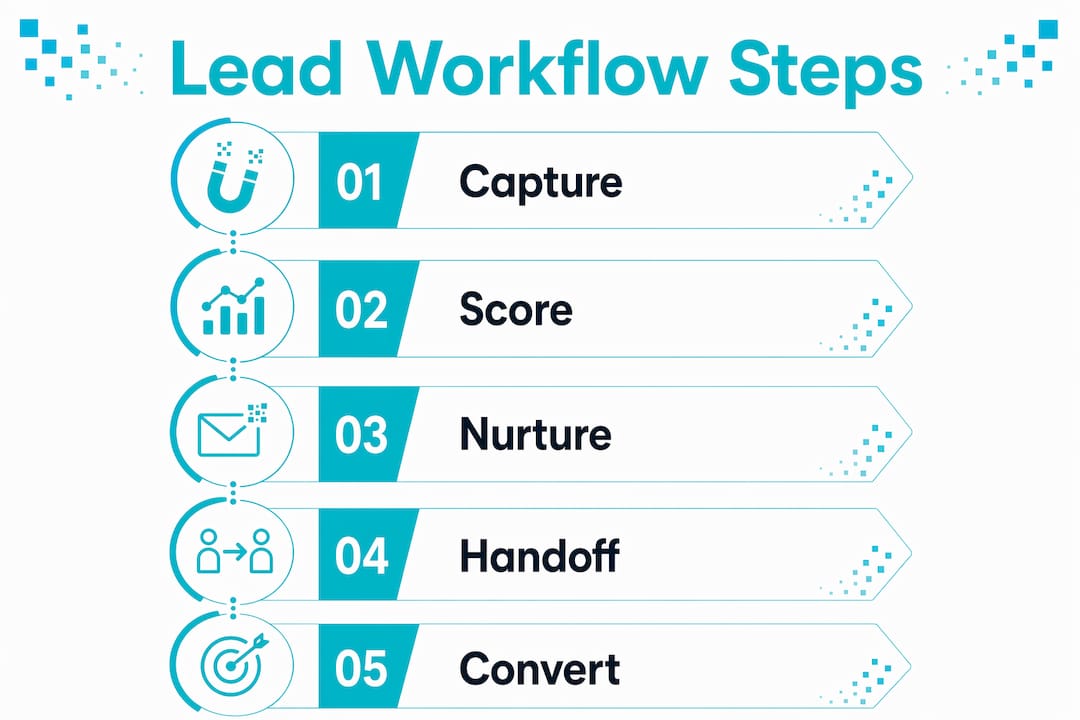
A lead generation workflow is the integrated system that captures, scores, nurtures, and hands off prospects to sales at precisely the right moment. Most businesses run fragmented versions of this system: forms feed into spreadsheets, follow-up emails go out on fixed schedules, and sales reps receive leads with no context. The result is wasted budget and stalled pipelines. To genuinely improve lead generation workflow performance, you need automation, behavioral data, and clear handoff criteria working together. Platforms like HubSpot, Marketo, and Salesforce make this possible at scale, but the architecture matters more than the tools you choose.
What are the essential steps to build an efficient lead generation workflow?
Adobe outlines nine steps from planning to reporting and iterating, treating lead generation as a continuous optimization loop rather than a one-off campaign. That framing is the right starting point. A workflow that never gets reviewed is a workflow that slowly breaks.
Here is the sequence that produces consistent results:
-
Set measurable goals and KPIs first. Define cost per lead, MQL volume, and pipeline contribution targets before building anything. Without these numbers, you cannot tell whether a change improved performance or just changed it.
-
Build multi-channel lead capture with fast response. Landing pages, chatbots, gated content, and paid ads should all feed into a single CRM. Speed matters here more than most teams realize. Workflows that score and assign leads within 30 seconds of form submission consistently outperform slower processes because prospects are still engaged.
-
Implement lead scoring based on fit and behavior. Assign points for firmographic fit (company size, industry, job title) and behavioral signals (pricing page visits, demo requests, content downloads). A lead who visits your pricing page twice in one week is fundamentally different from one who downloaded a whitepaper six months ago.
-
Deploy behavior-triggered nurture sequences with explicit exit criteria. Fixed-schedule email sequences treat all leads the same regardless of what they actually do. Behavior-triggered sequences respond to real signals. Set a scoring threshold, say 50 points, as the exit condition. When a lead crosses it, stop nurture and notify sales automatically to prevent duplicate outreach and stalled transitions.
-
Define MQL-to-SQL handoff with SLAs. Sales should receive a lead with verified contact information, a minimum score, and documented engagement history. Set a response SLA, typically under four hours for inbound leads, with a fallback workflow if no action is taken.
-
Iterate based on analytics. Review conversion rates at each stage monthly. If leads are dropping between MQL and SQL, the problem is usually scoring criteria or handoff speed, not the nurture content.
Pro Tip: Set up a shared Slack or Teams alert that fires every time a lead crosses your MQL threshold. Sales reps who see a real-time notification act faster than those who rely on CRM queue reviews.
Which tools best support lead capture, scoring, and nurturing?
The right technology stack depends on your volume, budget, and sales cycle length. That said, certain categories of tools are non-negotiable for any team serious about optimizing lead capture strategy.

Marketing automation platforms sit at the center of every effective stack. HubSpot works well for teams that want CRM and marketing automation in one place with minimal technical setup. Marketo is better suited for enterprise teams that need granular segmentation and complex workflow logic. Both support behavior-triggered sequences, lead scoring, and CRM synergy out of the box.
AI-powered intent data tools like Bombora and 6sense add a layer that most teams overlook. They identify which companies are actively researching your category, even before those companies fill out a form. Feeding that intent data into your scoring model means your sales team contacts prospects at the moment of highest interest, not weeks later.
Real-time qualification tools, including conversational chatbots, accelerate the top of the funnel significantly. Conversational qualification tools can increase qualification rates by up to 80% and generate 1.5 times more quality leads compared to static forms alone. That is a meaningful difference in pipeline volume for teams running high-traffic websites.
| Tool category | Example tools | Primary benefit |
|---|---|---|
| Marketing automation | HubSpot, Marketo | Behavior-triggered sequences, lead scoring |
| CRM integration | Salesforce, Zoho CRM | Unified contact records, handoff automation |
| Intent data | Bombora, 6sense | Pre-form prospect identification |
| Conversational qualification | Drift, Intercom | Real-time lead capture and routing |
| Analytics and attribution | Google Analytics 4, Dreamdata | Pipeline attribution and stage conversion tracking |
Pro Tip: Before adding a new tool, map the data flow between your existing platforms. A CRM that does not sync in real time with your marketing automation platform creates scoring gaps that no amount of new software will fix.
How do behavior-driven nurture sequences enhance lead conversion?
The difference between a fixed-schedule nurture and a behavior-driven one is the difference between a scripted phone call and an actual conversation. Fixed schedules send email three, then email four, regardless of what the lead did between sends. Behavior-driven sequences branch based on what the lead actually did.
Switching from fixed schedules to behavior-triggered workflows based on signals like pricing page visits and content downloads typically produces measurable engagement improvements within 60 to 90 days. The mechanism is simple: relevant content sent at the right moment gets opened and acted on. Generic content sent on a Tuesday because that is when the sequence fires does not.
Here is how to build a behavior-driven nurture that actually works:
- Segment by intent stage, not just persona. A VP of Marketing who visited your pricing page three times needs different content than a VP of Marketing who downloaded your beginner's guide. Treat them differently.
- Create branching logic for key signals. If a lead clicks a case study link, the next email should reference that case study and offer a related demo. If they do not open two consecutive emails, move them to a re-engagement branch before removing them from active nurture.
- Set score-based exit conditions. Stopping nurture at MQL thresholds prevents leads from receiving irrelevant follow-ups after they are already sales-ready. Sequences without exit conditions cause unsubscribes and hurt deliverability.
- Use AI for content timing. Tools like HubSpot's AI send-time optimization and Marketo's Engagement Score identify when individual contacts are most likely to engage, then send at that moment rather than a fixed time.
"Sequences that lack explicit exit conditions cause leads to unsubscribe or receive irrelevant follow-ups, hurting conversion." — Rework
The goal of a behavior-driven nurture is to enhance lead nurturing process outcomes by making every touchpoint feel like a logical next step, not a scheduled interruption.
What are best practices for aligning sales and marketing on lead handoffs?
Sales and marketing misalignment is the single most common reason qualified leads go cold. Zendesk's 2026 guidance emphasizes shared definitions, CRM synergies, and consistent nurturing as the foundation for workflow clarity. Without those three elements, handoffs become guesswork.
The most effective teams define MQL criteria using multiple signals, not just job title. Removing subjectivity from handoff criteria by requiring a minimum score, verified decision-maker status, and documented engagement history significantly boosts SQL conversion rates. A lead with the right title but no engagement history is not a qualified lead. It is a cold contact with a good job description.
Practical steps for tighter sales and marketing alignment:
- Build a shared MQL definition document. Include minimum lead score, required firmographic criteria, and engagement thresholds. Review it quarterly.
- Set SLAs with fallback workflows. If a sales rep does not contact an MQL within four hours, the workflow should automatically reassign it or send an escalation alert.
- Use shared dashboards. Both teams should see the same pipeline data in real time. Separate reporting creates separate realities and separate arguments.
- Enrich lead data before handoff. Tools like Clearbit and ZoomInfo append company size, revenue, and tech stack data to CRM records automatically, giving sales reps context before the first call.
Pro Tip: Run a monthly pipeline review where sales and marketing look at MQL-to-SQL conversion together. When both teams own the number, both teams work to improve it.
Automating lead handoffs without defining ownership produces stalled deals. Automation should accelerate human checkpoints, not replace them. Every handoff should have a named owner, a deadline, and a fallback if the deadline is missed.
Key takeaways
A well-built lead generation workflow converts more leads by combining speed, behavioral relevance, and clear ownership at every stage.
| Point | Details |
|---|---|
| Speed at capture matters | Scoring and assigning leads within 30 seconds of form submission outperforms slower processes. |
| Exit conditions are non-negotiable | Nurture sequences without score-based exit criteria cause unsubscribes and hurt pipeline quality. |
| Multi-criteria MQL handoffs win | Requiring score, verified contact, and engagement history reduces SQL rejections significantly. |
| Behavior-driven sequences outperform fixed schedules | Trigger-based workflows improve engagement within 60 to 90 days of implementation. |
| Shared ownership closes the gap | Sales and marketing aligned on definitions, SLAs, and dashboards convert more MQLs to closed deals. |
What I've learned from building lead workflows that actually convert
I have seen teams spend months selecting the perfect marketing automation platform and then wire it up to a workflow that was never designed to scale. The tool is not the problem. The architecture is.
The most common mistake I see is treating lead scoring as a one-time setup. Scores drift. Buyer behavior changes. A pricing page visit meant something different in 2023 than it does now, because buyers are more educated and do more research before engaging. If you set your scoring model and never recalibrate it, you will start handing sales leads that feel qualified on paper but are nowhere near ready to buy. That erodes trust between teams faster than almost anything else.
The second mistake is confusing automation with ownership. Workflow automation should accelerate human checkpoints, not eliminate them. I have watched companies automate their entire handoff process and then wonder why deals stall. It is because no one owns the moment between the automated notification and the first human conversation. That gap is where leads die.
What actually works is building checkpoints into the workflow itself. Assign a named owner to every MQL. Set a deadline. Build a fallback. Then review the fallback rate monthly, because a high fallback rate tells you something is wrong with your scoring, your SLAs, or your team capacity.
The teams that get this right treat their workflow as a product. They have a roadmap, they run experiments, and they measure outcomes at every stage. That mindset produces compounding returns. A 10% improvement in MQL-to-SQL conversion, combined with a 10% improvement in nurture-to-MQL conversion, produces a 21% improvement in pipeline without spending a dollar more on lead acquisition.
— Matthew
How Viralmarketingstudio can help you build a better lead workflow
If you have read this far, you already know what a high-performing lead generation workflow looks like. Building one is a different challenge.
Viralmarketingstudio designs and implements marketing automation systems built specifically for business owners and marketing teams who need results without a six-month setup timeline. From CRM integration and lead scoring architecture to behavior-triggered nurture sequences and sales handoff workflows, the team handles the technical build so your team can focus on closing. Viralmarketingstudio also covers web development, graphic design, and custom software, which means your lead capture assets and your automation backend are built to work together from day one. Explore what is possible at Viral Marketing Studio and see how a purpose-built workflow changes your pipeline numbers.
FAQ
What does it mean to improve a lead generation workflow?
Improving a lead generation workflow means redesigning the system that captures, scores, nurtures, and hands off leads so each stage operates faster and with less manual intervention. The goal is higher conversion at every stage, not just more leads at the top.
How quickly should leads be scored after form submission?
Leads should be scored and assigned within 30 seconds of form submission. Workflows that qualify leads in under a minute consistently outperform slower processes because prospect engagement is highest immediately after a form fill.
What is an MQL-to-SQL handoff and why does it matter?
An MQL (Marketing Qualified Lead) becomes an SQL (Sales Qualified Lead) when it meets defined criteria including minimum lead score, verified contact information, and documented engagement. A clean handoff process reduces lead dropout and prevents sales from wasting time on unqualified contacts.
How do behavior-driven nurture sequences differ from standard email campaigns?
Behavior-driven sequences send content based on what a lead actually does, such as visiting a pricing page or downloading a case study, rather than on a fixed schedule. This approach typically improves engagement within 60 to 90 days and reduces unsubscribe rates by keeping content relevant.
What causes leads to fall through the cracks between marketing and sales?
Leads fall through when handoff criteria are vague, SLAs are undefined, or no named owner is assigned to each MQL. Automating the notification without assigning ownership is the most common cause of stalled deals after a lead reaches sales-ready status.