
Search engine optimization is the primary driver of qualified organic traffic, and its role in business growth is to generate leads that convert at nearly nine times the rate of outbound marketing. Organic search accounts for 53% of all website visits, making it the single largest traffic source available to any business. SEO leads convert at 14.6% versus 1.7% for cold outbound channels. Tools like Google Analytics, BrightEdge, and platforms such as Ahrefs and Semrush give business owners the data to measure every dollar SEO generates. Unlike paid advertising, SEO builds owned digital assets that compound in value over time, making it one of the most durable investments a business can make.
How SEO drives higher quality traffic and reduces acquisition cost
The importance of SEO for growth comes down to one word: intent. When someone types "best accounting software for small business" into Google, they are not browsing. They are ready to buy. SEO targets these high-intent keywords and places your business directly in front of buyers at the exact moment they are searching for a solution.
This targeting precision has a direct impact on conversion rates. SEO leads convert at 14.6%, compared to just 1.7% for cold outbound marketing. That gap is not a rounding error. It means for every 1,000 visitors you attract through organic search, you generate roughly 146 leads. The same volume through cold email or display ads produces fewer than 20.
The financial case is equally strong. SEO reduces customer acquisition costs by up to 61% compared to outbound marketing. Here is why that matters practically:
- No per-click fees. Once a page ranks, traffic arrives without additional spend. A paid ad campaign charges you every time someone clicks, whether they convert or not.
- Compounding returns. A well-optimized page published today can generate leads for three to five years without major reinvestment.
- Higher lead quality. Organic visitors arrive with specific questions already formed, which shortens the sales conversation and increases close rates.
- Lower churn risk. Customers acquired through organic search tend to have higher lifetime value because they chose you based on research, not impulse.
For a business spending $5,000 per month on Google Ads, shifting even 40% of that budget toward SEO content and technical optimization can produce a lower cost per lead within 12 months. The acquisition cost advantage grows every year the SEO program runs.
Pro Tip: Track your cost per organic lead separately from paid leads in Google Analytics. Most business owners are shocked to find organic leads cost 60% to 80% less once the SEO program matures past the six-month mark.

SEO vs. paid advertising: which builds lasting business value?
Paid advertising delivers traffic the moment you fund it and stops the moment you pause it. That is rented visibility. SEO builds owned digital equity that generates leads around the clock without ongoing spend. The distinction matters enormously when you are planning for sustainable growth rather than short-term spikes.
Consider the ROI comparison. SEO delivers an average return of $22 for every $1 invested, with B2B SaaS companies reporting up to 702% ROI over three years. Paid search rarely sustains those numbers because click costs rise with competition, and the moment a competitor outbids you, your visibility disappears.
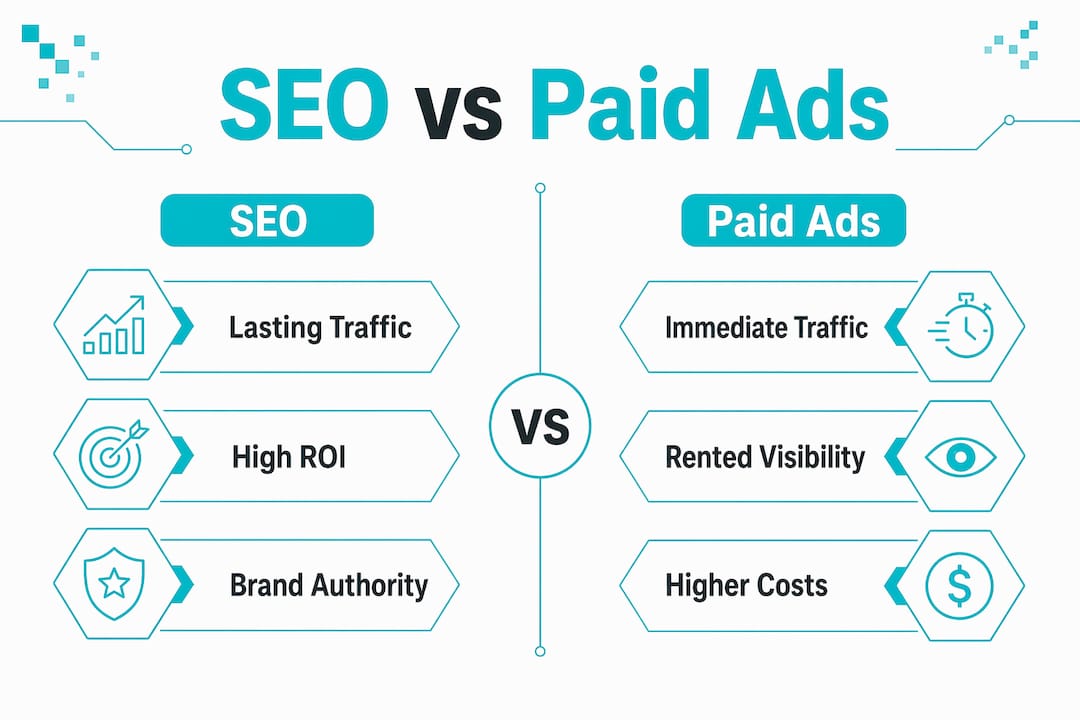
| Factor | SEO | Paid advertising |
|---|---|---|
| Traffic after pausing spend | Continues | Stops immediately |
| Average ROI | 22:1 | Varies, typically lower |
| Trust level with consumers | 70% trust organic results | 30% trust paid ads |
| Timeline to results | 3 to 6 months | Immediate |
| Long-term cost trend | Decreasing per lead | Increasing per click |
The trust gap is particularly significant. 70% of consumers trust organic results, while only 30% trust paid ads and 22% trust social ads according to Edelman data. Trust is a purchase prerequisite, especially in B2B markets where deal sizes are large and buyers are cautious.
Pro Tip: Run paid ads and SEO simultaneously during the first six months. Use paid data to identify which keywords convert best, then prioritize those exact terms in your SEO content calendar. This cuts the guesswork out of keyword strategy.
The practical takeaway is that paid ads are a short-term accelerant and SEO is the engine. Businesses that treat them as either-or miss the compounding advantage of running both with a clear handoff strategy.
Why SEO matters more in the age of AI-driven search
AI search is not replacing SEO. It is making SEO more consequential. 50% of Google queries now trigger AI Overviews, and these AI-generated answers cite only three to five authoritative sources per query. If your business is not among those sources, you are invisible to half of all searchers.
The impact of SEO on revenue in this new environment is direct. AI-sourced visitors convert at rates up to 27%, significantly higher than traditional organic traffic. Businesses that rank as authoritative sources in their category are being cited by ChatGPT, Perplexity, and Google's AI Overviews, which drives a new class of high-converting traffic that did not exist two years ago.
Here is what makes a business citation-worthy in AI search:
- Topical authority. Publishing deep, consistent content on a specific subject signals expertise to both Google and AI models. A business that covers its niche thoroughly ranks higher and gets cited more often.
- Technical SEO foundations. Fast page load times, clean site architecture, and proper schema markup make content easier for AI crawlers to parse and attribute.
- Authoritative backlinks. Links from recognized industry publications tell AI systems that your content is trusted by other credible sources.
- Structured answers. Content formatted to answer specific questions directly, with clear headings and concise paragraphs, is far more likely to be pulled into AI-generated responses.
"Early SEO adopters in competitive categories are seeing 120x impression increases as AI Overviews expand. The businesses that built authority before the shift are capturing the majority of this new traffic."
SEO also creates a defensive moat. When your business controls the top organic positions for the keywords your buyers use, competitors face a significant barrier to entry. Paid ads can be outbid overnight. Organic authority built over years cannot be bought away.
SEO builds brand authority that amplifies every other marketing channel. A prospect who sees your paid ad after already encountering your content organically is far more likely to click and convert. The familiarity effect from organic visibility makes paid campaigns more efficient, not less.
How to measure SEO ROI and implement growth strategies
Measuring the impact of SEO on revenue requires tracking the right metrics from the start. Most business owners look at rankings and traffic volume, but those are leading indicators. The metrics that connect SEO to actual growth are:
- Lead conversion rate from organic traffic. Set up goal tracking in Google Analytics to measure how many organic visitors complete a form, book a call, or make a purchase.
- Assisted conversions. Many buyers touch organic content early in their research, then convert through a paid ad or direct visit later. Google Analytics attribution reports show SEO's full contribution to revenue.
- Branded search volume. Rising searches for your company name indicate that SEO content is building awareness and recall. Track this monthly in Google Search Console.
- Cost per organic lead. Divide your total SEO investment by the number of leads generated through organic channels. Compare this to your paid cost per lead quarterly.
- Revenue from organic channel. Connect your CRM to Google Analytics to track deals closed that originated from organic search. This is the number that justifies SEO investment to any stakeholder.
On timeline, SEO programs typically show ranking improvements within 3 to 6 months, with measurable ROI appearing between 6 and 12 months. This is not slow. It is the normal compounding curve of any asset-building investment.
Effective SEO strategies for growth rest on four pillars. First, keyword research using tools like Ahrefs, Semrush, or Google Keyword Planner identifies the exact terms your buyers use at each stage of the purchase journey. Second, a content calendar ensures consistent publishing, which signals to Google that your site is active and authoritative. Third, technical SEO covers site speed, mobile optimization, and crawlability, all of which affect how Google indexes and ranks your pages. Fourth, link building through guest posts, digital PR, and partnerships earns the external authority signals that push rankings higher.
| SEO strategy | Primary benefit | Timeline to impact |
|---|---|---|
| Keyword research | Targets high-intent buyers | Immediate planning value |
| Content publishing | Builds topical authority | 3 to 6 months |
| Technical SEO | Improves crawl and indexing | 1 to 3 months |
| Link building | Increases domain authority | 6 to 12 months |
SEO shortens sales cycles for B2B companies by educating prospects before the first sales conversation. When a buyer has already read your comparison pages, integration guides, and case studies, the sales call becomes a confirmation rather than an education session. That efficiency compounds across every deal your team closes.
Key takeaways
SEO is the highest-ROI channel available to business owners because it generates intent-driven traffic that converts at 14.6%, builds owned digital assets that compound over time, and positions businesses as authoritative sources in both traditional and AI-driven search.
| Point | Details |
|---|---|
| SEO conversion advantage | Organic leads convert at 14.6% versus 1.7% for outbound, making SEO the highest-converting channel. |
| Cost reduction over time | SEO reduces customer acquisition costs by up to 61% compared to paid and outbound marketing. |
| ROI at scale | SEO delivers an average 22:1 return on investment, with B2B programs reaching 702% ROI over three years. |
| AI search visibility | 50% of Google queries trigger AI Overviews that cite only 3 to 5 sources, making authority-building SEO critical. |
| Timeline to results | Ranking gains appear in 3 to 6 months; full ROI is typically realized between 6 and 12 months. |
Why I think most businesses are treating SEO like a campaign when it's infrastructure
After working with dozens of businesses on digital growth, the single most common mistake I see is treating SEO as a quarterly campaign rather than permanent infrastructure. Companies run a three-month SEO push, see some ranking movement, then redirect budget to paid ads when they want faster results. The rankings decay. The process restarts. The compounding never happens.
SEO is not a campaign. It is essential digital infrastructure that builds value the same way a physical storefront or a sales team does. You do not pause your sales team for a quarter because the pipeline looks healthy. You do not pause SEO for the same reason.
The businesses I have seen win with SEO share one trait: they started early and stayed consistent. A company that begins publishing two authoritative articles per month today will have a content library in three years that no competitor can replicate quickly. That library generates leads, educates buyers, and gets cited by AI systems. The compounding effect is real, and it is durable.
The AI shift makes this more urgent, not less. Prospects who self-educate through SEO content arrive at sales conversations already convinced. That is the most efficient sales motion available, and it only works if the content exists and ranks. Start building now.
— Matthew
How Viralmarketingstudio can build your SEO growth engine
Your business deserves more than generic SEO advice. It needs a strategy built around your specific buyers, your competitive category, and the keywords that actually drive revenue.
Viralmarketingstudio builds SEO programs that connect directly to business growth metrics, not just rankings. From technical site audits and content strategy to link building and AI search optimization, the team at Viralmarketingstudio designs owned visibility systems that generate leads long after the initial investment. Whether you are starting from zero or scaling an existing program, the approach is the same: build authority that compounds, reduce acquisition costs, and make your business the most visible option in your category.
FAQ
What is the role of SEO in business growth?
SEO drives business growth by generating high-intent organic traffic that converts at 14.6%, far above paid or outbound channels. It builds owned digital assets that produce leads continuously without per-click costs, reducing customer acquisition costs over time.
How long does SEO take to show results?
Most businesses see ranking improvements within 3 to 6 months, with measurable ROI appearing between 6 and 12 months. The returns compound significantly beyond the 12-month mark as domain authority and content volume increase.
How does SEO compare to paid advertising for revenue impact?
SEO delivers an average 22:1 ROI versus lower and less predictable returns from paid ads. Paid ads stop generating traffic the moment spend pauses, while SEO content continues ranking and converting for years.
Why does SEO matter for AI-driven search in 2026?
AI Overviews now appear in 50% of Google queries and cite only three to five authoritative sources. Businesses with strong SEO authority are far more likely to be cited, capturing high-converting AI-sourced traffic that converts at up to 27%.
What are the most effective SEO strategies for business growth?
The four core strategies are keyword research targeting buyer-intent terms, consistent content publishing to build topical authority, technical SEO to improve crawlability and speed, and link building to increase domain authority. All four work together and deliver compounding returns over 6 to 12 months.