
Viral product launch campaigns are marketing efforts designed to generate rapid, widespread buzz and sales through organic sharing, influencer reach, or deliberately engineered content loops. The best examples of viral product launch campaigns share one trait: they create a mechanism that makes sharing feel natural or even rewarding for the audience. Brands like Reale Actives, Batiste, and SlapMac have each cracked this code in different ways, generating millions in revenue or tens of millions of views without relying on traditional ad budgets. This article breaks down exactly how they did it and what you can replicate.
1. examples of viral product launch campaigns that defined the playbook
The most instructive viral launches of recent years share a clear pattern: a strong hook, a fast execution window, and a built-in reason for audiences to spread the word. Three campaigns stand out as case studies every marketer should study closely.
Reale Actives built its entire launch around controversy. Founder Alix Earle seeded pre-emptive backlash into the campaign narrative, turning skeptics into free amplifiers. The result was over $5 million in sales in roughly 8 hours on launch day, with zero paid ad spend. The lesson here is that controversy, when tied to a credible founder story, compresses the awareness-to-purchase timeline dramatically.

Batiste took a different route. A single TikTok comment sparked an idea, and the brand moved from that comment to a fully produced influencer campaign in just 5 days. The campaign reached 10.6 million views and over 161,000 likes on TikTok. Speed was the entire competitive advantage. Most brands would have spent three weeks in approvals. Batiste was already filming within 72 hours.
SlapMac is the most instructive example for digital product marketers. The prank app built a viral loop directly into its user experience, prompting users to post on social media as part of the product's core mechanic. That loop drove 7,000 app installs and $5,000 in sales within the first week, all without paid advertising.
Pro Tip: If you are planning a product launch, identify the single most shareable moment in your product experience and build your campaign around making that moment public.
2. how viral launches differ from traditional product launches
Traditional product launches follow a predictable arc: months of planning, a media embargo, a press release, and a paid media push. Viral launches operate on a fundamentally different logic.
The core difference is speed. Where traditional campaigns measure timelines in quarters, viral campaigns measure them in hours. Batiste's team secured influencer partnerships and started filming within 72 hours of identifying the viral moment. That kind of rapid campaign execution is not accidental. It requires pre-built influencer relationships, pre-approved brand guidelines, and a team empowered to make fast decisions.
The second difference is the role of paid media. Viral campaigns do not abandon paid advertising entirely, but they sequence it differently. A proven approach for smaller brands is the two-step model:
- Awareness phase: Run low-budget social ads, as little as $5–$10 per day, to seed content with new audiences and test which hooks generate organic sharing.
- Retargeting phase: Once a piece of content proves it can spread organically, shift budget toward conversion-focused retargeting ads aimed at people who already engaged.
This model mirrors how consumers actually evaluate brands today. They see something, forget it, see it again from a different source, and then buy. The viral moment handles the first impression. Retargeting closes the sale.
Pro Tip: Never spend your full launch budget on day one. Reserve at least 40% for retargeting the audiences your organic content attracts in the first 48 hours.
3. which platforms drive the most viral launch momentum?
Platform selection is not a preference decision. Each platform has a distinct content mechanic, and matching your launch format to the right platform determines whether your campaign spreads or stalls.
TikTok and Instagram reward video hooks above everything else. The first 1.5 seconds of a video determine whether the algorithm pushes it to a wider audience. This means your opening frame must create immediate tension, curiosity, or surprise. A product reveal with no hook is invisible.
X (formerly Twitter) responds to provocative claims and strong opinions. A launch announcement framed as a bold statement generates replies, quote posts, and debate, all of which are free distribution. Reale Actives used this mechanic by leaning into pre-launch criticism rather than suppressing it.
LinkedIn favors text-heavy posts with a strong opening line that gets cut off in the preview. The goal is to make readers click "see more." Product launches framed as founder stories or industry challenges perform significantly better than straightforward promotional posts.
Here is a comparison of platform mechanics for product launches:
| Platform | Best Content Format | Primary Viral Mechanic |
|---|---|---|
| TikTok | Short video with strong hook | Algorithm amplification, shares |
| Reels, Stories, carousels | Saves, shares, influencer reach | |
| X | Provocative text posts | Replies, quote posts, debate |
| Founder story text posts | Comments, reshares, DMs | |
| Community-native posts | Upvotes, organic discussion |
Beyond platform selection, collaborative amplification loops among 5–10 non-competing brands multiply reach by letting each brand borrow credibility from the others' audiences. A skincare brand launching alongside a wellness supplement brand and a fitness apparel brand can triple its effective reach without spending a dollar more.
An influencer gifting program is another proven tactic. Gifting products to micro-influencers before launch creates a wave of authentic unboxing and review content that hits simultaneously with your public announcement.
4. pre-launch content that builds demand before day one
The most overlooked phase of any viral launch is the pre-launch window. Brands that generate demand before the product is available convert at dramatically higher rates on launch day.
One documented example involved a brand that livestreamed its behind-the-scenes production process. That content generated over 10 million views and 6,000 new Instagram followers in just 3 days. The audience arrived at launch day already emotionally invested in the product's success. That is a fundamentally different buyer than someone who sees a launch ad cold.
The mechanics of effective pre-launch content follow a clear pattern. Show the process, not just the product. Audiences connect with effort, craft, and the story behind what you are building. Behind-the-scenes content also generates a sense of exclusivity. Viewers feel like insiders, and insiders share.
Countdown content, waitlists with referral incentives, and teaser drops all serve the same function: they convert passive interest into active anticipation. A waitlist with a referral trigger, where users move up the queue by sharing, is a viral loop built directly into your pre-launch infrastructure.
5. infrastructure readiness: the part most marketers skip
A viral campaign that crashes your website or app on launch day is worse than no campaign at all. Infrastructure failure converts excitement into frustration, and frustrated customers do not come back.
For digital product launches, infrastructure planning should begin up to five months before launch. This includes stress-testing servers, setting up DDoS protection, and configuring cloud-based scaling so your system can absorb sudden traffic spikes without going down. Indie digital products now regularly hit concurrent user counts that rival major studio releases. The assumption that "we probably won't go viral" is a liability.
SlapMac's creator understood this. After the initial viral spike, the team seeded multiple platforms including Reddit and Product Hunt within 48 hours to sustain momentum. That multi-platform seeding strategy kept the app in discovery feeds long after the initial burst faded.
6. sustaining momentum after the initial viral spike
Viral content has a short half-life. The window between peak attention and audience drop-off is measured in days, not weeks. Brands that capitalize on this window correctly turn a single viral moment into a sustained growth curve.
The most reliable tool for sustaining momentum is email. Email audiences convert at 3–5 times the rate of social audiences, and referral triggers embedded in email sequences can add 10–15% additional growth on top of your organic reach. Every viral campaign should have an email capture mechanism running from day one.
Avoid the single-platform trap. Brands that go viral on TikTok and do nothing on Instagram, Reddit, or YouTube Shorts leave significant reach on the table. Cross-platform seeding within 48 hours of a viral moment is the difference between a spike and a trend.
"Viral success is not a strategy. It is an outcome. The strategy is building the systems that let you capture and extend that outcome when it arrives."
Pro Tip: Set up a 48-hour response protocol before launch day. Assign one person to monitor each major platform and have pre-approved content ready to deploy the moment organic traction appears.
Key takeaways
The most effective viral product launch campaigns combine a strong organic hook with fast execution, multi-platform seeding, and infrastructure built to handle sudden demand.
| Point | Details |
|---|---|
| Speed wins the viral window | Batiste went from a TikTok comment to a live campaign in 5 days. Build pre-approved workflows before launch. |
| Controversy and hooks drive organic reach | Reale Actives generated $5 million in 8 hours by leaning into pre-launch skepticism as a content mechanic. |
| Viral loops multiply results without ad spend | SlapMac's built-in share mechanic drove 7,000 installs in one week with zero paid advertising. |
| Infrastructure must match ambition | Plan server scaling and DDoS protection up to five months before a digital product launch. |
| Email extends what social starts | Email converts at 3–5 times the rate of social; use referral triggers to compound viral reach. |
What i've learned watching viral launches up close
The brands that execute viral launches well are not lucky. They are prepared. What looks spontaneous from the outside is almost always the result of pre-built influencer relationships, pre-approved creative assets, and a team with clear authority to move fast.
The mistake I see most often is treating the viral moment as the finish line. Reale Actives, Batiste, and SlapMac all understood that the spike is just the starting gun. What you do in the 48 hours after the spike determines whether you build a brand or just have a good story to tell at conferences.
Authenticity is not a soft concept here. It is a conversion driver. Alix Earle's credibility with her audience was the reason Reale Actives could use controversy as a launch mechanic without it backfiring. If your brand does not have that kind of earned trust, controversy will not work the same way. Know your actual relationship with your audience before you borrow tactics from someone else's playbook.
The brands I respect most in this space combine organic and paid tactics deliberately, not reactively. They run the low-budget awareness phase first, watch what spreads, and then put money behind what the audience already proved it wants to share. That sequence is repeatable. Guessing is not.
— Matthew
Ready to build a campaign that actually spreads?
Executing a viral product launch requires more than a good idea. You need fast web infrastructure that handles traffic spikes, app mechanics that create built-in sharing loops, and branding that makes your campaign instantly recognizable across platforms. Viralmarketingstudio specializes in exactly this combination.
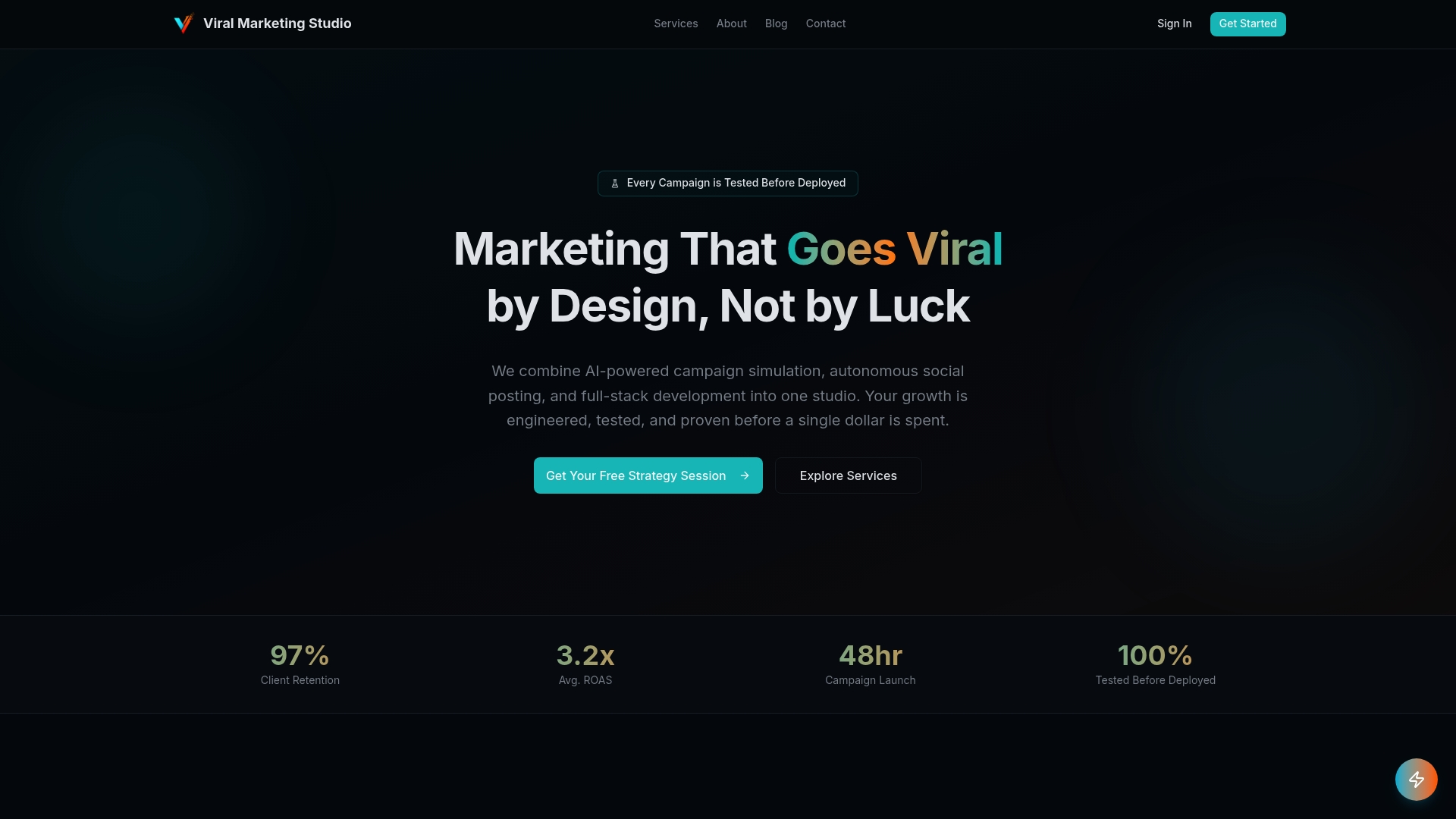
From web design built for launch day traffic to custom app development with viral loop mechanics baked in, Viralmarketingstudio builds the technical and creative foundation that lets your campaign scale when the moment arrives. If you are planning a product launch and want a team that understands both the marketing strategy and the infrastructure behind it, explore what Viralmarketingstudio offers at viralmarketingstudio.com.
FAQ
What makes a product launch campaign go viral?
A viral product launch combines a shareable hook, a built-in reason for audiences to spread the content, and fast execution that captures attention before the moment fades. Campaigns like Reale Actives and SlapMac succeeded by engineering the share mechanic into the product or campaign narrative itself.
How fast do viral launch campaigns need to move?
Speed is the defining variable. Batiste moved from a single TikTok comment to a live influencer campaign in 5 days. Brands that take weeks to approve creative miss the viral window entirely.
Do viral campaigns require a large budget?
No. SlapMac generated $5,000 in sales and 7,000 installs in one week with zero paid advertising. A two-step model using $5–$10 per day in awareness ads followed by conversion retargeting is a proven low-budget approach.
Which platform is best for a viral product launch?
TikTok and Instagram deliver the highest organic reach for video-based launches, but the best platform is the one where your audience already spends time. Cross-platform seeding within 48 hours of a viral moment sustains momentum better than any single channel.
How do you sustain momentum after a viral spike?
Capture email addresses from day one and embed referral triggers in your sequences. Email converts at 3–5 times the rate of social audiences, making it the most reliable tool for turning a viral spike into sustained growth.