
Content marketing is defined as the strategic creation and distribution of valuable, relevant, and consistent content designed to attract and engage a specific audience while building trust over time. Unlike a direct sales pitch, it works by educating, entertaining, or informing your audience until they are ready to buy. Formats include blog posts, videos, podcasts, email newsletters, webinars, and social media posts. Platforms like HubSpot and Salesforce have built entire business models around this approach, and tools like Grammarly help businesses produce polished content at scale. For small business owners, understanding the content marketing definition is the first step toward building an audience that actually converts.
How does content marketing work to drive business growth?
Content marketing builds awareness and trust by delivering useful content that moves prospects through the buyer journey, from first discovering your brand to becoming loyal customers. Salesforce defines this as a causal chain: create helpful content, build awareness and trust, then convert and profit over time. This is not a fast process, but it produces compounding returns that paid ads rarely match.
The buyer journey has three stages, and your content should serve each one deliberately:
- Awareness — The prospect has a problem but does not know your brand yet. Blog posts, short videos, and social media content introduce your expertise without asking for anything in return.
- Consideration — The prospect is comparing options. Webinars, case studies, and detailed guides position you as the credible choice over competitors.
- Decision — The prospect is ready to act. Testimonials, product demos, free trials, and email sequences close the gap between interest and purchase.
Distribution matters as much as creation. Publishing a blog post no one reads produces zero results. Effective distribution uses social media, email newsletters, search engine optimization, and paid promotion to get content in front of the right people at the right time.
Measurement closes the loop. Successful content teams define clear goals such as awareness, engagement, or lead generation, then refine their approach based on performance data rather than posting frequency alone. This feedback loop is what separates a content marketing program from random online activity.

Pro Tip: Set one primary KPI per content piece before you publish it. A blog post targeting new visitors should be measured by organic traffic and time on page, not by sales conversions.
What are effective content marketing strategies for small businesses?
A content marketing strategy connects every piece of content to a defined business objective. HubSpot distinguishes between a content "program," which is the ongoing system of creating, publishing, and distributing content aligned with business goals, and a content "plan," which is simply the schedule of what to publish and when. Small businesses often have a plan but no program. That gap is where most efforts stall.
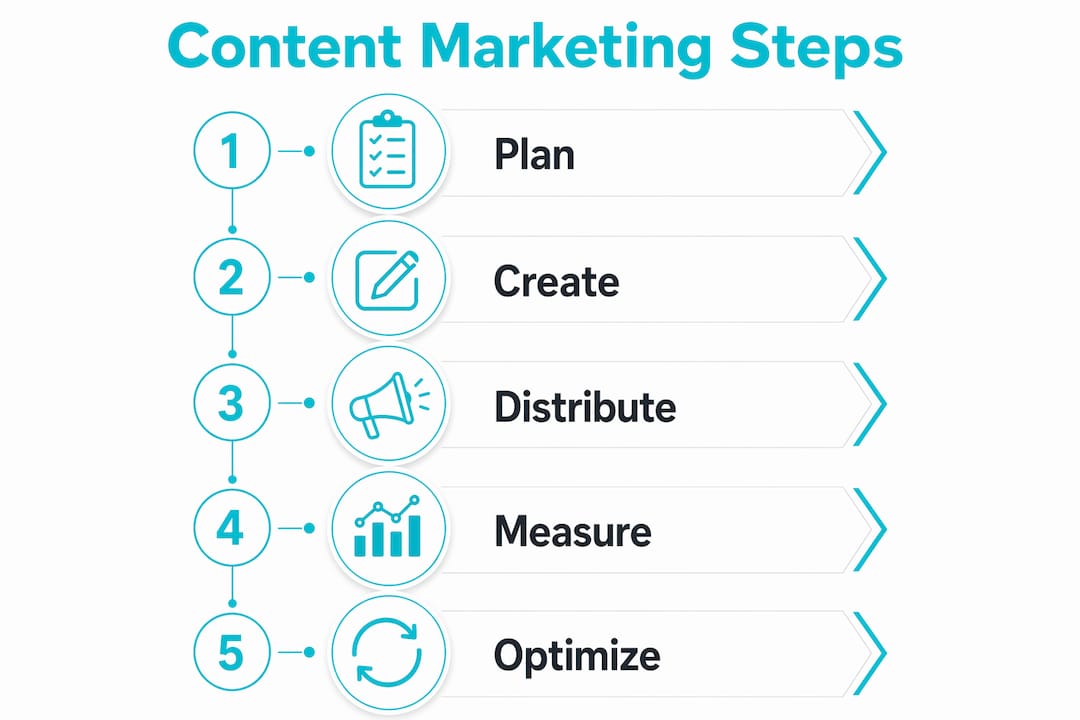
Building a real program starts with audience research. You need to know what questions your customers are asking, what problems keep them up at night, and where they spend time online. Google Search Console, Reddit communities, and customer service emails are three underused sources of this intelligence.
Once you understand your audience, a strong content marketing program for a small business typically includes:
- A blog or resource center that targets search queries your customers are already typing into Google
- Social media content tailored to the platforms where your audience is most active, whether that is Instagram, LinkedIn, or YouTube
- Visual content such as infographics and short-form video, which consistently outperform text-only posts for engagement
- Premium assets like ebooks, webinars, or free tools that capture email addresses and move prospects deeper into your funnel
- Email newsletters that nurture existing subscribers and keep your brand top of mind between purchases
HubSpot's 2025 guide confirms that small businesses running programs built around these five components attract customers more predictably than those relying on any single channel.
Tracking performance is non-negotiable. Key performance indicators worth monitoring include organic traffic, email open rates, lead form completions, and content-assisted conversions. Review these monthly and cut what is not working.
| Approach | Focus | Best for |
|---|---|---|
| Blog-first strategy | SEO traffic and long-form authority | Businesses with search demand for their niche |
| Social-first strategy | Reach, engagement, and community building | Businesses with visual products or strong personalities |
| Email-first strategy | Nurturing leads and repeat purchases | Businesses with an existing customer base |
| Mixed program | Awareness through conversion across channels | Businesses ready to invest consistently in content |
Pro Tip: Start with one content format you can produce consistently every week. Mastering one channel beats spreading yourself thin across five.
What are the key benefits of content marketing for small businesses?
Content marketing delivers compounding value that paid advertising cannot replicate. Coursera's analysis points to Michelin's century-long content marketing program as proof that the benefits extend far beyond immediate sales. Michelin's travel guides built brand loyalty and cultural authority for decades before digital marketing existed. That same principle applies to a small business publishing a weekly how-to video today.
The core benefits are concrete and measurable:
- Long-term relationship building. Consistent, helpful content turns strangers into subscribers and subscribers into loyal customers. Trust accumulates with every useful piece you publish.
- Cost-effectiveness. A well-written blog post can generate organic traffic for years. A paid ad stops the moment you stop paying. For small businesses with limited budgets, this difference is significant.
- Improved SEO and online visibility. Search engines reward websites that publish relevant, authoritative content regularly. More content means more pages indexed, more keywords ranked, and more organic visitors.
- Increased customer engagement. Content gives your audience a reason to interact with your brand outside of a transaction. Comments, shares, and replies build community.
- Lead generation. Premium content assets like free guides or webinars generate qualified leads at a fraction of the cost of paid lead generation campaigns.
"Content marketing is not a sprint. It is the most patient and profitable way to build a business audience that actually trusts you."
The businesses that see the strongest results treat content as an asset, not an expense. Every piece of content you publish adds to a library that works for you around the clock.
How does content marketing differ from social media and traditional advertising?
Content marketing is a strategic approach focused on creating valuable content for a defined audience. Social media marketing is one channel used to distribute that content and engage customers in conversation. The distinction matters because confusing the two leads to businesses posting on Instagram without a strategy and calling it content marketing.
Traditional advertising promotes products for immediate sale. A billboard, a Google display ad, or a television commercial interrupts the audience with a message designed to trigger a purchase. Content marketing builds trust first and sells second. Salesforce frames this clearly: traditional ads focus on overt sales pitches, while content marketing educates or entertains to build lasting customer relationships.
The three approaches are not mutually exclusive. The most effective small business marketing programs use all three in coordination.
| Tactic | Primary goal | Audience relationship | Time to results |
|---|---|---|---|
| Content marketing | Build trust and authority | Long-term, relationship-based | Months to years |
| Social media marketing | Distribute content and engage | Medium-term, community-based | Weeks to months |
| Traditional advertising | Drive immediate sales | Short-term, transactional | Days to weeks |
Content marketing supports and amplifies every other marketing effort. A strong blog post gives you material to share on social media. A well-produced video can become a paid ad. An email newsletter repurposes content your audience already engaged with. The strategy feeds the channels, and the channels feed the strategy.
For small businesses with limited time and budget, understanding this hierarchy prevents wasted effort. Build the content foundation first, then use social media and advertising to accelerate its reach.
Key takeaways
Content marketing is the strategic foundation that makes every other marketing channel more effective, more trusted, and more cost-efficient over time.
| Point | Details |
|---|---|
| Clear definition | Content marketing creates and distributes valuable content to build trust, not to sell directly. |
| Buyer journey alignment | Effective content serves awareness, consideration, and decision stages with different formats. |
| Strategy over posting | A documented program with defined goals outperforms random publishing every time. |
| Compounding benefits | SEO, brand loyalty, and lead generation grow over time in ways paid ads cannot replicate. |
| Integration wins | Content marketing amplifies social media and advertising when used as the strategic foundation. |
Why most small businesses get content marketing wrong
Most small businesses I have worked with treat content marketing as a volume game. They publish three blog posts, post on Instagram for two weeks, and then wonder why nothing happened. The problem is not the content. The problem is the absence of a system.
The shift that changes everything is treating every piece of content as a business asset with a specific job. A blog post targeting "how to fix a leaking faucet" is not just content. It is a 24-hour sales representative for a plumbing business, answering the exact question a homeowner types at 11 p.m. before calling someone in the morning. That is the mindset.
I have also seen businesses confuse social media activity with content marketing. Posting daily on Facebook is not a strategy. It is a habit. A coordinated content system defines what to create, who it is for, where to distribute it, and how to measure success. Without those four elements, you are just making noise.
One more thing worth saying directly: the rules are changing. Content strategy in 2026 now requires thinking beyond keyword rankings to how AI systems like ChatGPT and Perplexity discover and cite your content. If your content is not structured to be cited by AI, you are missing a growing share of how people find information. This is not a future concern. It is a present one.
Start small, stay consistent, and measure everything. The businesses that win with content are not the ones with the biggest budgets. They are the ones with the clearest strategy.
— Matthew
Ready to build a content marketing program that actually works?
Understanding content marketing principles is the first step. Executing a program that consistently attracts leads, builds authority, and converts visitors into customers is where most small businesses need support.
Viralmarketingstudio works with small business owners and entrepreneurs to build full-scale marketing programs, from content strategy and web design to branding and automation. The team at Viralmarketingstudio takes a tailored approach, building systems that fit your business goals and budget rather than applying a one-size-fits-all template. If you are ready to stop guessing and start growing, explore what a real content marketing program can do for your business.
FAQ
What is the simplest content marketing definition?
Content marketing is the strategic creation and distribution of valuable, relevant content designed to attract and engage a specific audience, building trust that leads to profitable customer action over time.
How does content marketing work for a small business?
Content marketing works by publishing helpful content that moves prospects through the buyer journey, from awareness to consideration to decision, using formats like blogs, videos, emails, and webinars distributed across owned and social channels.
What are the most effective content marketing strategies for beginners?
Start with a blog targeting search queries your customers already use, build an email list with a free premium asset, and distribute content consistently on one social media platform before expanding to others.
How is content marketing different from social media marketing?
Content marketing is the overall strategy for creating valuable content; social media marketing is one channel used to distribute that content and engage audiences. The two work together but serve different functions.
What are the main benefits of content marketing compared to paid ads?
Content marketing builds long-term SEO visibility, brand trust, and lead generation at a lower ongoing cost than paid advertising, with results that compound over time rather than stopping when the budget runs out.
Recommended
- Content Marketing ROI: A Framework for Measuring What Matters | VMS Blog
- Video Marketing Strategy: Why Video Converts 80% Better Than Text | VMS Blog
- Content Repurposing: Turn One Piece Into 10 Across Every Platform | VMS Blog
- User-Generated Content Campaigns: Let Your Customers Do the Marketing | VMS Blog