
Digital marketing is defined as the use of digital technologies, including websites, social media, email, and search engines, to promote products and services to targeted audiences online. Unlike traditional advertising, every campaign is measurable in real time, which means you can see exactly what is working and cut what is not. Tools like Google Analytics, HubSpot, and Salesforce CRM give business owners data that print ads and billboards never could. The result is a marketing model where budget follows performance, not guesswork. If you are building or scaling a business, understanding how digital marketing works is the foundation every growth decision rests on.
What is digital marketing and why does it matter for your business?
Digital marketing uses digital technologies such as computers, mobile phones, and digital media platforms to promote products and services across internet channels including search engines, social media, and email. The term covers a wide spectrum of tactics, from search engine optimization (SEO) and pay-per-click advertising (PPC) to content marketing, influencer partnerships, and automated email sequences. Each of these tactics operates differently, but they share one defining characteristic: the results are trackable.
The importance of digital marketing for business owners comes down to reach and precision. A Facebook ad campaign can target users by age, location, income bracket, and purchase behavior. A Google search ad appears only when someone types a query directly related to your product. That level of targeting is simply not available in traditional media. Small businesses benefit from digital marketing as a cost-effective alternative to traditional advertising, with the added advantage of real-time engagement tracking.

Digital marketing is broader than online marketing because it also includes digital customer data management and electronic CRM systems that support retention and repeat purchase behavior. A business that only focuses on acquiring new customers through ads while ignoring email follow-up and CRM workflows is leaving compounding revenue on the table. The full scope of what is online marketing extends from the first ad impression a prospect sees all the way through to post-purchase loyalty programs.
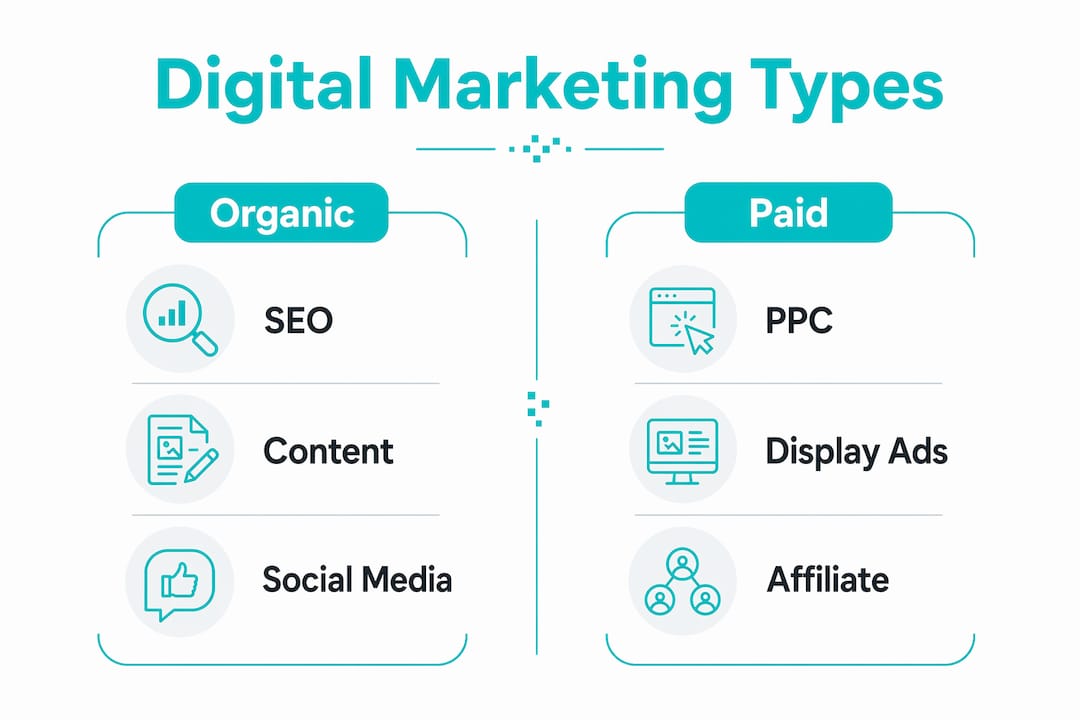
What are the main types of digital marketing and how do they differ?
Digital marketing includes both free and paid methods such as SEO, social media posts, paid advertising, and email campaigns, all used together to engage audiences and drive revenue. Understanding each type helps you decide where to invest first.
| Type | Primary Channel | Key Benefit |
|---|---|---|
| SEO (Search Engine Optimization) | Google, Bing | Long-term organic traffic at no cost per click |
| SEM / PPC | Google Ads, Microsoft Ads | Immediate visibility for high-intent searches |
| Content marketing | Blog, YouTube, podcasts | Builds authority and supports SEO over time |
| Social media marketing | Instagram, LinkedIn, TikTok | Brand awareness and direct audience engagement |
| Email marketing | Mailchimp, Klaviyo, HubSpot | Highest ROI channel for retention and upsell |
| Influencer marketing | Instagram, YouTube, TikTok | Trust transfer from creator to brand |
| Display advertising | Google Display Network, programmatic | Retargeting and broad awareness campaigns |
The organic versus paid distinction matters for budget planning. SEO and content marketing take three to six months to generate meaningful traffic, but the results compound over time without ongoing spend. PPC delivers traffic on day one but stops the moment you pause the budget. Most business owners who succeed with digital marketing run both in parallel, using paid ads for immediate revenue while organic channels build long-term equity.
Channel selection should also follow the customer journey. Digital marketers assign channels based on the job they perform at each stage: SEO for discovery, retargeting ads for consideration, email for conversion and retention. The same platform can serve different functions depending on how you configure it. LinkedIn, for example, works for brand awareness through organic posts and for direct lead generation through LinkedIn Ads.
How to develop an effective digital marketing strategy
A digital marketing strategy without a documented roadmap produces disconnected projects that rarely move financial metrics. A high-level roadmap links all online initiatives to measurable business goals, which is the difference between a coherent growth plan and a collection of random tactics.
Google's four-stage framework gives business owners a practical structure to follow:
-
Strategic planning and audience definition. Define your business goals first, whether that is lead generation, e-commerce sales, or brand awareness. Then build audience personas using real data from existing customers, Google Analytics demographics, and social media insights. Knowing who you are targeting determines which channels deserve your budget.
-
Content creation and channel activation. Produce content that matches each stage of the buyer journey. A blog post targets someone in the discovery phase. A product comparison page serves someone in the consideration phase. A limited-time offer email targets someone ready to convert. Activate channels in sequence rather than all at once to maintain quality.
-
Performance monitoring and data analysis. Set up tracking before you launch anything. Google Analytics 4, Meta Pixel, and UTM parameters on every link give you the data needed to understand which campaigns drive revenue and which drain budget. Without this infrastructure, you are flying blind.
-
Iteration and conversion rate optimization (CRO). Use the data from step three to run A/B tests on landing pages, ad copy, and email subject lines. CRO is the practice of improving the percentage of visitors who take a desired action, and even a 1% improvement in conversion rate can significantly impact annual revenue.
Effective digital marketing focuses on measurable outcomes through digital media, data, and technology rather than simply adopting new tools. A business owner who chases every new platform without a strategy will spread resources too thin. Integrate CRM data from tools like Salesforce or HubSpot into your marketing workflows so that customer behavior informs every campaign decision.
Pro Tip: Build your analytics infrastructure on day one. Instrument Google Analytics 4, set up conversion goals, and tag every campaign with UTM parameters before you spend a dollar on ads. Data collected from the start is far more valuable than data collected after the fact.
How do business owners measure digital marketing success?
Measurement is what separates digital marketing from every other form of promotion. Marketers use tools like Google Analytics and social media insights to track metrics including traffic, engagement, and click-through rates in real time, then adjust campaigns based on what the data shows.
The metrics that matter most depend on your business model, but these five apply to nearly every situation:
- Website traffic. Total sessions, unique visitors, and traffic source breakdown tell you which channels are driving awareness and whether your SEO efforts are gaining traction.
- Engagement rate. On social media, this measures likes, comments, shares, and saves relative to reach. High engagement signals that your content resonates with the audience.
- Click-through rate (CTR). For email campaigns and paid ads, CTR shows how compelling your messaging is. A low CTR on a Google Ad usually means the headline or offer needs revision.
- Conversion rate. The percentage of visitors who complete a desired action, whether that is a purchase, a form submission, or a phone call. This is the metric most directly tied to revenue.
- Return on investment (ROI). Total revenue generated divided by total marketing spend. Every campaign should be evaluated against this number over a defined time period.
High-performing digital marketers embed measurement early in campaign design to enable testing and conversion rate optimization rather than analyzing results after the fact. Connecting your marketing analytics to a CRM like HubSpot or Salesforce adds another layer of insight: you can see not just which campaigns generate leads, but which ones generate customers who actually retain and spend more over time.
Pro Tip: Do not wait until a campaign underperforms to look at the data. Schedule a weekly 20-minute analytics review from the first week of any campaign. Early signals, even with small data sets, reveal patterns that save significant budget.
What are common challenges for entrepreneurs starting with digital marketing?
Digital marketing is not instant, and it is not easy by default. The most common mistake entrepreneurs make is expecting fast results from channels that require time to mature. SEO, for example, typically takes three to six months before organic rankings produce meaningful traffic. Starting with realistic timelines prevents premature abandonment of strategies that would have worked with more patience.
The second most damaging mistake is chasing every channel at once. A solo founder or small team that tries to maintain a blog, run Google Ads, post daily on three social platforms, and manage email campaigns simultaneously will do all of them poorly. Start with one or two channels that match where your audience actually spends time. A B2B software company will find LinkedIn and content marketing far more productive than TikTok. A local restaurant will get faster results from Google Business Profile optimization and Instagram than from a complex email automation sequence.
Common pitfalls to avoid when starting out:
- No clear goals. "Get more customers" is not a goal. "Generate 50 qualified leads per month at a cost under $30 per lead" is a goal you can build a campaign around.
- Ignoring data. Running ads for 60 days without reviewing performance metrics is the equivalent of leaving money on the floor.
- Inconsistent content. Publishing three blog posts in January and nothing until April signals unreliability to both search engines and audiences.
- Skipping the basics. A slow, poorly designed website will undermine every campaign you run. Fix the foundation before scaling traffic.
Pro Tip: Invest in three fundamentals before anything else: a fast, mobile-optimized website, a Google Business Profile, and one active social media presence. These three assets compound in value over time and support every other tactic you add later.
Key takeaways
Digital marketing works because it combines measurable channel execution with continuous data-driven optimization, giving business owners direct control over growth outcomes.
| Point | Details |
|---|---|
| Definition and scope | Digital marketing covers SEO, paid ads, email, social media, and CRM, all tied to measurable business goals. |
| Strategy before tactics | A documented roadmap linking channels to business outcomes prevents wasted budget on disconnected projects. |
| Measurement from day one | Set up Google Analytics 4 and conversion tracking before launching any campaign to enable real optimization. |
| Start focused, then expand | Launch one or two channels matched to your audience before scaling to additional platforms or tactics. |
| CRM integration compounds ROI | Connecting marketing analytics to CRM data reveals which campaigns drive retention, not just acquisition. |
Why most business owners get digital marketing backwards
Most entrepreneurs I work with come in treating digital marketing as a list of tasks: post on Instagram, run some ads, send an email blast. The results are predictably inconsistent because tasks without a system produce random outcomes.
The shift that changes everything is treating digital marketing as a feedback loop, not a broadcast. You put a message out, measure what happens, learn something specific, and adjust. Google's framework captures this well, but the insight that most business owners miss is that the measurement step is not the end of the process. It is the beginning of the next one. The businesses I have seen grow fastest are the ones that review their analytics weekly and make at least one concrete change based on what they find.
The second thing most people overlook is CRM. Acquisition gets all the attention because it feels like growth. But retention and repeat sales compound ROI in ways that acquisition alone never will. A customer who buys twice is worth more than two customers who each buy once, because the second purchase cost you nothing to acquire. Build your email sequences and CRM workflows from month one, not month twelve.
Digital marketing also evolves fast enough that adaptability matters more than expertise in any single channel. The business owners who stay ahead are the ones who treat learning as part of the job, not something they will get to eventually.
— Matthew
How Viralmarketingstudio helps you build and scale your digital presence
Running a business while building a digital marketing system from scratch is genuinely difficult. Most entrepreneurs know what they need to do but do not have the time or technical depth to execute it consistently.
Viralmarketingstudio works with business owners and entrepreneurs to build digital marketing systems that are integrated, measurable, and built for growth. From SEO strategy and content production to paid advertising management, CRM integration, and web development, the team handles execution so you can focus on running your business. Every engagement starts with a clear strategy tied to your specific revenue goals, not a generic package. If you are ready to build a marketing system that actually compounds over time, explore what Viralmarketingstudio offers and see how the right infrastructure changes your results.
FAQ
What is digital marketing in simple terms?
Digital marketing is the practice of promoting your business through digital channels like Google, social media, email, and your website. Every tactic is measurable, which means you can track exactly what drives revenue and cut what does not.
What are the most important types of digital marketing?
The core types are SEO, pay-per-click advertising, content marketing, social media marketing, email marketing, and influencer marketing. Each serves a different role in the customer journey, from discovery through retention.
How is digital marketing different from traditional marketing?
Traditional marketing uses channels like TV, radio, and print where results are difficult to measure precisely. Digital marketing provides real-time data on traffic, conversions, and ROI, allowing continuous optimization that traditional channels cannot match.
How long does it take to see results from digital marketing?
Paid advertising can generate traffic within 24 hours of launch. SEO and content marketing typically take three to six months to produce meaningful organic results. A combined strategy delivers both short-term and long-term returns.
Do small businesses really need a digital marketing strategy?
A documented strategy is what separates businesses that grow consistently from those that spend on tactics without results. Without a roadmap linking channels to business goals, marketing spend tends to be fragmented and ineffective.