
Lead generation is the process of attracting and capturing consumer or business interest in a product or service, typically in the form of contact information. Leads come from internet activity, referrals, phone calls, paid ads, and live events. The goal is to build a pipeline of prospects who are ready for a sales follow-up. For entrepreneurs and small business owners, this process is the engine behind predictable revenue growth. Tools like calls-to-action (CTAs), lead magnets, and CRM platforms are the core mechanics that make it work. Understanding how to generate leads effectively is the difference between chasing customers and attracting them.
What is lead generation and how does it work?
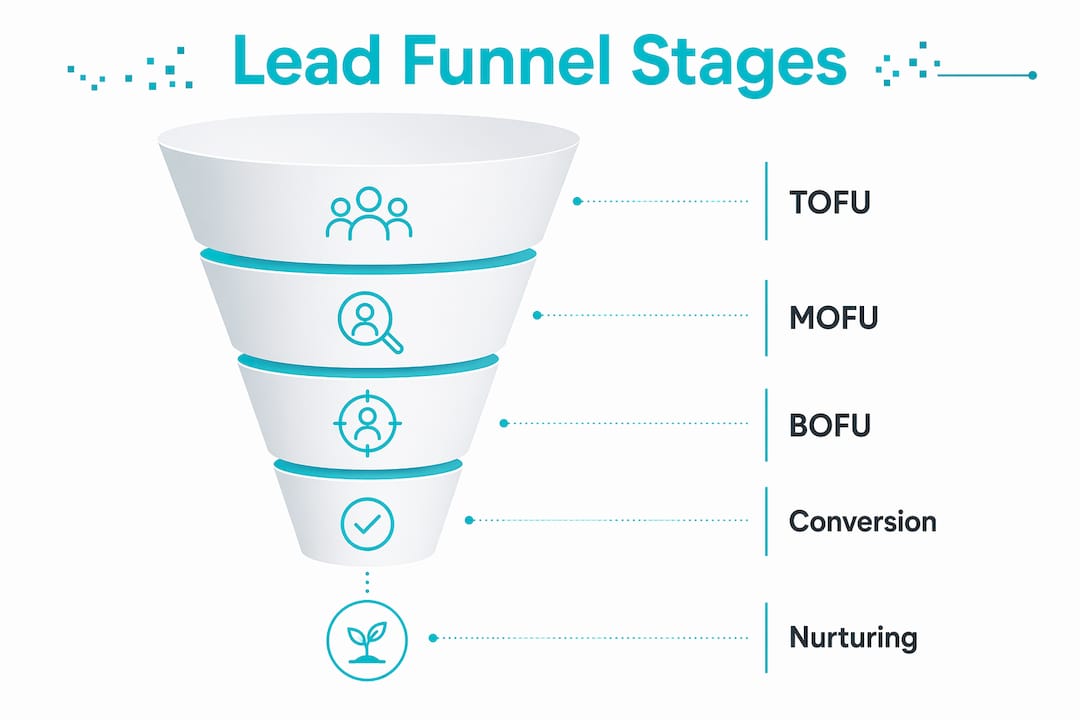
Lead generation works by moving prospects through three funnel stages: TOFU (top of funnel), MOFU (middle of funnel), and BOFU (bottom of funnel). According to Salesforce's lead generation guide, content must match the buyer's stage to nurture and qualify leads effectively before any sales handoff. Pushing a sales pitch at the TOFU stage is one of the fastest ways to lose a prospect permanently.
At the TOFU stage, your job is awareness. Blog posts, social media content, and short videos attract strangers who have a problem but no solution yet. At MOFU, gated content like ebooks, webinars, and case studies build trust and capture contact information. At BOFU, free trials, demos, and consultations close the gap between interest and purchase.
Two terms define lead quality in this funnel: MQL and SQL. An MQL (Marketing Qualified Lead) has shown enough interest to be worth nurturing. An SQL (Sales Qualified Lead) has met criteria that make them ready for a direct sales conversation. Lead scoring assigns numerical values based on engagement and fit, and those scores update dynamically as new data arrives. This keeps your sales team focused on prospects who actually want to buy.
- Attract anonymous visitors through content, SEO, or ads.
- Capture contact information via forms, CTAs, or lead magnets.
- Qualify leads using scoring criteria tied to behavior and fit.
- Nurture with automated email sequences until the lead is sales-ready.
- Hand off qualified leads to sales with clear MQL-to-SQL criteria.
Pro Tip: Organizing your marketing assets by funnel stage prevents asking for a sale too early. Map each piece of content to TOFU, MOFU, or BOFU before you publish it.
What are the most effective lead generation techniques?
Generating your own leads means getting people to willingly share contact information through website forms, CTAs, or lead magnets. This is the foundation of inbound lead generation. Outbound methods add a proactive layer on top.

The most effective techniques for small business owners fall into two categories:
Inbound methods:
- SEO-optimized blog content that ranks for problems your customers search for
- Lead magnets like free ebooks, checklists, templates, or webinars that trade value for an email address
- CTAs placed on high-traffic pages that direct visitors to a landing page
- Webinars and live Q&A sessions that build authority and capture registrations
Outbound methods:
- Cold email sequences targeting a defined prospect list
- LinkedIn outreach for B2B businesses with a clear ideal customer profile
- Paid ads on Google or Meta that drive traffic to a dedicated landing page
- Trade shows and local events where face-to-face conversations generate warm leads
One technique most small business owners overlook is visitor identification. Visitor identification technology captures leads without requiring a form fill, converting anonymous website traffic into identified prospects. B2B buyers increasingly research anonymously before making contact, which means a significant portion of your real demand never shows up in your form submissions. Tools that address this gap reduce lead leakage and increase total lead volume.
CRM platforms like Salesforce and Zendesk connect all of these methods into one system. They track where each lead came from, what content they engaged with, and when they are ready for a sales conversation. Without a CRM, you are managing leads in spreadsheets, and that does not scale.
Pro Tip: Your best lead magnet is the one that solves a specific, urgent problem your ideal customer already knows they have. A generic "free guide" underperforms a targeted "5-step checklist for [specific problem]" every time.
Inbound vs. outbound lead generation: which one should you use?
Inbound and outbound lead generation are not competing strategies. They serve different purposes and work best together. Here is how they compare:
| Factor | Inbound | Outbound |
|---|---|---|
| How it works | Attracts leads through content and opt-ins | Proactively reaches prospects via calls, emails, and ads |
| Cost over time | Lower long-term cost as content compounds | Higher ongoing cost per lead |
| Lead quality | Generally higher intent, self-selected | Variable; depends on targeting precision |
| Speed to results | Slower to build, but sustainable | Faster initial results |
| Best for | Businesses with time to build content assets | Businesses that need leads quickly or operate in niche B2B markets |
Inbound and outbound lead generation each carry trade-offs, and blending both approaches is the dominant trend in 2026. A small business that publishes consistent SEO content while running targeted LinkedIn outreach covers both the long game and the short game simultaneously.
The practical rule is straightforward. If you need leads within 30 days, outbound delivers faster. If you want a system that generates leads while you sleep six months from now, inbound is the investment. Most entrepreneurs who struggle with lead generation are relying entirely on one method and wondering why it is not enough.
How to build a lead generation strategy for your small business
A lead generation strategy fails without a clear picture of who you are trying to attract. Start there.
-
Define your ideal customer profile. Write down the industry, company size, job title, and specific problem your best customers share. Vague targeting produces vague leads.
-
Create a valuable offer. Your lead magnet must solve a real problem. A free consultation, a downloadable checklist, or a short video course all work. The offer must be specific enough that the right person immediately wants it.
-
Build your capture mechanism. Set up a landing page with a single CTA. Add forms to your highest-traffic website pages. Consider visitor identification tools to capture leads from anonymous traffic. Review your lead generation strategies checklist to confirm you have covered every capture point.
-
Set up automated nurturing. Automated email and drip sequences keep leads engaged between their first contact and their purchase decision. Lead scoring based on page visits, email opens, and webinar attendance tells you when a lead is ready for a sales call.
-
Respond fast. Speed-to-lead is a critical success factor. Automated workflows that trigger within minutes of a form submission dramatically improve conversion rates. A lead that waits 24 hours for a response has already moved on.
-
Measure and refine. Track cost per lead, lead-to-MQL rate, and MQL-to-SQL rate. These three numbers tell you where your funnel is leaking. Test one variable at a time: the offer, the CTA copy, or the landing page layout.
The most common pitfall is defining "lead" too broadly. Clear MQL-to-SQL handoff criteria reduce wasted sales effort and keep marketing and sales aligned. If your sales team is calling people who downloaded a blog post and have no purchase intent, your qualification criteria need tightening.
Key takeaways
Lead generation is the structured process of attracting, capturing, qualifying, and nurturing prospects until they are ready to buy, and every step requires a defined system to work consistently.
| Point | Details |
|---|---|
| Define leads clearly | Set explicit MQL and SQL criteria before building any funnel or campaign. |
| Match content to funnel stage | TOFU content builds awareness; MOFU content captures leads; BOFU content closes deals. |
| Use both inbound and outbound | Inbound builds long-term pipeline; outbound delivers faster short-term results. |
| Automate follow-up immediately | Automated workflows triggered within minutes of a form submission increase conversion rates. |
| Capture beyond form fills | Visitor identification tools recover leads from anonymous traffic that forms never capture. |
The lead generation mistake I see most often
Most small business owners treat lead generation as a one-time setup. They build a landing page, add a form, run a few ads, and then wonder why results plateau after 60 days. The problem is not the tactic. The problem is the absence of a qualification system behind it.
I have seen businesses with hundreds of leads per month and a sales team that is exhausted and frustrated. The leads are there. The criteria for what makes a good lead are not. Without a clear definition of what an MQL looks like for your specific business, every lead gets treated the same, and that burns time and money fast.
The second mistake is ignoring speed. A lead that fills out a form at 9:00 AM and gets a response at 4:00 PM is a cold lead by the time you call. Automated follow-up is not optional. It is the minimum standard for any business that takes lead generation seriously.
My honest advice: spend more time defining your ideal customer profile and your qualification criteria than you spend building the funnel itself. A well-defined target with a mediocre funnel outperforms a beautiful funnel aimed at everyone. Test your offers, track your numbers, and cut what does not convert. Lead generation is not magic. It is a system, and systems improve when you measure them.
— Matthew
How Viralmarketingstudio helps you build lead generation systems
Viralmarketingstudio builds the infrastructure that makes lead generation work at scale for small businesses and entrepreneurs.
From lead capture websites designed to convert visitors into contacts, to custom business software that automates nurturing workflows and lead scoring, Viralmarketingstudio covers every layer of the system. The team specializes in web development, app development, and automation, which means your lead capture and follow-up processes run without manual effort. If your current website is not generating leads, or your follow-up process depends on someone remembering to send an email, Viralmarketingstudio can fix both problems with systems built specifically for your business.
FAQ
What is lead generation in simple terms?
Lead generation is the process of attracting people who might want your product or service and collecting their contact information so you can follow up. The goal is to fill your sales pipeline with prospects who have genuine interest.
What are the main types of lead generation?
The two main types are inbound lead generation, which attracts leads through content and opt-ins, and outbound lead generation, which reaches prospects through cold emails, calls, and paid ads. Most effective strategies combine both.
What is the difference between an MQL and an SQL?
An MQL (Marketing Qualified Lead) has shown enough interest to be worth nurturing but is not yet ready to buy. An SQL (Sales Qualified Lead) has met specific criteria that make them ready for a direct sales conversation.
How do I start generating leads for my small business?
Define your ideal customer profile, create a specific offer that solves their problem, build a landing page with a clear CTA, and set up automated follow-up. Start with one channel, measure results, and expand from there.
Why is lead generation important for small businesses?
Lead generation speeds up sales cycles by focusing effort on prospects with genuine interest, which improves conversion rates and return on investment. Without it, growth depends on unpredictable referrals and word of mouth.