
Branding is defined as the process of creating a distinct identity for a business that builds trust, recognition, and customer loyalty. Why branding matters for businesses goes far beyond a logo or color scheme. It shapes how customers feel about you before they ever buy. According to a Shopify 2025–2026 survey, 68% of customers pay more for products from brands they trust. Companies like Amazon and Shopify have built their dominance not just on product quality but on the emotional certainty their brands create. If you are a business owner who has not yet treated your brand as a strategic asset, this article will show you exactly why that needs to change.
Why branding matters for businesses: trust and credibility
Trust is the foundation of every customer relationship. Without it, price becomes the only differentiator, and that is a race you cannot win long-term. Branding gives customers a reason to choose you before they compare prices.
The numbers are clear. 80% of consumers trust the brands they actively use, and 68% will pay a premium for those brands. That means a well-built brand does not just attract customers. It retains them and commands higher margins at the same time.

Brand consistency is what turns first impressions into lasting credibility. When your messaging, visuals, and customer experience align across every touchpoint, customers know what to expect. That predictability builds confidence. Maintaining consistency in brand voice across all channels is one of the most direct ways to reinforce trust and meet customer expectations.
Consider how brands like Apple and Nike operate. Their tone, visual language, and product experience are identical whether you encounter them on social media, in a store, or on a billboard. That consistency is not accidental. It is a deliberate strategy that compounds trust over time.
Pro Tip: Audit every customer touchpoint, from your website to your email signature, and confirm that your tone, colors, and messaging match. Inconsistency at any point chips away at the credibility you have built everywhere else.
Here is what brand trust actually produces in practice:
- Customers refer others without being asked
- Negative reviews carry less weight against a strong reputation
- New product launches benefit from existing goodwill
- Price increases face less resistance from loyal buyers
What are the key elements of a strong brand identity?
Strong brand identity includes five core components: visual identity, brand voice, mission, values, and consistent customer experience. Each one plays a specific role in how your business is perceived and remembered.
Here is how each element functions:
- Visual identity covers your logo, color palette, typography, and design system. These are the signals customers recognize before they read a single word.
- Brand voice is the personality behind your words. It determines whether your business sounds authoritative, friendly, playful, or direct across every piece of content you publish.
- Mission and values define why your business exists beyond profit. Edelman's 2025 research found that 73% of consumers trust brands more when they authentically reflect current culture and values.
- Brand positioning clarifies how you solve problems uniquely for your customers. Effective brand positioning distinguishes your company from competitors and anchors all your marketing decisions.
- Customer experience is the proof of your brand promise. Every interaction either confirms or contradicts what your brand claims to stand for.
| Brand Element | What It Does for Your Business |
|---|---|
| Visual Identity | Creates instant recognition and recall |
| Brand Voice | Builds personality and emotional connection |
| Mission and Values | Attracts customers who share your beliefs |
| Brand Positioning | Differentiates you in a crowded market |
| Customer Experience | Validates the promise your brand makes |
A brand positioning statement guides every messaging and design decision, anchoring your branding efforts to a clear statement of differentiation and customer benefit. Without it, your marketing pulls in multiple directions and confuses the people you are trying to reach.
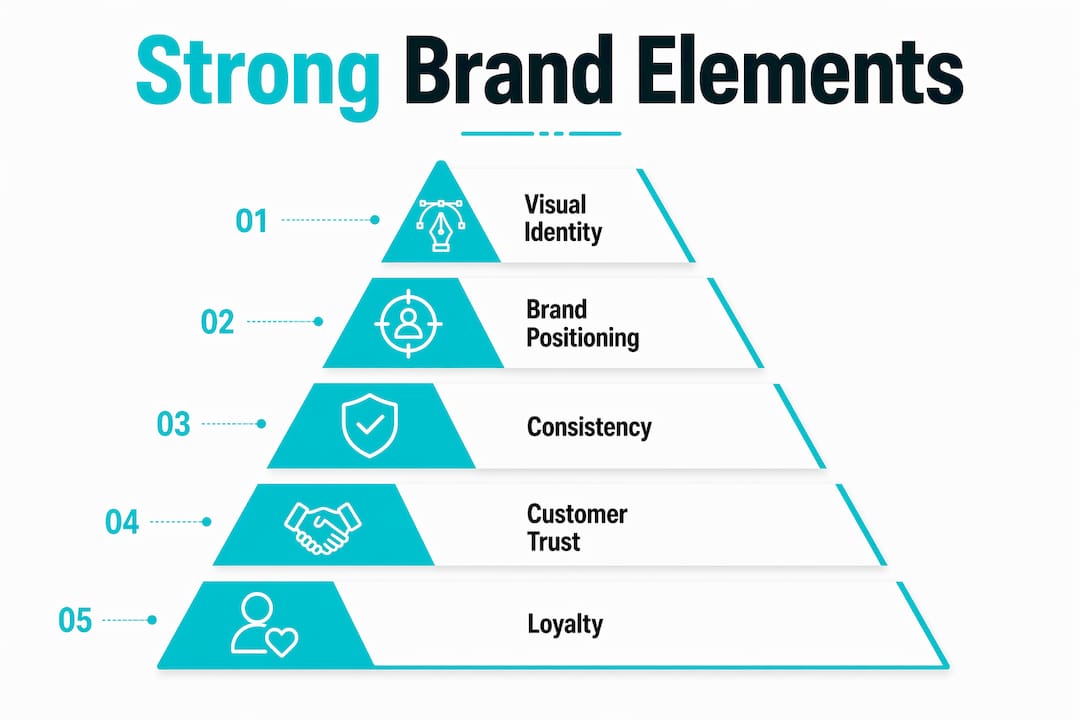
Pro Tip: Write your brand positioning statement in one sentence: "We help [audience] achieve [outcome] by [unique method]." Pin it above your desk and test every piece of content against it before publishing.
How does branding influence pricing and customer loyalty?
Branding creates perceived quality, and perceived quality supports premium pricing. This is one of the most direct financial benefits of investing in your brand. When customers believe your product is superior because of how your brand presents itself, they pay more without needing additional justification.
Branding reduces customer acquisition costs and strengthens loyalty, which drives repeat business and higher lifetime value. Acquiring a new customer costs significantly more than retaining an existing one. A strong brand makes retention easier because customers feel an emotional connection that price alone cannot replicate.
"Strong brands build emotional connections that outperform price or product attributes in driving customer loyalty and lifetime value." — Shopify Brand Research, 2026
The risk of ignoring branding is commoditization. When your business looks and sounds like every competitor, customers default to comparing prices. That erodes margins and makes growth expensive. Businesses without strong branding spend more on advertising to achieve the same results that a recognized brand achieves organically.
Cultural alignment also plays a role in retention. Brands that reflect the values of their customers create a sense of belonging. That emotional bond is far more durable than any loyalty program or discount strategy. When brand messaging aligns with ESG practices, it boosts both sales and customer trust. Misalignment does the opposite.
Here is what strong branding produces over time in terms of loyalty:
- Lower churn rates because customers feel understood
- Higher average order values from buyers who trust the brand
- Organic word-of-mouth that reduces paid acquisition spend
- Resilience during market downturns when trust is already established
Why are ceos and boards prioritizing brand investment now?
Branding has shifted from a marketing line item to a CEO-level capital allocation decision. This is not a trend. It is a structural change in how enterprise value is built and protected. Brand investment is now a strategic priority because its impact on valuation and competitive position is measurable.
The data supports this shift. A company's strongest brand equity drives an average 20% revenue premium over competitors with similar products. That premium does not come from product features. It comes from the intangible value that a recognized, trusted brand creates in the minds of buyers.
| Brand Investment Level | Business Outcome |
|---|---|
| No brand strategy | Competes on price, high acquisition costs |
| Basic visual identity only | Recognizable but not differentiated |
| Full brand system with positioning | Commands premium pricing, builds loyalty |
| Brand as strategic asset | Drives revenue premium and enterprise value |
Artificial intelligence is accelerating this dynamic. AI is leveling product features across industries, making it easier for competitors to replicate what you build. In that environment, brand is the main way to sustain pricing power and competitive advantage. When products look identical, the brand is the deciding factor.
For small and mid-sized business owners, this is the clearest argument for why to invest in branding now rather than later. Waiting until your market is commoditized means you are building brand equity under pressure, which is slower and more expensive than building it proactively.
Pro Tip: Track brand health metrics quarterly, including unaided awareness, net promoter score, and brand sentiment. Treat these numbers the same way you treat revenue figures. What gets measured gets managed.
You can also learn how to brand your company with practical frameworks that protect brand integrity and maximize trust at every stage of growth.
Key takeaways
Strong branding is a measurable strategic asset that drives revenue premiums, reduces acquisition costs, and protects businesses from commoditization.
| Point | Details |
|---|---|
| Trust drives purchasing decisions | 68% of customers pay more for brands they trust, making trust a direct revenue driver. |
| Brand identity has five core elements | Visual identity, voice, mission, values, and customer experience all work together. |
| Branding reduces acquisition costs | Loyal customers cost less to retain and generate higher lifetime value over time. |
| Brand equity commands a revenue premium | Companies with strong brand equity earn an average 20% revenue premium over competitors. |
| AI makes branding more critical | As AI levels product features, brand becomes the primary source of competitive differentiation. |
Branding is not a marketing expense. it is your business strategy.
I have worked with enough business owners to know the most common mistake: they treat branding as something you do once, usually when you launch, and then move on. A logo gets designed, a color palette gets chosen, and the brand is considered "done." That thinking costs businesses more than they realize.
What I have seen consistently is that the businesses struggling most with growth are not struggling because of their product. They are struggling because no one can tell them apart from their competitors. Their messaging shifts depending on who wrote the last social post. Their website looks nothing like their packaging. Their customer service sounds like a different company entirely. That is not a marketing problem. It is a brand problem.
The businesses that grow with less friction treat their brand as the operating system everything else runs on. Every hire, every campaign, every product decision gets filtered through the question: does this reflect who we are? That kind of discipline sounds simple, but it requires a clear brand foundation to exist in the first place.
My honest advice is this: do not wait until you are big enough to care about branding. Build the brand first, then grow into it. The companies that need a brand are not just the large ones. They are every business that wants customers to come back, refer others, and pay a fair price without negotiating.
Authenticity is the part most people underestimate. Customers in 2026 are sophisticated. They can tell when a brand is performing values it does not actually hold. The brands that win long-term are the ones where the internal culture and the external messaging are the same thing.
— Matthew
Build a brand that works as hard as you do
Your brand is often the first thing a potential customer encounters before they ever speak to you or use your product. A professional, consistent brand identity signals competence and builds the kind of trust that converts browsers into buyers.
Viralmarketingstudio specializes in building brand identities that are grounded in strategy, not just aesthetics. From logo design and visual systems to brand voice development and web presence, the team at Viralmarketingstudio creates brands that communicate clearly and compete effectively. If you are ready to build a brand that reflects the quality of your business, explore the branding services available through Viralmarketingstudio and take the first step toward a brand that works for you around the clock.
FAQ
What is branding and why does it matter for businesses?
Branding is the process of creating a distinct identity, including visuals, voice, and values, that shapes how customers perceive and remember a business. It matters because it builds trust, supports premium pricing, and drives customer loyalty over time.
How does branding affect customer trust?
According to Shopify's 2025–2026 research, 80% of consumers trust the brands they actively use, and 68% will pay more for products from those brands. Consistent branding across all channels is the primary mechanism that builds and maintains that trust.
What are the benefits of strong branding for small businesses?
Strong branding reduces customer acquisition costs, increases repeat purchases, and allows small businesses to compete on value rather than price. It also creates word-of-mouth referrals, which is the most cost-effective growth channel available.
How does brand equity create a revenue premium?
WGA Advisors' 2026 analysis found that strong brand equity drives an average 20% revenue premium over competitors with similar products. That premium reflects the intangible value customers assign to a brand they recognize and trust.
Why should business owners invest in branding now rather than later?
As AI continues to level product features across industries, brand becomes the primary differentiator in competitive markets. Building brand equity proactively is faster and less expensive than rebuilding it after commoditization has already taken hold.