
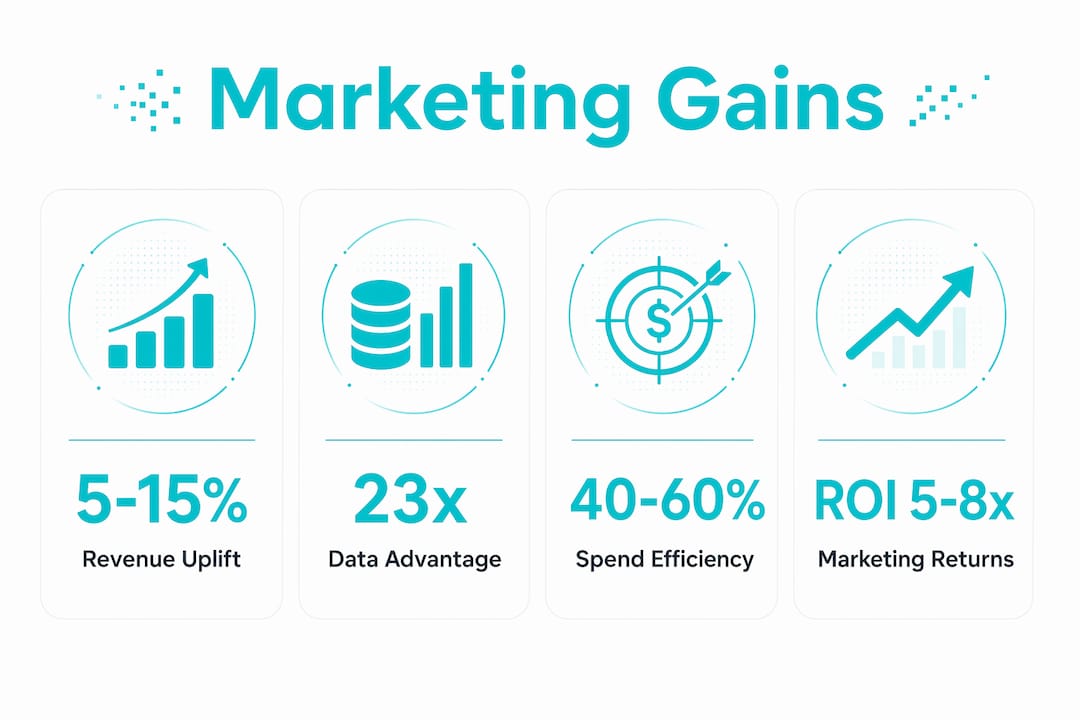
Data-driven marketing is the practice of making every marketing decision based on verified customer data and analytics rather than intuition or assumption. Companies that adopt this approach are 23 times more likely to acquire customers and 6 times more likely to retain them. That gap between data-driven and traditional marketing is not a marginal improvement. It is a structural competitive advantage that compounds over time. Viralmarketingstudio works with businesses at every stage of this shift, and the evidence for why data-driven marketing works is impossible to ignore.
Why data-driven marketing works: the measurable benefits
The most direct answer to why data-driven marketing works is that it replaces expensive guesswork with evidence. Every dollar you spend gets directed by actual customer behavior rather than a creative team's best guess about what might resonate.
The numbers are specific and significant. Personalization driven by data generates 5 to 15% revenue uplift across most industries, reaching 25% in sectors like retail and financial services. Data analytics applied to product bundling and upsell strategies can increase average order value by 20 to 40%. Companies applying data-driven approaches consistently report 5 to 8 times ROI on marketing spend and sales growth exceeding 10%. These are not projections. They are documented outcomes from organizations that replaced assumption with measurement.
The efficiency gains matter just as much as the revenue gains. 40 to 60% of marketing spend in traditional models is wasted or allocated to channels and messages that underperform. Data-driven marketing cuts that waste by identifying which channels, messages, and audience segments actually convert. The result is not just higher revenue. It is lower cost per acquisition and a marketing budget that works harder with every cycle.

Pro Tip: Before reallocating budget, run a 30-day attribution audit across your top three channels. The data almost always reveals one channel absorbing spend without producing proportional pipeline.
The benefits of data-driven marketing decisions also extend to customer lifetime value. When you understand behavioral patterns, purchase history, and engagement signals, you can identify at-risk customers before they churn and activate retention campaigns at exactly the right moment. That precision is impossible without data infrastructure.
How data-driven marketing differs from traditional marketing
The core difference is not technology. It is the basis for decisions. Traditional marketing relies on demographic assumptions, periodic campaign reviews, and creative instinct. Data-driven marketing uses behavioral and transactional signals to make decisions continuously, not quarterly.
| Dimension | Traditional marketing | Data-driven marketing |
|---|---|---|
| Decision basis | Intuition and experience | Customer data and analytics |
| Audience targeting | Broad demographic segments | Micro-segments based on behavior |
| Campaign measurement | Periodic reviews, last-click | Multi-touch attribution, real-time |
| Optimization cycle | Post-campaign | Continuous, in-flight |
| Personalization | Generic messaging | Individual-level relevance |
| Budget allocation | Historical precedent | Performance data and forecasting |
Traditional marketing treats a campaign as a finished product. Data-driven marketing treats every campaign as an experiment with a hypothesis, a measurement plan, and a feedback loop. That shift in framing changes everything downstream, from how briefs are written to how results are reported to leadership.
Micro-segmentation is where the practical gap becomes most visible. Instead of targeting "women aged 25 to 44," a data-driven approach segments by purchase recency, category affinity, and engagement frequency. The message delivered to a lapsed customer who bought twice in the last year looks nothing like the message delivered to a first-time visitor. Precision targeting driven by data produces stronger engagement and conversion rates because relevance is built into the communication architecture from the start.
Pro Tip: Map your current campaign workflow and mark every decision point where data could replace assumption. Most teams find 5 to 7 decision points per campaign that are still running on gut feel.
What are the core components of effective data-driven marketing?
Data-driven marketing effectiveness depends on four interconnected components: data quality, unified customer profiles, analytics and testing infrastructure, and organizational activation.
-
Data quality and hygiene. Inaccurate data causes 40% of business objective failures. Deduplication, validation, and consistent formatting are not optional maintenance tasks. They are prerequisites for any analysis you trust enough to act on. First-party data collected directly from your customers carries the highest accuracy and the lowest privacy risk, making it the foundation of any sustainable data strategy.
-
Unified customer profiles. Data silos are the most common reason data-driven marketing fails in practice. Fewer than 30% of enterprises successfully translate their data into marketing action. Customer Data Platforms like Segment or Salesforce Data Cloud resolve identity across touchpoints and build a Customer 360 view that makes segmentation and personalization actually work. Without that unified profile, you are making decisions from fragments.
-
Analytics, attribution, and testing infrastructure. Multi-touch attribution models, A/B testing frameworks, and predictive analytics tools form the analytical layer. AI-powered segmentation and predictive analytics identify behavioral patterns and forecast future actions, enabling proactive resource allocation rather than reactive campaign adjustments. Tools like Google Analytics 4, Mixpanel, and HubSpot provide the measurement layer most mid-market teams need to start.
-
Real-time activation and automation. Insight without activation is just reporting. Marketing automation platforms connect your data layer to your execution layer, triggering personalized messages based on real-time behavioral signals. The gap between insight and action must be measured in minutes, not weeks.
Pro Tip: Start with first-party data from your CRM and website before investing in third-party data enrichment. The data you already own is almost always underused and immediately actionable.
What challenges and misconceptions undermine data-driven marketing?
The most damaging misconception in data-driven marketing is that having dashboards makes you data-driven. It does not. Marketing plans that remain unchanged despite data indicate a reporting problem, not a data-driven culture. Data must change what you spend, where you spend it, and what creative you run. If it does not, the dashboards are decoration.
Several specific failure patterns appear repeatedly:
- Data volume confusion. More data does not mean better decisions. Teams that collect everything without clear business questions produce analysis paralysis, not insight. Start with a specific hypothesis: "We believe email re-engagement campaigns targeting customers inactive for 60 days will recover 8% of lapsed revenue." That question shapes what data you need.
- Treating negative results as failures. Every campaign is a learning opportunity regardless of outcome. A test that disproves a hypothesis is as valuable as one that confirms it, because it eliminates a wrong direction and redirects resources faster.
- Organizational resistance. True data-driven capability requires willingness to change resource allocation based on evidence, not seniority or historical precedent. That is a leadership and culture challenge as much as a technical one.
- Underestimating data literacy. Analysts can build models, but marketers need to understand what the outputs mean and how to act on them. Closing that gap through training and shared language is one of the highest-leverage investments a marketing organization can make.
"Being data-driven is a capability, not a product. You cannot buy it. You build it through repeated cycles of hypothesis, measurement, and behavioral change." — Formula
The importance of data in marketing also extends to experiential and event contexts, where behavioral signals from live interactions can feed back into digital campaigns and improve targeting precision across the full customer journey.
How to implement data-driven marketing effectively
Implementation works best as a staged capability build rather than a single technology deployment. The following sequence reflects how high-performing marketing organizations actually build this competency.
- Define your business questions first. Avoid treating data as decoration. Start with specific, measurable questions tied to revenue or retention outcomes. "Which customer segments have the highest 90-day churn risk?" is a business question. "Let's look at our data" is not.
- Audit and integrate your data sources. Map every data source your organization owns: CRM records, website behavior, email engagement, transaction history, and customer service interactions. Identify gaps and prioritize integration based on which data would most directly answer your business questions.
- Invest in the right tech stack. A CRM like HubSpot or Salesforce, a Customer Data Platform, a testing tool like Optimizely or VWO, and an attribution platform form the core infrastructure. You do not need all of them on day one. You need the ones that address your current highest-value questions.
- Build a testing calendar. Experimental culture and testing velocity are among the strongest predictors of improved marketing performance. Schedule structured tests across channels, document hypotheses and outcomes, and create institutional memory from every experiment.
- Measure and reallocate continuously. The revenue growth acceleration of 6 to 10% that data-driven organizations achieve over competitors comes from compounding optimization cycles, not single campaigns. Build a monthly review cadence where data directly informs the next cycle's budget and creative decisions.
Pro Tip: Document every test in a shared log with four fields: hypothesis, sample, outcome, and learning. After six months, that log becomes one of your most valuable strategic assets.
Balancing personalization with strong data governance and privacy compliance is also non-negotiable. GDPR, CCPA, and evolving consent frameworks mean that how you collect and use data is as important as what you do with it. Privacy-compliant first-party data strategies are both ethically sound and more durable than third-party data dependence.
Key takeaways
Data-driven marketing works because it replaces assumption with evidence at every decision point, from audience targeting to budget allocation to creative optimization.
| Point | Details |
|---|---|
| Acquisition and retention gains | Data-driven organizations are 23x more likely to acquire customers and 6x more likely to retain them. |
| Revenue and ROI impact | Personalization generates 5 to 15% revenue uplift and 5 to 8x ROI on marketing spend. |
| Waste reduction | Traditional models waste 40 to 60% of marketing spend; data-driven allocation eliminates most of that loss. |
| Unified data is foundational | Fewer than 30% of enterprises activate data effectively; a Customer 360 view is the prerequisite. |
| Culture drives results | Dashboards do not make you data-driven. Changing decisions and resource allocation based on data does. |
The shift most marketing teams still haven't made
I have worked with marketing teams that had more data than they could process and still made decisions based on what the CMO felt confident about. The dashboards were beautiful. The strategy was unchanged. That is the most common and most expensive failure mode in data-driven marketing, and it is entirely a leadership problem, not a technology problem.
The teams that actually extract competitive advantage from their data share one trait: they treat every campaign as a structured experiment. They write the hypothesis before the brief. They define success metrics before the creative goes live. They document what they learned whether the test won or lost. Over 12 to 18 months, that discipline creates a knowledge base that no competitor can replicate quickly.
I also think the industry undersells the value of brand strategy as a complement to data. Data tells you what is working. It rarely tells you why. The teams that combine rigorous measurement with genuine creative curiosity outperform the ones that let data crowd out instinct entirely. The goal is not to eliminate judgment. It is to make judgment accountable.
Start smaller than you think you need to. One well-defined business question, one clean data source, one structured test. The compounding effect of that discipline over time is what the statistics about 23x customer acquisition actually describe.
— Matthew
How Viralmarketingstudio can build your data-driven marketing engine
Viralmarketingstudio builds the infrastructure that makes data-driven marketing actually work, not just look good in a presentation. From CRM integration and marketing automation to custom analytics dashboards and campaign architecture, the team at Viralmarketingstudio connects your data to your decisions at every stage of the customer journey. Whether you are starting from scratch or untangling years of disconnected tools, Viralmarketingstudio designs systems that turn customer data into revenue. If your marketing spend is not producing measurable, attributable results, that is the problem worth solving first.
FAQ
What is data-driven marketing?
Data-driven marketing is the practice of using customer data, behavioral signals, and analytics to inform and optimize every marketing decision. It replaces assumption-based planning with evidence-based strategy across targeting, messaging, channel selection, and budget allocation.
How much can data-driven marketing improve ROI?
Companies applying data-driven strategies report 5 to 8 times ROI on marketing spend and revenue uplift of 5 to 15% from personalization alone. Acquisition costs drop by up to 50% compared to traditional approaches.
Why do most data-driven marketing efforts fail?
Most failures trace back to organizational behavior, not technology. When marketing plans remain unchanged despite data, the organization has a reporting culture rather than a data-driven one. Acting on data requires leadership willingness to reallocate resources based on evidence.
What data do you need to start data-driven marketing?
First-party data from your CRM, website analytics, and email platform is sufficient to begin. Unified customer profiles built from these sources provide the behavioral and transactional signals needed for segmentation, personalization, and attribution without requiring expensive third-party data.
How long does it take to see results from data-driven marketing?
Initial improvements in targeting efficiency and campaign performance are typically visible within 60 to 90 days of implementing structured measurement and testing. The compounding advantage from an experimental culture builds over 12 to 18 months as institutional learning accumulates.