
Content marketing for early-stage startups is defined as the practice of creating and distributing valuable content to attract, educate, and convert customers without relying on paid advertising. Startup content strategy delivers 3x more leads than traditional outbound methods at 62% lower cost over 12–18 months. That math matters when your runway is limited and every dollar needs to work harder. The compounding nature of owned content, from SEO blog posts to founder videos, means the assets you build today keep generating inbound leads months from now. Paid ads stop the moment you stop paying. Content does not.
What content channels should early-stage startups focus on first?
The biggest mistake founders make is starting at the top of the funnel. Blog posts about industry trends feel productive, but they rarely convert. Start with bottom-of-funnel content: pricing pages, comparison landing pages, case studies, and short product explainer videos. These pieces speak directly to buyers who are already evaluating solutions.
Your channel mix depends on your startup type. B2B SaaS founders get the highest return from LinkedIn posts paired with an SEO-optimized blog. Consumer app founders see faster traction on short-form video platforms and email newsletters. The channel is not the strategy. The strategy is meeting your specific buyer where they already spend time.

70% of B2B buyers consume 3–5 pieces of content before contacting a vendor. That means a single blog post is not enough. You need a cluster of content that answers the questions buyers ask at each stage of their decision. Build that cluster around one core topic before expanding.
Founder-led content is the most underused asset in early-stage marketing. Your personal LinkedIn profile, your Twitter presence, and your direct outreach to niche communities carry credibility that a company page cannot replicate. Founder-led distribution beats SEO volume at early stages because your personal network amplifies content organically before you have domain authority.
Pro Tip: Post your first ten pieces of content through your personal founder profile, not the company page. Personal accounts get more reach, more comments, and more trust from early adopters.
SEO-optimized blog content compounds traffic over months and years, while social media posts fade within 24–48 hours. Use social to test ideas fast, then invest in the formats that get traction as long-form SEO content.
How do you build a sustainable content calendar without burning out?
Consistency beats volume every time. One well-researched blog post per month plus three to four short social posts per week outperforms a burst of twenty posts followed by silence. The goal is a cadence you can maintain for twelve months, not a sprint you abandon in week six.
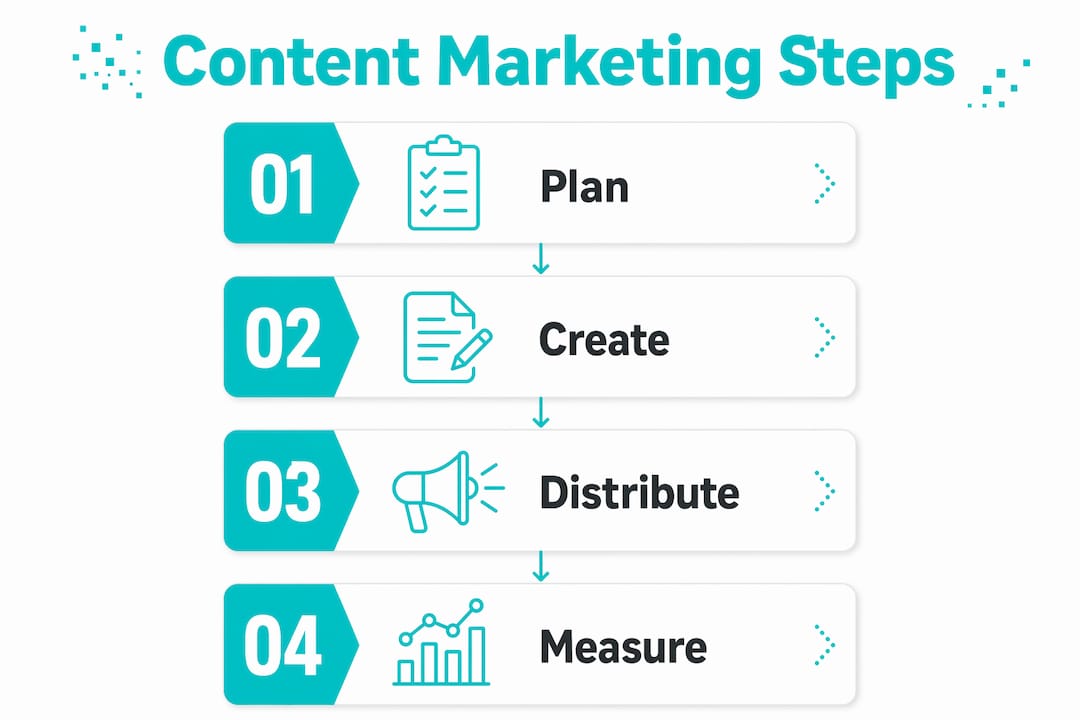
Structure your workflow around anchor content and derivative content. One long-form piece, such as a guide, a video, or a detailed case study, becomes the anchor for the month. From that single anchor, you extract social posts, email newsletter sections, short video clips, and quote graphics. This batching approach cuts production time significantly.
AI writing tools like ChatGPT and Jasper accelerate first drafts, but the founder's voice and specific examples are what make content credible. Use AI to handle structure and outlines. Write the insights yourself. Readers and search engines both reward specificity over generic advice.
Here is a practical weekly rhythm for a two-person founding team:
- Monday: Outline the week's anchor content and assign any research tasks.
- Tuesday–Wednesday: Write or record the anchor piece in a single focused session.
- Thursday: Repurpose the anchor into three social posts and one email snippet.
- Friday: Engage with comments, reply to relevant posts in your niche, and track which posts are getting traction.
- End of month: Review which content drove sign-ups, demo requests, or email subscribers. Double down on what worked.
Most startups see organic search growth within 3–6 months of consistent publishing. Social media engagement tends to show results within 4–8 weeks. Set those timelines as your benchmarks before concluding a channel is not working.
Pro Tip: Tie every content piece to a specific KPI before you create it. Ask: "If this post works, what will increase?" If you cannot answer that, reconsider whether to make it.
What is the role of video content in early-stage startup marketing?
Video is the highest-trust format available to a startup with no brand recognition. A written blog post tells. A video shows the founder, the product, and the personality behind the company. That combination builds the kind of trust that converts skeptical early adopters into paying customers.
Explainer videos on landing pages can lift conversions by up to 86%. That is not a marginal improvement. A single well-placed video on your homepage or pricing page can double the number of visitors who take action. For a startup spending nothing on paid traffic, that conversion lift is the equivalent of doubling your ad budget.
"Video content compresses explanation, emotion, and social proof into a single format. It builds the deep trust needed to convert early-stage prospects in a way that text alone cannot replicate." — Mean.CEO, Video Content Strategy for Startups
The most effective video types for early-stage startups are:
- Founder introduction video: A 60–90 second video where you explain who you are, what problem you solve, and why you built this. Place it on your homepage and LinkedIn profile.
- Product walkthrough: A screen-recorded demo showing the core use case in under three minutes. This replaces a dozen support emails.
- Customer testimonial: A short clip of a real customer describing their result. Even a phone-recorded video works. Authenticity outperforms production quality at this stage.
- FAQ video series: Answer the five most common objections you hear on sales calls. Post one per week on LinkedIn or YouTube Shorts.
Keep videos authentic rather than polished. Early adopters and investors respond to genuine founders, not corporate productions. A founder recording on a decent webcam with good lighting converts better than an overproduced brand video with no personality.
Batch your video production. Record four to six short videos in a single two-hour session. This prevents the weekly friction of setting up equipment and getting into the right headspace. Reuse clips across pre-launch, launch, and growth phases by updating the call to action rather than reshooting the entire video.
How do you measure content marketing ROI for an early-stage startup?
Vanity metrics destroy early-stage content programs. Follower counts and page views feel good but tell you nothing about whether content is driving revenue. Focus on leading indicators that connect directly to business outcomes.
The table below shows which metrics matter at each stage of startup growth.
| Stage | Metrics to track | What they tell you |
|---|---|---|
| Pre-launch (0–3 months) | Search impressions, time on page, email sign-ups | Whether content attracts and holds the right audience |
| Early traction (3–6 months) | Demo requests, sign-ups from organic search, qualitative prospect feedback | Whether content converts readers into leads |
| Growth (6+ months) | Customer acquisition cost from content, assisted conversions, content-attributed revenue | Whether content is reducing paid acquisition costs |
Testing content hooks with short 48-hour campaigns prevents wasting budget on content not tied to revenue metrics. Run a landing page variant with a new headline or video for two days before committing to a full content series around that angle.
Track assisted conversions in Google Analytics 4 by reviewing the full conversion path. A prospect may read three blog posts, watch a founder video, and then sign up via a direct visit. Without assisted conversion tracking, you would credit the direct visit and miss the content's role entirely.
The most common measurement pitfall is over-investing in content creation without a distribution plan. A great blog post that nobody reads generates zero leads. Allocate at least as much time to distribution, including email outreach, social sharing, and community posting, as you spend on creation.
Key Takeaways
Content marketing for early-stage startups works because owned content compounds over time, reduces customer acquisition cost, and builds credibility that paid advertising cannot replicate.
| Point | Details |
|---|---|
| Start bottom-of-funnel | Build pricing pages, case studies, and explainer videos before writing awareness-level blog posts. |
| Founder-led distribution first | Post through your personal profile to amplify content before your company page has any audience. |
| Video drives conversion | Landing page explainer videos can lift conversions by up to 86%, making video the highest-ROI format. |
| Consistency over volume | A sustainable monthly cadence beats a content sprint followed by silence every time. |
| Measure what converts | Track demo requests, sign-ups, and assisted conversions. Ignore follower counts and raw page views. |
What I've learned about content marketing that most startup advice gets wrong
Most content marketing advice tells founders to publish more. Write more posts, post more often, cover more topics. That advice is wrong for early-stage startups, and I've watched it waste months of effort for founders who followed it.
Focusing on one core topic deeply builds credibility and market authority faster than spreading thin across many subjects. Pick the single problem your startup solves and become the most useful voice on that problem. Everything else is a distraction until you own that space.
The founders who get content right treat it as an owned asset that compounds over time, not a campaign with a start and end date. They write one definitive guide, record one clear founder video, and build one email list. Then they distribute relentlessly through personal networks, niche communities, and direct outreach.
The trap I see most often is founders who create great content and then wait for the audience to show up. Distribution is not optional. It is half the job. If you are not spending as much time getting your content in front of people as you spend creating it, you are leaving most of the value on the table.
Founder-led content taps authentic authority and credibility signals that company-branded content simply cannot match. Your story, your reasoning, and your specific experience are the competitive advantage. No competitor can copy that.
— Matthew
How Viralmarketingstudio helps startups build content that converts
Early-stage founders rarely lack ideas. They lack the systems, design, and technical infrastructure to turn those ideas into content that actually performs.

Viralmarketingstudio builds the web presence, branding, and business software that give your content a professional foundation to convert on. From web design that makes your landing pages work harder to graphic design that makes your content stand out in crowded feeds, the team handles the execution so you can focus on the founder-led content that only you can create. If you are ready to build a content engine that compounds, Viralmarketingstudio is the partner that gets it done.
FAQ
What is content marketing for an early-stage startup?
Content marketing for an early-stage startup is the practice of creating blog posts, videos, and social content to attract and convert customers without paid advertising. It builds organic inbound leads over time at a fraction of the cost of traditional outbound methods.
How long does it take to see results from startup content marketing?
Most startups see organic search traffic growth within 3–6 months of consistent publishing. Social media engagement typically shows results within 4–8 weeks of regular posting.
Should a startup founder create content personally?
Yes. Founder-led content carries credibility and personal network reach that company-branded content cannot replicate. Posting through your personal profile generates more organic amplification, especially on LinkedIn.
What type of video content works best for early-stage startups?
Founder introduction videos, product walkthroughs, and customer testimonials deliver the highest return. Authentic, simply produced videos consistently outperform polished corporate productions with early adopters.
How do you measure whether content marketing is working?
Track demo requests, email sign-ups, and assisted conversions in Google Analytics 4. Avoid using follower counts or raw page views as primary success metrics at the early stage.