
Email marketing is the practice of sending targeted commercial messages to a permission-based list of subscribers to attract, engage, and retain customers. It delivers an average ROI of $36–$40 for every $1 spent, making it 40 times more effective at customer acquisition than social media. With over 4.3 billion email users globally as of mid-2026, no other digital channel reaches as many people at that cost. This guide covers email marketing explained from first principles, including strategies, automation, and deliverability, so you can build a system that generates real revenue.
How does email marketing work?
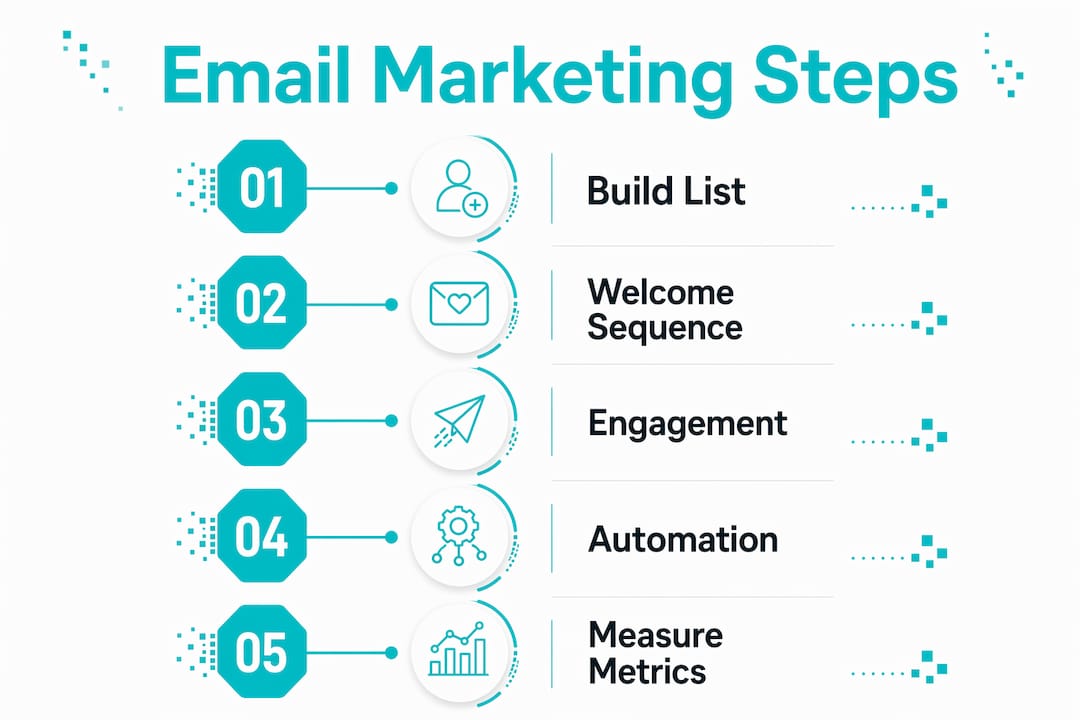
Email marketing works by collecting subscriber contact information, sending targeted messages through an Email Service Provider (ESP), and measuring results to improve future campaigns. The process follows a clear sequence, and skipping any step creates what Twilio describes as "zombie systems" that fail to convert.
Here is the core workflow every small business owner needs to understand:
- Build your list. Collect email addresses through opt-in forms on your website, at checkout, or via lead magnets like free guides or discount codes. Opt-in consent is not optional. It protects your sender reputation and keeps you compliant with laws like CAN-SPAM and GDPR.
- Choose an ESP. Platforms like Mailchimp, Klaviyo, and ConvertKit manage your subscriber list, send emails at scale, and track performance. Sending from a personal Gmail or Outlook account damages your domain reputation and risks blacklisting.
- Write subject lines that get opened. Subject lines should not exceed 50 characters to avoid truncation on mobile devices. That limit forces clarity and specificity, which are the two qualities that drive opens.
- Send and automate. Schedule one-time campaigns for promotions or newsletters, and set up automated sequences that trigger based on subscriber behavior. A welcome email sent within 5 minutes of signup is the single highest-performing message in any email program.
- Measure and adjust. Track open rates, click-through rates, and conversions after every send. Use that data to test subject lines, send times, and content formats in the next campaign.
Pro Tip: Set up a 3–5 email welcome sequence delivered over 7–10 days after signup. This sequence introduces your brand, delivers value, and moves new subscribers toward a first purchase before they go cold.
Which email strategies boost engagement?

The most effective email marketing strategies in 2026 shift from generic blasting to hyper-personalized, behaviorally driven content. Generic newsletters sent to your entire list produce weak results. Targeted messages sent to the right segment at the right time produce revenue.
These are the strategies that consistently move the needle for small businesses:
- Use names and job context. Subject lines featuring the recipient's company name increase open rates by 41%. Mentioning a specific job function lifts opens by 38%. These are not cosmetic touches. They signal relevance before the email is even opened.
- Segment by behavior, not just demographics. Behavioral segmentation anchored to specific business goals outperforms broad demographic targeting. Sending a re-engagement offer to subscribers who clicked a product page last week is more effective than sending a discount to everyone on your list.
- Apply the 80/20 content rule. Eighty percent of your emails should deliver value: tips, how-to content, or exclusive insights. Twenty percent should promote your products or services. Subscribers who feel educated rather than sold to stay on your list longer and buy more often.
- Use carousel and visual content formats. Carousel content formats drive 32% higher engagement than standard single-image emails. This format works especially well for product showcases and step-by-step tutorials.
- Optimize send times with AI. Platforms like Klaviyo and Mailchimp now include AI-powered send time optimization. These tools analyze when individual subscribers are most likely to open and deliver each email at that moment, lifting open rates without any manual effort.
"Treating email as a conversation instead of a megaphone is the single most important mindset shift for small business email marketing." — Twilio
Pro Tip: Compare your email performance against the direct mail vs. email ROI data when making budget decisions. Email wins on cost per acquisition, but direct mail can complement it for high-value customer segments.
What technical setup do your emails actually need?
Email deliverability is the percentage of your emails that reach the inbox rather than the spam folder. SPF, DKIM, and DMARC authentication are the three protocols that prove to receiving mail servers that you are a legitimate sender. Without them, your emails go to spam regardless of how good your content is.
Here is what each protocol does in plain terms:
| Protocol | What It Does | Why It Matters |
|---|---|---|
| SPF | Lists the servers authorized to send email from your domain | Prevents spammers from spoofing your address |
| DKIM | Adds a digital signature to each email | Verifies the message was not altered in transit |
| DMARC | Sets a policy for what happens when SPF or DKIM fails | Protects your domain reputation and gives you reporting |
All three are configured in your domain's DNS settings. Your ESP will provide the exact records to add. The setup takes about 30 minutes and is a one-time task that protects every email you send going forward.
List quality matters just as much as technical setup. A smaller, engaged list consistently outperforms a large, disengaged one in both deliverability and conversions. A list of 1,000 subscribers with a 35% open rate generates more revenue than a list of 10,000 with a 4% open rate. Remove subscribers who have not opened an email in 90 days. Your sender reputation depends on engagement signals, and dead weight drags it down.
Pro Tip: Never send commercial email from a personal Gmail or Outlook account. Professional ESPs protect your sender reputation and prevent your domain from being blacklisted, which is nearly impossible to recover from.
How do automation and metrics drive consistent revenue?
Automated email flows are the highest-ROI activity in email marketing because they generate revenue without requiring manual effort after the initial setup. Automated flows like welcome sequences and cart abandonment emails are foundational revenue drivers, often responsible for the majority of email-generated sales in small business accounts.
The three automations every small business should have running before anything else:
- Welcome series. Triggered immediately when someone subscribes. A 3–5 email sequence over 7–10 days introduces your brand story, delivers a promised incentive, and makes a soft product offer. This sequence converts cold subscribers into buyers at a higher rate than any broadcast campaign.
- Cart abandonment sequence. Triggered when a shopper adds items to their cart but does not complete the purchase. A two or three email sequence sent over 24–48 hours recovers a significant share of lost revenue. The first email is a simple reminder. The second adds social proof. The third, if needed, offers a small incentive.
- Reactivation campaign. Triggered when a subscriber has not engaged in 60–90 days. A short sequence of two or three emails attempts to re-engage them with a compelling offer or content piece. Subscribers who do not respond get removed from the active list to protect deliverability.
Measuring the right metrics separates businesses that grow from those that spin their wheels. The most effective email programs shift focus from open rates and clicks to business outcomes like sales and retention. The table below shows which metrics actually matter.
| Metric | What It Measures | Why It Matters |
|---|---|---|
| Revenue per email | Direct sales generated per send | Ties email activity to business outcomes |
| Conversion rate | Subscribers who complete a desired action | Shows whether your offer and copy are working |
| List growth rate | Net new subscribers per month | Indicates whether your acquisition is keeping pace with churn |
| Unsubscribe rate | Subscribers leaving per campaign | Flags content or frequency problems before they damage reputation |
High-impact email marketing requires anchoring each campaign to a clear business goal, such as retention or activation, to maximize ROI. Without that anchor, you end up measuring activity instead of results.
For a step-by-step process to plan and launch your first campaign, the email campaign launch guide from Viralmarketingstudio walks through each phase with practical examples.
Key takeaways
Email marketing delivers the highest ROI in digital marketing when it combines authenticated infrastructure, behavioral segmentation, and automated flows tied to specific business goals.
| Point | Details |
|---|---|
| ROI is unmatched | Email returns $36–$40 per $1 spent, outperforming every major digital channel. |
| Authentication is non-negotiable | SPF, DKIM, and DMARC must be configured before you send a single commercial email. |
| List quality beats list size | A small, engaged list outperforms a large, inactive one in both deliverability and revenue. |
| Automation drives consistent sales | Welcome sequences and cart abandonment flows generate revenue without ongoing manual effort. |
| Measure business outcomes | Track revenue per email and conversion rates, not just opens and clicks. |
What i've learned after years of watching email programs succeed and fail
Most small business owners treat email marketing as a broadcast tool. They build a list, send a newsletter when they remember to, and wonder why it does not convert. The problem is not the channel. The problem is the approach.
The businesses I have seen generate real, consistent revenue from email share one habit: they treat every email as a conversation with a specific person who has a specific problem. They do not send the same message to everyone. They use behavioral data from their CRM or ESP to understand what each segment cares about, and they write to that.
The second pattern I keep seeing is the obsession with list size. Entrepreneurs spend months running ads to grow their list to 10,000 subscribers, then send a generic promotional email and get a 3% open rate. Meanwhile, a competitor with 800 highly engaged subscribers sends a personalized sequence and generates more revenue. Relevance beats volume every time.
My honest advice: set up your three core automations first. Get your authentication protocols in place. Then focus on segmentation. The businesses that do those three things before worrying about design, frequency, or subject line formulas are the ones that build email programs that actually scale.
— Matthew
Ready to build an email program that actually converts?
Viralmarketingstudio works with small businesses and entrepreneurs to design, build, and automate marketing systems that generate measurable results. Whether you need help setting up your ESP infrastructure, building automated email flows, or integrating email with your existing website and CRM, the team at Viralmarketingstudio has the technical and strategic depth to do it right.
From business software integration to full web design and development, Viralmarketingstudio builds the systems that make email marketing work at scale. If you are ready to stop guessing and start growing, reach out to Viralmarketingstudio for a customized strategy built around your business goals.
FAQ
What is email marketing in simple terms?
Email marketing is the practice of sending targeted messages to a permission-based list of subscribers to promote products, share content, or build customer relationships. It delivers an average ROI of $36–$40 for every $1 spent.
How do i start email marketing for my small business?
Choose an ESP like Mailchimp or Klaviyo, add an opt-in form to your website, and set up a welcome email sequence. Authenticate your domain with SPF, DKIM, and DMARC before sending any commercial messages.
How often should i send marketing emails?
Most small businesses perform well with one to two emails per week. Frequency matters less than relevance. Sending fewer, well-targeted emails produces better results than high-volume generic blasts.
What is the best email marketing strategy for beginners?
The best starting strategy for beginners is to build a small, engaged list, set up a 3–5 email welcome sequence, and track conversion rates rather than open rates. Behavioral segmentation improves results as your list grows.
Why are my emails going to spam?
Emails land in spam when SPF, DKIM, and DMARC authentication is missing or misconfigured, or when your list contains too many inactive subscribers. Authentication protocols must be set up in your domain DNS before your ESP can protect your sender reputation.