
A viral marketing campaign is defined as a deliberate strategy to create highly shareable content that spreads rapidly through targeted networks, generating exponential brand awareness without relying primarily on paid advertising. The industry term for this discipline is "viral marketing," and it sits at the intersection of behavioral psychology, platform mechanics, and content design. When you build a viral marketing campaign correctly, you compress months of organic growth into days. Tools like Mailchimp for email distribution, Artlist for licensed video assets, and AI-powered platforms for multi-channel content generation have made this process more accessible than ever. This guide breaks down the exact frameworks, metrics, and workflows that separate campaigns that spread from campaigns that stall.
What essential elements make a marketing campaign go viral?
Virality is not luck. Emotional appeal, clear audience targeting, and shareability are the consistent hallmarks of campaigns that spread, which means every structural decision you make before launch either increases or decreases your odds.
The foundation is audience understanding. You cannot create engaging marketing campaigns without knowing precisely what your audience fears, desires, and finds funny or inspiring. Segmentation tools inside platforms like Meta Ads Manager or HubSpot let you map psychographic profiles, not just demographics. A 35-year-old entrepreneur in Austin and a 35-year-old marketing manager in Chicago may share an age bracket but respond to completely different emotional triggers.
Emotional resonance is the mechanism that converts a viewer into a sharer. Content that triggers awe, humor, or righteous anger travels furthest because sharing becomes a form of self-expression for the viewer. Campaigns built around a single, clear emotional arc outperform those that try to communicate multiple feelings at once. Think of how Dove's "Real Beauty" campaign worked: one emotion, one message, relentless consistency.

Messaging clarity is equally non-negotiable. The most shareable content communicates its core idea in a single sentence. If you cannot explain your campaign's hook in under ten words, the audience will not do it for you. Platform fit matters too. A 60-second emotional video performs on YouTube and TikTok; a punchy statistic with a bold visual performs on LinkedIn and X.
Campaigns must capture audience attention within the first 3 seconds to prevent scrolling away. This 3-second rule is the single most underestimated constraint in mobile-first content creation. It means your opening frame, subject line, or headline must deliver the hook before any context.
Key share triggers to build into every campaign:
- Emotional payoff: Humor, inspiration, or surprise that makes sharing feel rewarding
- Social currency: Content that makes the sharer look smart, funny, or informed
- Practical value: Tips, tools, or data the audience wants to pass along
- Identity alignment: Content that reflects the audience's values or group membership
- Clear call to action: A specific, frictionless prompt to share, tag, or repost
Pro Tip: Test your opening 3 seconds in isolation before launching. Show only the first frame or subject line to five people outside your team and ask what they expect next. If their answers diverge wildly, rewrite the hook.
How do you design a viral loop to maximize organic sharing?
A viral loop is the self-sustaining mechanism that turns one user's engagement into multiple new users' awareness. Mapping natural sharing moments and designing viral loops with triggers, actions, and outputs is the structural work that separates campaigns with a spike from campaigns with sustained growth.
Every viral loop contains four components:
- Trigger: The moment that prompts a user to share. This could be completing a quiz, receiving a personalized result, or hitting a milestone inside your product.
- Action: The specific sharing behavior you want. Tagging a friend, forwarding an email, or reposting a reel are all distinct actions with different friction levels.
- Output: The new content or experience the referred person receives. This must deliver immediate value or the loop dies at step three.
- Viral moment: The point where the referred person becomes a new sharer, restarting the loop.
Reducing friction is where most campaigns fail. Mobile-first design, pre-populated share text, and correctly configured Open Graph (OG) tags for link previews all lower the effort required to share. Every additional tap or form field you add cuts your share rate measurably.
Measuring viral metrics like k-factor, share rate, and cycle time enables continual campaign optimization. Small improvements compound rapidly, which means a k-factor improvement from 0.8 to 1.1 does not just add users linearly. It creates exponential growth because each new user now generates more than one additional referral.
| Metric | What it measures | Target benchmark |
|---|---|---|
| K-factor | Average new users generated per existing user | Above 1.0 for true virality |
| Share rate | Percentage of users who share after engaging | 5% or higher is strong |
| Cycle time | Time for one loop to complete | Under 24 hours for fast-moving campaigns |
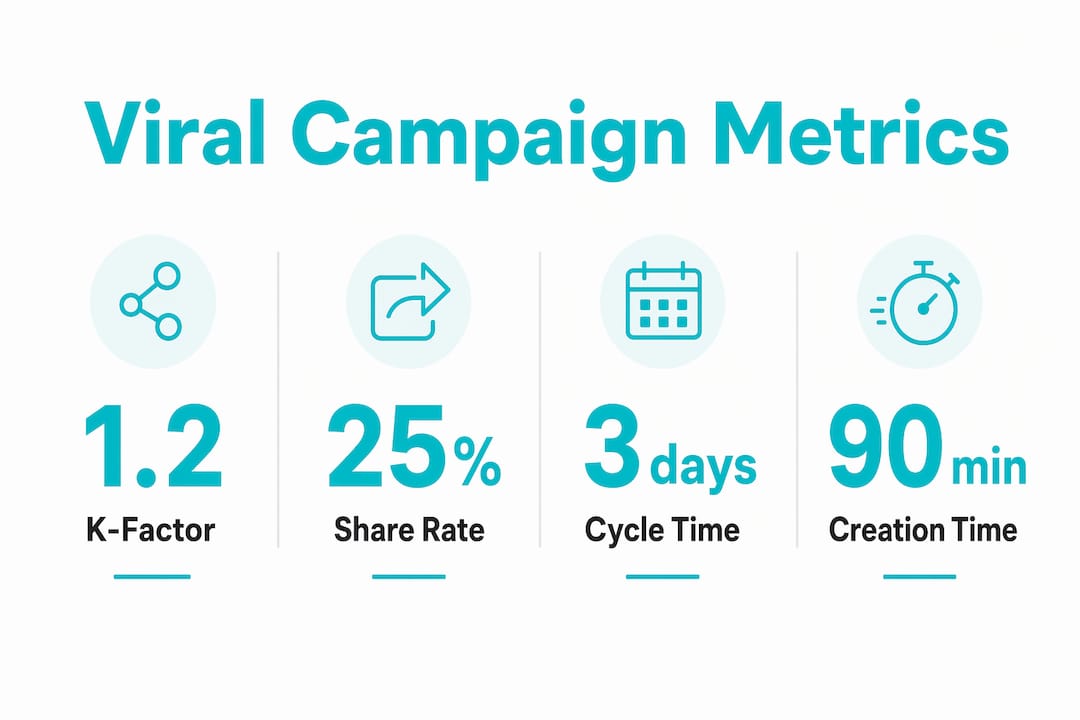
Run a 30-day viral loop challenge: launch your loop, measure k-factor weekly, identify the highest-friction step, remove one barrier, and re-measure. Most campaigns see their biggest gains in weeks two and three after the first round of friction removal.
Pro Tip: Use A/B testing on your share prompt copy before scaling. "Send this to a friend who needs it" consistently outperforms generic "Share" buttons because it gives the user a reason and a recipient in one sentence.
Can AI really cut campaign creation time to 90 minutes?
Yes. AI integration reduces campaign execution time from 10 to 14 hours to under 90 minutes, representing a 90% reduction in repetitive manual rewrites. That is not a marginal efficiency gain. It fundamentally changes how fast you can test and iterate.
Here is what an AI-powered campaign workflow looks like in practice:
- Brand tone scanning: Feed your existing copy into a tool like ChatGPT or Claude and ask it to extract your brand voice rules. Use those rules as a system prompt for every subsequent content generation task.
- Campaign brief generation: Describe your audience, emotional hook, and platform in three sentences. The AI produces a full brief including headline variants, body copy, and CTA options in under five minutes.
- Multi-channel asset generation: AI marketing platforms can generate entire multi-channel campaigns including emails, social posts, and video scripts in minutes, maintaining brand tone and style consistency across every format.
- Visual direction: Tools like Midjourney or Adobe Firefly generate on-brand visual concepts from text prompts, cutting the briefing-to-concept cycle from days to hours.
- Distribution planning: AI can sequence your posting schedule based on platform-specific peak engagement windows, removing the guesswork from timing.
The critical constraint is emotional alignment. AI generates volume efficiently, but it does not inherently know which emotional angle will resonate with your specific audience. You must input that strategic direction. The role of AI in marketing is to execute your creative strategy faster, not to replace the strategic thinking that makes campaigns worth executing.
Pro Tip: Build a "campaign starter kit" prompt that includes your brand voice rules, audience profile, and emotional hook. Save it as a reusable template. Every new campaign starts from the same foundation, which keeps output consistent even when you are moving fast.
What multi-channel strategies sustain a viral campaign's reach?
A single platform is a single point of failure. Effective social media campaigns distribute content across multiple channels in a deliberate sequence, with each platform serving a specific role in the funnel.
Campaign sequencing and distribution planning are critical, and poor sequencing causes many campaigns to fail before they gain momentum. The standard error is launching everywhere simultaneously with identical content. Platform audiences are distinct, and what performs on TikTok will feel out of place on LinkedIn without adaptation.
A practical sequencing model for a 7-day launch window:
- Day 1: Publish the anchor content piece. This is your highest-production asset, typically a video or long-form post, on the platform where your audience is most active.
- Days 2 and 3: Distribute derivative content. Pull quotes, short clips, and data points from the anchor piece and post them on secondary platforms with platform-native formatting.
- Day 4: Activate email. Send your list a curated version of the campaign with a direct share prompt. Email subscribers share at higher rates than cold social audiences because they already trust you.
- Days 5 through 7: Monitor engagement signals and double down on the format and platform showing the highest share rate. Redirect budget or effort toward what is already working.
Trend integration amplifies relevance. When your campaign connects to a current cultural moment or trending topic, the platform algorithm treats it as timely content and extends organic reach. The storytelling and emotional arcs that drive shareability work even harder when they tap into something the audience is already discussing.
Pro Tip: Set up a shared dashboard in Google Looker Studio or Databox that pulls metrics from every platform into one view. Checking five separate analytics tabs daily is how campaigns lose momentum while you are still looking at the data.
Key takeaways
Building a viral marketing campaign requires combining emotional content design, a frictionless viral loop, AI-powered execution, and deliberate multi-channel sequencing to generate sustained organic growth.
| Point | Details |
|---|---|
| 3-second rule | Your hook must land before the third second or mobile audiences scroll past. |
| Viral loop design | Build trigger, action, output, and viral moment into every campaign structure. |
| K-factor above 1.0 | A k-factor over 1.0 means each user generates more than one new referral, creating exponential growth. |
| AI cuts execution time | AI workflows reduce campaign production from 14 hours to under 90 minutes, enabling faster iteration. |
| Sequence your channels | Launch anchor content first, then distribute derivatives across platforms over 7 days for maximum reach. |
What I have learned from campaigns that almost went viral
The campaigns I have seen fail most often were not bad ideas. They were good ideas with one fatal flaw: the team optimized for production quality instead of shareability. They spent three weeks perfecting a video and zero hours mapping the sharing moment. The content looked great and went nowhere.
The uncomfortable truth about strategies for viral marketing is that friction removal matters more than creative polish. A slightly rough video with a frictionless share prompt will outperform a beautifully produced piece that requires three taps to forward. I have watched this play out repeatedly, and it still surprises clients when I show them the data.
The other pattern I see constantly is teams that launch and wait. Virality is not passive. You need to seed the campaign manually in the first 24 hours, get it in front of the people most likely to share it first, and use those early shares to signal relevance to the algorithm. The SMB growth strategies that work long-term all share this active seeding approach in the launch window.
Embrace the failed campaign. Every campaign that does not spread teaches you exactly which element broke the loop. That data is worth more than a successful campaign you cannot explain.
— Matthew
Ready to build your next campaign with expert support?
If you have the strategy but need the execution infrastructure, Viralmarketingstudio builds the systems that make viral campaigns repeatable. From web design and branding to custom business software that automates your sharing mechanics, the team at Viralmarketingstudio handles the technical and creative layers so you can focus on strategy. Whether you need a campaign-ready website, an app with a built-in viral loop, or backend infrastructure to track k-factor in real time, Viralmarketingstudio's services are built for marketing professionals who need results, not just deliverables.
FAQ
What is a viral marketing campaign?
A viral marketing campaign is a strategy designed to create content that spreads rapidly through social sharing, generating brand awareness through networks rather than paid reach. The goal is a k-factor above 1.0, where each person who engages brings in more than one new viewer.
How long does it take to build a viral marketing campaign?
AI-powered workflows reduce full campaign production from 10 to 14 hours down to under 90 minutes, covering copy, visuals, and distribution planning. The strategic work, including audience research and viral loop design, still requires dedicated time before production begins.
What is a k-factor and why does it matter?
K-factor measures how many new users each existing user generates through sharing. A k-factor above 1.0 means your campaign grows exponentially on its own, while a k-factor below 1.0 means growth depends entirely on continued paid or manual promotion.
How do you make content go viral on social media?
Content goes viral when it delivers a strong emotional payoff within the first 3 seconds, fits the native format of the platform, and includes a frictionless share prompt. Humor, inspiration, and social currency are the three emotional triggers with the highest share rates across platforms.
What is the biggest mistake in viral campaign planning?
The most common mistake is prioritizing production quality over shareability mechanics. A campaign without a mapped viral loop, a clear share trigger, and friction-free sharing paths will underperform regardless of how polished the content looks.