
Low-cost lead generation strategies are methods that attract and convert prospects without relying on large advertising budgets. Content marketing generates over 3 times as many leads as outbound marketing while costing 62% less. That gap is the core argument for every small business owner who thinks they need to spend big to grow. The most effective affordable lead generation techniques combine inbound content, referral systems, and direct outreach. Each of these channels compounds over time, meaning the work you do today keeps producing results months from now.
Which low-cost lead generation strategies deliver the best ROI?
The five highest-return channels for budget-friendly marketing are content, local search, referrals, cold email, and community presence. Each one costs more in time than money, which is exactly why they work for small businesses.
Content marketing and SEO
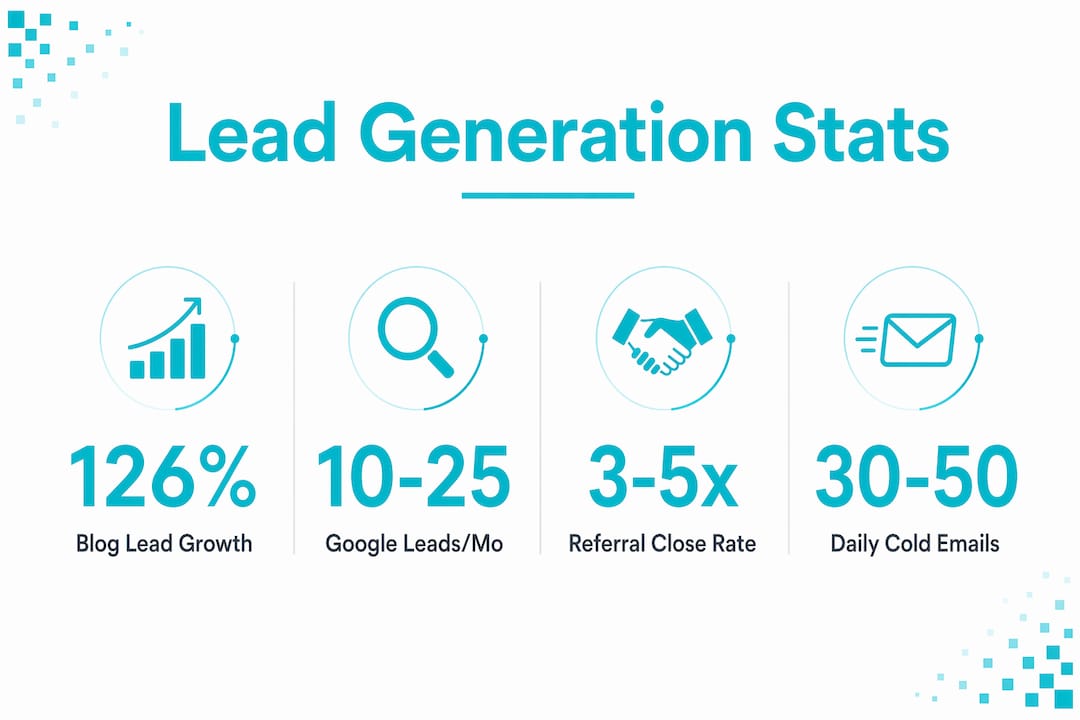
Companies with active blogs experience 126% higher lead growth than those without. That number reflects the compounding nature of search traffic. A well-written blog post targeting a specific problem ranks on Google, attracts readers, and feeds your email list for years without additional spend. Pair each post with a lead magnet, such as a checklist or short guide, and you convert passive readers into contacts.

Google Business Profile
Optimizing a Google Business Profile and collecting 25 or more reviews can generate 10–25 leads per month at zero financial cost for local businesses. Setup takes about 30 minutes. For any business serving a local area, this is the single fastest free channel to activate.
Referral programs
Referral leads close at 3–5 times the rate of cold leads and carry 16–25% higher lifetime value. That means a referred customer is worth more and easier to close than any lead you buy. Most small businesses never ask for referrals systematically. A simple script sent to satisfied customers after a completed project costs nothing and produces inexpensive sales leads with the highest conversion rate available.
Manual cold outreach
Structured manual outreach sending 30–50 personalized emails daily can outperform a $3,000 monthly ad spend within 60 days. The key metric is reply rate. If replies fall below 3%, rewrite the messaging before sending more volume. Personalization is the variable that separates a 1% reply rate from a 5% one.
LinkedIn and community engagement
Posting consistently on LinkedIn and engaging in niche online communities builds visibility without ad spend. The mechanism is simple: every comment you leave on a relevant post puts your name in front of that post's audience. Over 60 days of consistent activity, that exposure compounds into inbound inquiries.
Pro Tip: Pick one content format you can produce consistently, whether that is a 600-word blog post, a short LinkedIn update, or a video. Consistency beats variety at the start.
How to build a focused lead gen system on a small budget
Most small business owners fail by spreading effort across too many channels instead of committing to one primary channel for 60–90 days. Commitment to a single channel drives better results than multi-channel shortcuts. The system below fixes that mistake.
-
Choose one or two acquisition channels. Select based on where your buyers already spend time. B2B owners typically get faster results from LinkedIn and cold email. B2C local businesses get faster results from Google Business Profile and referrals.
-
Set up free or low-cost tools. Google Sheets handles prospect tracking at no cost. Mailchimp's free tier manages up to 500 contacts for email sequences. A lead generation system built with Google Sheets and AI-powered data enrichment is fully functional without any software subscription.
-
Build your prospect list by hand. Manual list building forces you to understand who you are targeting. Pull contacts from LinkedIn, Google Maps, or industry directories. Add a short note about each prospect's specific situation. That note becomes the personalization hook in your outreach.
-
Schedule daily activities. Block 45–60 minutes each morning for outreach, content posting, and reply handling. Treat it like a sales call, not an optional task.
-
Track reply rates and lead quality, not vanity metrics. Open rates and follower counts tell you nothing about revenue. Reply rate, booked calls, and cost per lead are the numbers that matter.
| Metric | What it tells you |
|---|---|
| Reply rate | Whether your messaging resonates |
| Booked calls per week | Whether leads are moving toward a sale |
| Cost per lead | Whether the channel is worth scaling |
| Close rate by source | Which channel produces the best buyers |
Pro Tip: Run each channel for at least 60 days before judging it. Most low-budget customer attraction efforts take 4–6 weeks to produce consistent data.
What content and referral triggers actually convert leads?
Content converts when it solves a specific problem the reader is already searching for. Generic posts about industry trends attract readers but rarely produce leads. Problem-specific posts, such as "how to reduce no-shows for a dental practice" or "how to price a landscaping job," attract buyers with an active need.
- Write each blog post around one search query with clear buyer intent.
- Add a gated content asset, such as a template or checklist, at the end of every post.
- Place a clear call to action above the fold on your homepage, not buried at the bottom.
- Use Google reviews as social proof on your website and in your email signature.
"The best lead magnet is the one that solves the exact problem your buyer has right now, not the one that took you the longest to create."
Referral triggers work best at moments of high customer satisfaction. Adding referral triggers at moments of delight converts neutral satisfaction into proactive referrals without incentives or costs. The right moment is immediately after a customer says something positive, whether in a review, a reply email, or a conversation. A simple ask like "Do you know anyone else who could use this?" costs nothing and produces leads that close at the highest rate of any channel.
Social proof accelerates every other channel. A prospect who finds your website after a referral will check your Google reviews before replying. A prospect who finds your blog post will look at your testimonials before booking a call. Reviews and case studies are not optional extras. They are conversion infrastructure.
How to balance free and paid tactics for scalable growth
Free channels build the foundation. Paid channels scale what already works. The mistake is reversing that order.
Prioritizing conversion rate optimization before spending on ads can triple revenue from paid efforts without increasing budget. That means fixing your landing page, your offer, and your follow-up sequence before you spend a dollar on Google Search Ads or Meta Ads. Invest at least 20% of your marketing time into CRO before adding paid traffic.
The smallest viable test for paid ads is a $5–$10 daily budget on one campaign targeting one audience with one offer. Run it for two weeks. If the cost per lead is lower than your average customer value divided by your close rate, scale it. If not, adjust the offer or the audience before spending more.
Agencies should only be hired once you know your cost per lead and close rates. Outsourcing lead generation before you have those benchmarks means paying someone to run experiments you should have run yourself. DIY lead gen first, then hand off a proven system.
Free lead generation channels compound when integrated. A blog post promoted across LinkedIn, your email list, and a relevant online community generates 5–10 times more leads than publishing alone. The integration multiplier is free. It just requires a distribution habit.
Pro Tip: Before hiring any agency or buying any lead gen software, calculate your current cost per lead from free channels. That number is your benchmark. Any paid channel must beat it.
Key takeaways
The most effective low-cost lead generation system combines one or two committed channels, consistent daily activity, and measurement focused on reply rates and cost per lead rather than vanity metrics.
| Point | Details |
|---|---|
| Content marketing outperforms outbound | Blogging produces 126% more lead growth and costs 62% less than outbound methods. |
| Referrals are the highest-converting channel | Referral leads close at 3–5 times the rate of cold leads and carry higher lifetime value. |
| Commit to one channel first | Running one channel for 60–90 days produces better data than spreading across five at once. |
| Fix conversion before adding paid spend | CRO improvements can triple paid ad results without increasing your budget. |
| Outsource only after benchmarking | Know your cost per lead and close rate before hiring an agency or buying lead gen tools. |
What I've learned from watching small businesses generate leads on nothing
The businesses I see generate the most leads on the smallest budgets share one trait: the founder does the work personally, at least at the start. They write the emails. They post on LinkedIn. They ask customers for referrals face to face. That hands-on involvement is not just about saving money. It builds a feedback loop that no agency can replicate. You learn what messaging works, which objections come up, and which customers refer the most, all from direct contact.
The biggest waste I see is small business owners who try three channels for two weeks each, see no results, and conclude that lead generation does not work for their industry. It always works. What does not work is inconsistency. Referral marketing remains one of the highest-ROI channels that most small businesses neglect, despite better conversion and lifetime value metrics. The reason is simple: asking for referrals feels awkward. Getting over that discomfort is worth more than any software subscription.
Track the metrics that connect to revenue. Reply rate, booked calls, and close rate by source tell you exactly where to put your next hour of effort. Follower counts and email open rates tell you almost nothing. Pick one number to improve each month and build your activity around moving that number.
— Matthew
How Viralmarketingstudio supports your lead generation goals
Small businesses that build a solid lead gen foundation often hit a ceiling when their website, software, or follow-up systems cannot handle the volume they create. Viralmarketingstudio builds the infrastructure that turns lead generation effort into revenue.
From web design built to convert to custom business software that tracks leads and automates follow-up, Viralmarketingstudio delivers solutions sized for small business budgets. Every service is built to support measurable growth, not just a better-looking website. If your current setup loses leads between first contact and closed sale, that is the problem worth fixing first.
FAQ
What is the cheapest way to generate leads for a small business?
Content marketing combined with Google Business Profile optimization is the lowest-cost starting point. Both channels cost time rather than money and produce compounding results over months.
How many leads can cold email generate on a small budget?
Sending 30–50 personalized emails daily with a reply rate above 3% can outperform a $3,000 monthly ad spend within 60 days. Personalization is the primary driver of reply rate.
When should a small business start paying for lead generation?
Start paid channels only after you know your cost per lead and close rate from free channels. Those benchmarks tell you whether a paid channel is improving your results or just adding cost.
Why do referral leads convert better than other sources?
Referral leads arrive with built-in trust from the person who referred them. That trust shortens the sales cycle and produces customers with higher lifetime value than cold or paid leads.
How long does it take to see results from free lead gen channels?
Most free channels require 60–90 days of consistent activity before producing reliable data. Stopping before that point is the most common reason small business owners conclude a channel does not work.