
A marketing technology agency, known in the industry as a martech agency, specializes in designing, implementing, and managing integrated marketing technology solutions that automate processes and drive measurable revenue growth. These agencies go far beyond what a traditional digital marketing agency offers. They connect platforms like HubSpot, Salesforce Marketing Cloud, and Marketo into a unified system that works for your business around the clock. A well-architected martech stack can deliver a 3–10x ROI by automating repetitive tasks and personalizing customer experiences at scale. That number reflects what happens when software is configured correctly, not just purchased and left alone.
What does a marketing technology agency actually do?
The core job of a martech agency is integration. Implementation and integration quality drive marketing outcomes more than software licenses alone. Buying HubSpot or Marketo without expert configuration is like buying a race car and never tuning the engine. These agencies map your customer journey, connect your CRM to your ad platforms, and build automation workflows that replace manual tasks. If you want to understand the foundation these agencies build on, the 2026 guide to marketing automation covers the core concepts clearly.

1. Widelly: RevOps-aligned martech consulting
Widelly focuses on aligning marketing technology with revenue operations. Their clients report 30–60% improvement in lead conversion and a 40–70% reduction in manual marketing tasks within six months of implementation. That kind of result comes from treating your CRM data, ad platforms, and analytics as one connected system rather than separate tools. Widelly is a strong fit for B2B companies that need their marketing and sales data to tell the same story.
2. The Higher Pitch: martech studio for complex stacks
The Higher Pitch runs a dedicated martech studio that handles the technical architecture most agencies avoid. They specialize in CRM and analytics integration, building a single source of truth that improves attribution and campaign performance. Their strength is in enterprise environments where multiple platforms need to share data without creating conflicts. If your team is running disconnected tools and losing visibility into what drives revenue, this agency addresses that directly.
3. Syntasa: agentic AI marketing platform
Syntasa builds what the industry now calls agentic marketing. Their platform autonomously plans and executes campaigns inside client-governed cloud environments, which means the AI acts on your behalf without exposing your data to third parties. Deployment takes under three months with full transparency and data governance built in. For companies that want AI to do more than suggest, Syntasa lets it act.
4. MessageGears: warehouse-native journey orchestration
MessageGears takes a fundamentally different approach to data. Their warehouse-native architecture allows data to flow directly from your data warehouse into campaign execution without copying or duplicating records. That eliminates the latency and data silos that plague most martech stacks. Segmentation becomes more accurate, personalization becomes more reliable, and your data governance stays intact. Enterprise brands with large customer databases get the most value here.
5. Iterable: AI-driven cross-channel engagement
Iterable addresses a problem that kills most personalization efforts: disconnected data that hides what customers actually want. Their platform converts real-time data into personalized engagement across email, SMS, push, and in-app channels. The platform also closes the visibility gap between CMOs and CFOs by making marketing impact measurable in revenue terms. Iterable works best for consumer brands running high-volume, multi-channel campaigns.
6. Agencies specializing in HubSpot and Salesforce ecosystems
A large category of martech agencies builds their entire practice around one platform. HubSpot-certified agencies configure CRM pipelines, email automation, lead scoring, and reporting inside a single HubSpot environment. Salesforce Marketing Cloud partners handle enterprise-scale personalization, journey building, and data extensions. Klaviyo-focused agencies serve e-commerce brands that need deep integration between their store data and email or SMS campaigns. Choosing a platform-specialist agency makes sense when you have already committed to one ecosystem and need it configured correctly.
Core services every martech agency should offer
The best agencies deliver a consistent set of services regardless of which platforms they use. These include:
- Marketing automation setup: Building workflows in HubSpot, Marketo, or Klaviyo that trigger emails, tasks, and alerts based on customer behavior.
- CRM integration: Connecting Salesforce, HubSpot CRM, or Microsoft Dynamics to your marketing tools so sales and marketing share the same data.
- Data architecture: Designing how data flows between your warehouse, analytics tools, and campaign platforms without creating duplicates or gaps.
- AI-powered personalization: Using tools like Iterable or Syntasa to deliver content and offers based on real-time customer signals.
- Campaign orchestration: Managing multi-channel campaigns across email, paid media, SMS, and web from a single coordinated system.
- Attribution and reporting: Building dashboards in tools like Google Analytics 4, Looker, or Tableau that show which campaigns drive revenue.
Pro Tip: Before signing with any agency, ask them to show you a data flow diagram from a past client. Agencies that can visualize how data moves between systems are the ones that actually understand integration, not just software.
How to choose a marketing technology agency
The right agency for your business depends on four factors: proven ROI, integration depth, AI capabilities, and alignment with your revenue operations. Use this comparison to evaluate candidates:
| Criteria | What to look for | Red flag |
|---|---|---|
| Proven ROI | Case studies with specific metrics | Vague "results-driven" claims |
| Integration expertise | Experience with your existing stack | Single-platform focus only |
| AI capabilities | Deployed AI tools, not just planned ones | AI mentioned but not demonstrated |
| RevOps alignment | Marketing and sales data connected | Marketing treated as isolated function |
| Data governance | Clear ownership and access policies | No mention of data security or compliance |
Ask every agency three questions before you hire them. First, how do you connect CRM data to paid advertising platforms? Second, what does your reporting show at the revenue level, not just the campaign level? Third, how do you handle data when a client switches platforms? The answers reveal whether the agency thinks in systems or in tasks.
Connecting CRM to ad platforms and analytics creates a single source of truth that improves attribution across every channel. Agencies that cannot explain how they do this are not ready to manage your martech stack.
Future trends shaping martech agency services
Three developments are changing what the best agencies offer right now.
Agentic AI marketing moves beyond automation into autonomous decision-making. Agentic platforms like Syntasa plan and execute campaigns without waiting for human approval on every step. This compresses the time between insight and action from days to minutes.
Warehouse-native orchestration is becoming the standard for data-mature companies. Rather than syncing data between platforms and creating copies, warehouse-native tools run segmentation and personalization directly against your source data. Accuracy improves and compliance becomes easier to manage.
AI-powered cost reduction is measurable and significant. Marketing automation can reduce cost per acquisition by up to 60% through AI-driven ad testing and optimization. That figure reflects what happens when AI tests creative variations and bid strategies faster than any human team can.
Pro Tip: Ask agencies whether their AI tools are deployed in your cloud environment or a shared one. Client-governed deployment, as Syntasa uses, protects your data and keeps your AI models proprietary.
Key takeaways
The best martech agency is the one that connects your entire technology stack to a single revenue outcome, not the one with the longest platform list.
| Point | Details |
|---|---|
| Integration drives results | Agencies that connect CRM, ads, and analytics outperform those that manage tools in isolation. |
| ROI is measurable | Optimized martech stacks deliver 3–10x ROI and up to 60% lower cost per acquisition. |
| AI is already deployed | Agentic platforms like Syntasa execute campaigns autonomously inside secure client environments. |
| Warehouse-native matters | Tools like MessageGears eliminate data copies, improving segmentation accuracy and governance. |
| Ask the right questions | Evaluate agencies on revenue-level reporting, data flow clarity, and RevOps alignment. |
Why I think most businesses pick the wrong martech agency
Most business owners evaluate agencies on the platforms they know, not on the outcomes they need. They ask "Do you work with HubSpot?" instead of "How do you connect HubSpot data to our ad spend and revenue?" That question gap is where most martech investments go wrong.
I have seen companies spend six figures on a martech stack that never gets properly integrated. The software works. The workflows do not. The reason is almost always the same: the agency treated the engagement as a software deployment, not a revenue operations project. Martech agencies that align technology with RevOps produce fundamentally different outcomes than those that treat marketing as isolated from sales and finance.
The agencies worth hiring are the ones that make you uncomfortable in the first meeting. They ask about your sales cycle, your data warehouse, your attribution model, and your CFO's reporting requirements. If an agency's first conversation is about which platform to buy, walk away. The platform is a tool. The system is the product.
— Matthew
How Viralmarketingstudio helps you build the right martech system
Viralmarketingstudio works with business owners and marketing managers who need more than a software subscription. The team handles web design and development, custom app development, backend integration, and business operating software that connects your marketing stack to your core operations. Every engagement starts with understanding your revenue goals, not your platform preferences.
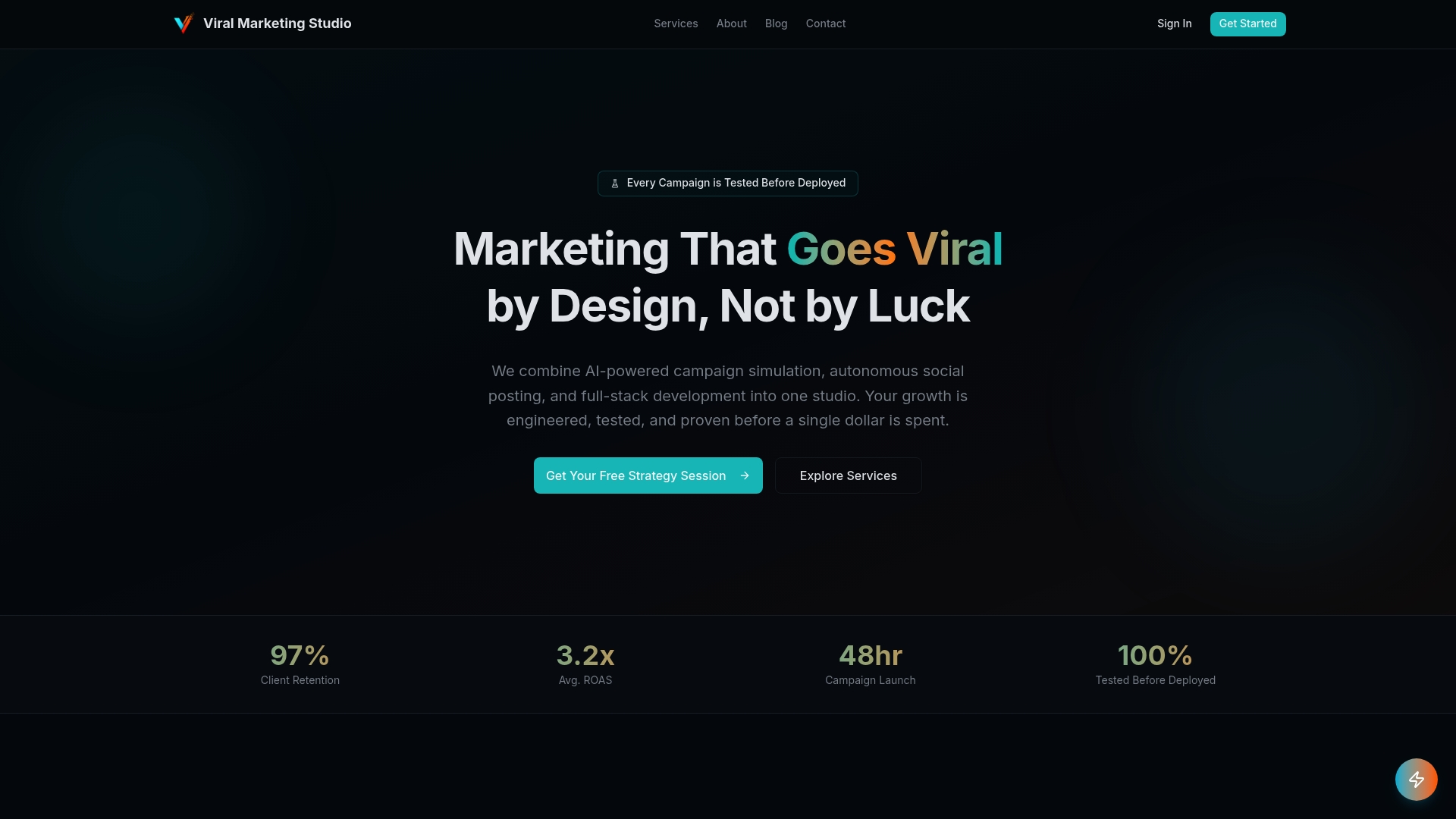
If your current marketing tools are not talking to each other, or if your reporting stops at clicks and never reaches revenue, Viralmarketingstudio builds the connections that fix that. The goal is a system where your data, your campaigns, and your sales process work as one.
FAQ
What is a marketing technology agency?
A marketing technology agency, or martech agency, designs and manages integrated marketing platforms that automate workflows and connect CRM, analytics, and advertising systems. Their work differs from a traditional digital marketing agency because they focus on technology architecture and revenue operations, not just campaign execution.
How much ROI can a martech agency deliver?
A well-configured martech stack delivers a 3–10x ROI, with clients typically seeing 30–60% improvement in lead conversion within six months. Results depend on integration quality and how closely the agency aligns technology with sales and marketing goals.
What platforms do martech agencies typically work with?
The most common platforms include HubSpot, Salesforce Marketing Cloud, Marketo, Klaviyo, and Iterable. Agencies also integrate data warehouses, analytics tools like Google Analytics 4 and Looker, and paid media platforms to create a connected system.
How do I know if an agency understands data integration?
Ask them to explain how data moves between your CRM, your ad platforms, and your reporting tools. Agencies with real integration experience can draw that flow clearly and explain where data governance applies.
What is warehouse-native marketing orchestration?
Warehouse-native orchestration runs segmentation and campaign logic directly against your data warehouse without copying records to a separate system. Tools like MessageGears use this approach to improve accuracy and simplify compliance.