
Branding is defined as the complete system of identity signals that shapes how customers perceive, remember, and choose a business. The role of branding for startups goes far beyond a logo or color palette. It is the strategic framework that builds trust, drives recognition, and creates the conditions for sustainable growth from day one. A strong brand identity transforms a simple business into a memorable market presence and an engine for long-term customer loyalty. Founders who treat branding as infrastructure, not decoration, gain a measurable competitive edge from the start.
How does branding influence customer perception and startup growth?
Branding shapes every first impression a customer forms about your startup. A usable startup brand includes a name, logo, color system, typefaces, and a clear verbal voice. These elements work together to build legitimacy and customer trust, even on a minimal budget. Without them, a startup looks unfinished, and customers fill that gap with doubt.

Brand consistency is the mechanism that turns recognition into recall. When your visual identity, tone, and messaging stay consistent across every touchpoint, customers begin to associate your brand with reliability. That association simplifies their decision-making. A buyer who already trusts your brand does not need to re-evaluate you every time they return.
The benefits of strong branding compound over time. A strong brand gives customers clear reasons to choose you and stay loyal in crowded markets. Differentiation is not just about looking different. It is about communicating a distinct value that competitors cannot easily copy.
The core components of brand identity and their direct customer impact:
- Name and logo: Create instant recognition and anchor memory
- Color system: Triggers emotional associations and builds visual consistency
- Typography: Signals personality, from authoritative to approachable
- Brand voice: Builds familiarity and trust through consistent language
- Mission statement: Gives customers a reason to care beyond the product
Pro Tip: Mirror the exact language your customers use in reviews and support tickets. When your brand voice reflects how your audience already speaks, it feels familiar rather than manufactured.
What are common branding mistakes startups should avoid?
The single most expensive branding mistake is spending scale-up money at the MVP stage before product-market fit. Founders who invest heavily in branding too early often must rebrand within two years, doubling costs and confusing early customers. That is not a branding problem. It is a sequencing problem.
The "inauthenticity trap" catches many early-stage startups. An overly slick, corporate identity at pre-seed can alienate early adopters who are specifically looking for authentic, scrappy partners. Early customers want to feel like insiders, not like they are buying from a Fortune 500 company that does not know their name. Matching branding maturity to your startup stage is not a compromise. It is a credibility decision.
Premature polish leads to wasted budgets and reactive rebrands within 24 months. Startups should treat MVP branding as a temporary scaffold, not a permanent structure. The goal at that stage is to look legitimate, not impressive.
A practical way to sequence branding investment across growth stages:
- Pre-seed: Name, basic logo, one brand color, and a one-sentence value proposition
- MVP launch: Add a simple website, consistent social presence, and a defined brand voice
- Early traction: Refine visual identity based on customer feedback and market positioning
- Series A and beyond: Invest in a full design system, brand guidelines, and professional creative assets
- Scale-up: Extend brand architecture to cover product lines, partnerships, and employer branding
Pro Tip: Before commissioning a full rebrand, run a brand audit. Survey your ten best customers about what words they associate with your company. Their answers often reveal a stronger brand than you think you have.
How can startups build and evolve their brand effectively?
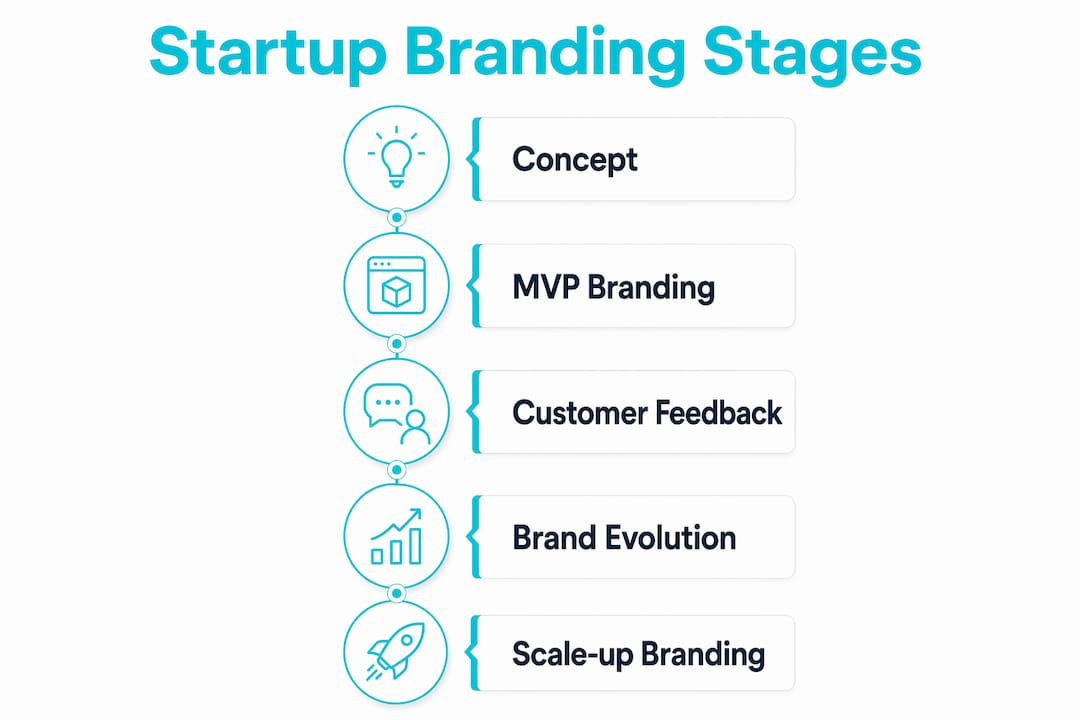
MVP-stage branding should be minimal yet complete enough to establish legitimacy. You do not need a brand agency at day one. You need a coherent scaffold: a name that is easy to spell and say, a logo that works in black and white, and a voice that sounds like a real person wrote it. That foundation costs far less than founders assume.
The most effective branding strategies for new businesses treat brand identity as a living document. As you gather customer data, run experiments, and refine your product, your brand should absorb those learnings. A startup that launched targeting enterprise clients but found its real traction with mid-market teams needs to update its messaging to reflect that reality. Holding onto an outdated brand position costs you conversions every day.
Coordinating brand strategy across product, marketing, sales, and culture is where most startups fall short. Your sales team's pitch deck, your product's onboarding copy, and your social media tone should all feel like they come from the same company. When they do not, customers notice the inconsistency and trust erodes.
Real customer feedback is the most underused branding tool available to founders. Read your reviews, listen to your support calls, and pay attention to how customers describe your product to their colleagues. That language is your brand voice in the wild. Use it.
| Branding dimension | MVP stage | Scale-up stage |
|---|---|---|
| Visual identity | Basic logo, one color, one font | Full design system with brand guidelines |
| Brand voice | One-paragraph tone guide | Detailed voice and messaging framework |
| Website | Single-page or simple site | Multi-page site with SEO and conversion architecture |
| Budget | Minimal, founder-led or freelance | Dedicated brand team or agency retainer |
| Review cycle | As needed, driven by customer feedback | Quarterly brand audits with structured process |
What strategic branding approaches foster internal alignment?
Branding acts as company-wide infrastructure that aligns product, marketing, and sales teams under a coherent mission. This internal alignment drives better decision-making and improves employee retention. When every team member understands what the brand stands for, they make faster, more consistent choices without waiting for approval.
A strong brand story and mission attract top talent and investors by demonstrating market understanding and purpose. Candidates choose employers partly based on how the company presents itself. A startup with a clear, compelling brand signals that it knows where it is going. That confidence is magnetic to the people you most want to hire.
Branding also functions as an internal compass that improves decision speed and culture retention. When a team debates whether to pursue a partnership, launch a product feature, or respond to a PR situation, the brand values provide a filter. The question becomes: "Does this fit who we are?" That question alone eliminates hours of unproductive debate.
Internal branding benefits that directly affect startup operations:
- Faster onboarding: New hires understand the company's purpose and tone from day one
- Consistent customer experience: Every team member delivers the same brand promise
- Stronger culture: Shared values reduce internal friction and improve morale
- Better hiring outcomes: Clear brand identity attracts candidates who align with company values
- Investor confidence: A coherent brand signals operational maturity and market clarity
The importance of branding for startups extends well beyond the marketing department. It is a management tool that shapes how your company behaves, not just how it looks. Founders who internalize this distinction build companies that scale with less chaos.
Key Takeaways
Branding is the most underleveraged growth tool available to startup founders, and the ones who treat it as infrastructure from day one consistently outpace those who treat it as an afterthought.
| Point | Details |
|---|---|
| Brand identity drives trust | A name, logo, color system, and voice build legitimacy from the earliest stage. |
| Sequence your investment | Avoid heavy branding spend before product-market fit to prevent costly rebrands. |
| Evolve with customer data | Treat brand identity as a living document updated by real customer feedback. |
| Brand aligns teams internally | A clear mission and values guide faster decisions and stronger culture across all departments. |
| Authenticity beats polish early | Matching branding maturity to your startup stage protects credibility with early adopters. |
Why most founders get branding backwards
Most founders I work with treat branding as a finish line. They plan to "do branding properly" once the product is ready, the funding is closed, or the team is bigger. That logic is exactly backwards.
The founders who build the strongest companies treat branding as a starting point. They define what they stand for before they write a single line of code or pitch a single investor. That clarity shapes every decision that follows, from hiring to product prioritization to how they handle a bad review.
The uncomfortable truth is that branding requires ongoing adaptation, not a one-time commission. I have watched startups spend $40,000 on a brand identity at pre-seed, only to pivot their entire positioning six months later. The money was not wasted because the branding was bad. It was wasted because it was premature.
The founders who get it right do something simple. They build a minimal but coherent brand at launch, stay obsessively close to their customers, and update their brand as their understanding deepens. They also resist the pressure to look bigger than they are. Early adopters are not looking for a polished corporation. They are looking for a team that understands their problem better than anyone else. Your brand should say exactly that.
The importance of branding for startups is not about aesthetics. It is about building a company that people remember, trust, and choose again.
— Matthew
How Viralmarketingstudio helps startups build brands that grow
Building a brand that scales with your startup requires more than a good logo. It requires a connected system of identity, web presence, and technology that works together from day one.
Viralmarketingstudio specializes in exactly that. From web design services that translate your brand into high-converting digital experiences, to custom app development that extends your brand into every customer interaction, the team builds the infrastructure that growing startups need. Whether you are launching your first MVP or preparing for your next funding round, Viralmarketingstudio delivers branding and development solutions that match your stage and your ambitions.
FAQ
What is the role of branding for startups?
Branding establishes a startup's identity, builds customer trust, and creates differentiation in competitive markets. It functions as both an external signal to customers and an internal framework that aligns teams around a shared mission.
When should a startup invest in professional branding?
A startup should build a minimal, functional brand at launch and invest in professional branding after achieving early product-market fit. Heavy investment before validation often leads to costly rebrands within two years.
What are the core elements of a startup brand?
A functional startup brand includes a name, logo, color system, typefaces, and a clear verbal voice. These five elements together establish legitimacy and customer trust at minimal cost.
How does branding help startups attract investors and talent?
A strong brand story and clear mission signal market understanding and organizational purpose. Investors and top candidates use brand clarity as a proxy for founder competence and company direction.
How often should a startup update its brand?
Startups should treat brand identity as a living document and update it as customer insights and market positioning evolve. A formal brand audit at each major growth milestone keeps identity aligned with business reality.