
Search engine marketing (SEM) is defined as the practice of combining paid search advertising, organic SEO, and AI search visibility to place your business in front of high-intent buyers at the moment they search. AI Overviews now appear on roughly 20.5% of all SERPs as of Q2 2026, which means the search results page your ads and content compete on looks fundamentally different than it did two years ago. 15.5% of all retail sales occurred online in Q2 2025. That number signals how much revenue flows through search, and why getting SEM right is not optional for growth-minded businesses. Relying on paid ads alone, or organic SEO alone, leaves money on the table and exposes you to unnecessary risk.
What is search engine marketing in 2026?
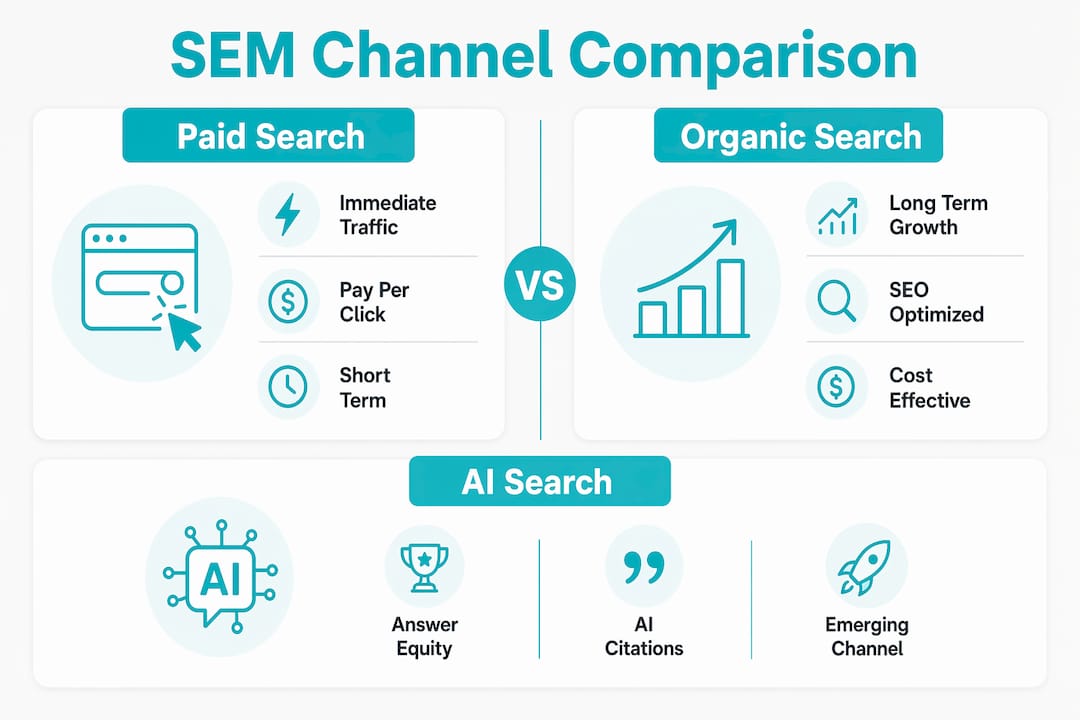
Search engine marketing is the integrated strategy that uses three distinct channels: paid search (PPC), organic search (SEO), and AI search visibility. Each channel serves a different purpose, and each operates on a different timeline. Understanding how they work together is the foundation of any effective SEM approach.
Paid search delivers immediate traffic. You bid on keywords, and Google Ads auctions determine which ads appear based on your bid, ad quality score, and contextual signals. The auction runs with every single search query. A higher quality score can win placement over a higher bid, which means creative and relevance matter as much as budget.
Organic search builds lasting authority. SEO earns placement through content quality, technical site health, backlinks, and topical depth. Results take longer to appear, but they compound over time. A well-ranked page can generate traffic for years without additional spend.
AI search visibility is the newest channel. AI-powered answer engines pull citations from authoritative sources and display them directly in search results. Winning a citation in an AI Overview means your brand appears even when a user never clicks a traditional result. This channel rewards structured, authoritative content above all else.

How the three channels compare
| Channel | Speed to traffic | Cost model | Longevity |
|---|---|---|---|
| Paid search (PPC) | Immediate | Pay per click | Stops when budget stops |
| Organic search (SEO) | Weeks to months | Time and content investment | Compounds over years |
| AI search visibility | Emerging | Content and schema investment | Durable if authority holds |
No single channel wins outright. The strongest SEM programs use all three in coordination.
How has AI changed the SEM landscape?
AI has shifted the goal of SEM from ranking on page one to owning the answer itself. The concept is called answer equity: structuring your content so AI models can cite it directly in generated responses. Businesses that build answer equity gain durable inclusion in AI-driven results, which no paid bid can buy.
The practical implication is significant. When an AI Overview answers a user's question, the traditional ten blue links receive less attention. Your content must be the source the AI pulls from, not just a result beneath it. That requires a different approach to content creation than most businesses currently use.
Three factors determine whether AI retrievers include your content:
- Information gain: Your content must add something beyond what already exists. Restating common knowledge does not earn a citation.
- Schema markup: Schema markup functions as trust infrastructure that signals expertise and authorship to AI systems. Without it, even well-written content may be ignored.
- Author provenance: AI systems favor content tied to verifiable, credible authors. Bylines, author bios, and linked credentials all contribute.
Pro Tip: Add Article, FAQPage, and HowTo schema to your highest-traffic pages first. These three schema types are the ones AI retrievers most commonly use to validate and cite content.
Adapting your SEM campaigns to target AI visibility means auditing your existing content for information gain, adding schema where it is missing, and building topical authority around the questions your customers actually ask.
What are effective strategies to balance paid and organic SEM?
The most common mistake in SEM is treating PPC and SEO as competing budget lines. They are not. PPC and SEO are complementary channels: paid search bridges the traffic gap while organic authority builds, and organic data informs which paid keywords are worth bidding on.
A practical framework for balancing the two looks like this:
- Audit your organic rankings first. Identify which keywords already rank in positions 1–5 organically. These are candidates for reduced PPC spend.
- Run incrementality testing. Incrementality testing measures whether your paid ads are generating net-new leads or simply duplicating traffic you would have received organically. Reducing PPC on top organic keywords can maintain lead volume while cutting wasted spend.
- Merge your data streams. Organic and paid data must feed a single decision loop. If a paid keyword converts at a high rate, that is a signal to build organic content around the same intent. If an organic page ranks well but converts poorly, paid retargeting can recover those visitors.
- Segment by intent. Informational queries are better served by organic content. Transactional queries with high commercial intent often justify paid bids, especially in competitive categories where organic ranking takes months.
- Shift budget dynamically. As organic rankings improve for specific terms, reallocate PPC budget toward new keyword targets or higher-funnel awareness campaigns.
Pro Tip: Run a 30-day incrementality test by pausing PPC on your top five organic keywords. Compare lead volume before and after. The result will tell you exactly how much overlap exists and where budget reallocation makes sense.
The SEO and PPC data loop is the mechanism that separates efficient SEM programs from wasteful ones. Businesses that treat these channels as separate silos consistently overspend and underperform.
For a deeper look at how organic search compounds over time, the role of SEO in business growth is worth reading before you finalize your budget split.
How to measure and optimize your SEM performance
Clicks are a vanity metric. The metrics that actually tell you whether SEM is working are conversion rate and cost-per-acquisition (CPA). SEM performance measurement requires moving beyond click-through rate to understand which traffic actually turns into revenue.
The core metrics to track across all three SEM channels:
- Conversion rate by channel: Compare how paid, organic, and AI-referred traffic converts. Paid traffic often converts faster but at higher cost. Organic traffic converts at lower cost but takes longer to generate.
- Cost-per-acquisition: Calculate CPA for paid campaigns weekly. A rising CPA signals either increased competition, declining ad quality, or a landing page problem.
- Organic visibility score: Track the percentage of target keywords where you rank in the top ten. This measures SEO momentum independent of traffic fluctuations.
- AI citation rate: Monitor how often your content appears in AI Overviews for your target queries. Tools that track SERP features can surface this data.
- Entity audit results: Review whether your content covers the full set of related topics and named entities that AI systems associate with your core subject. Gaps in entity coverage reduce citation probability.
Precise audience targeting in paid campaigns, using location, behavioral, and demographic signals, reduces CPA by showing ads only to users most likely to convert. The same targeting logic applies to content: writing for a specific audience with a specific intent outperforms generic content every time.
Optimization is not a quarterly task. SERPs shift, AI Overview coverage expands, and competitor bids change daily. Build a weekly review cadence for paid metrics and a monthly review for organic and AI visibility. Adjust based on data, not assumptions.
Key Takeaways
Search engine marketing in 2026 requires integrating paid search, organic SEO, and AI search visibility into a single, data-driven strategy to capture high-intent traffic across all three channels.
| Point | Details |
|---|---|
| SEM has three channels | Paid search, organic SEO, and AI visibility each serve a distinct role and timeline. |
| AI Overviews reshape results | AI Overviews appear on 20.5% of SERPs; answer equity is now a core SEM objective. |
| Schema markup is mandatory | Without schema and author provenance, AI retrievers may exclude your content entirely. |
| PPC and SEO complement each other | Incrementality testing reveals overlap and guides smarter budget allocation between channels. |
| Measure CPA, not just clicks | Conversion rate and cost-per-acquisition are the metrics that reflect real SEM performance. |
Why I stopped treating SEM as a paid ads problem
Most businesses I work with arrive with the same assumption: SEM means Google Ads. They have a budget, they run campaigns, and they measure success by how many clicks they bought. That framing is expensive and increasingly fragile.
The shift I have seen work consistently is reorienting the entire SEM program around authority, not spend. When you build content that AI systems want to cite, you earn placement that no competitor can outbid. That is a fundamentally different asset than a paid campaign that stops the moment the budget runs out.
Schema markup is the piece most businesses skip because it feels technical. That is a mistake. Treating schema as optional infrastructure is like building a store with no sign. The AI retriever cannot confirm your expertise if you have not given it the structured signals to do so.
The businesses winning in search right now are not necessarily spending more. They are spending smarter, running incrementality tests to cut waste, and investing the savings into content that builds answer equity. The compounding effect of that approach outperforms a pure PPC strategy within 12 months in most categories I have seen.
SEM is not a channel. It is an ecosystem. The sooner you manage it as one, the faster your results improve.
— Matthew
How Viralmarketingstudio supports your SEM goals
Viralmarketingstudio works with business owners and marketing professionals who need more than a single-channel fix. The team covers web design and development, app development, and business software built to support the technical foundation that modern SEM demands.
Whether you need schema implementation, paid search management, or content built for AI citation, Viralmarketingstudio brings all three SEM channels under one roof. The result is a program where paid and organic data feed the same decisions, and every dollar works harder. Visit Viralmarketingstudio to see how the team can build your SEM program from the ground up.
FAQ
What is search engine marketing?
Search engine marketing is the practice of combining paid search ads, organic SEO, and AI search visibility to drive qualified traffic from search engines. All three channels work together to maximize reach and conversion.
How does paid search differ from SEO in SEM?
Paid search delivers immediate traffic through ad auctions based on bids and quality scores, while SEO builds organic rankings over time through content and authority. Both are necessary components of a complete SEM strategy.
What is answer equity in search engine marketing?
Answer equity means structuring your content so AI-powered search engines cite it directly in generated responses. It builds durable search presence that paid bids cannot replicate.
Why does schema markup matter for SEM?
Schema markup signals expertise and authorship to AI retrievers. Without it, well-written content may be excluded from AI Overviews regardless of its quality.
How do you measure SEM success beyond click-through rate?
The most reliable SEM metrics are conversion rate and cost-per-acquisition by channel. These metrics reveal which traffic actually generates revenue, not just visits.