
Viral marketing is defined as a strategy where content spreads rapidly through social networks by motivating people to share it, replicating the exponential reach of a biological virus across human networks. Unlike paid media, viral marketing explained properly is about turning your audience into a voluntary distribution channel. Jonah Berger's STEPPS framework, the viral coefficient (K-factor), and Earned Media Value (EMV) are the three pillars every marketing professional needs to understand before launching a campaign. Viral spread works through network effects, not ad budgets. Get the mechanics right, and a single piece of content can reach millions without spending a dollar on placement.
What is viral marketing and how does it differ from traditional marketing?
Viral marketing spreads content person-to-person the way a virus moves from host to host, using existing social networks as the distribution infrastructure. Traditional marketing pushes messages through paid channels like TV spots, display ads, or sponsored posts. Viral marketing pulls audiences into sharing the message themselves, which means the brand pays once to create and seed the content, then the audience does the rest.

The core difference is who does the distributing. In a paid campaign, the brand controls every impression. In a viral campaign, the audience controls the spread. That shift transfers trust to the message, because people trust recommendations from friends and peers far more than ads.
Virality is not just big numbers. A video with 10 million views but zero shares is reach, not virality. True viral content includes a mechanism that motivates sharing. That mechanism can be humor, outrage, utility, or identity, but it must exist by design, not accident.
- Organic distribution: Audiences share because the content resonates, not because they were paid to.
- Network effects: Each new sharer exposes the content to their own network, compounding reach exponentially.
- Lower cost per impression: Once seeded, viral content generates impressions at a fraction of paid media cost.
- Trust transfer: Peer-to-peer sharing carries implicit endorsement, which increases conversion likelihood.
Pro Tip: Before you build a campaign, ask one question: "Why would someone share this with a specific person in their life?" If you cannot answer that question clearly, the content is not ready to seed.
What are the six STEPPS drivers that make content go viral?
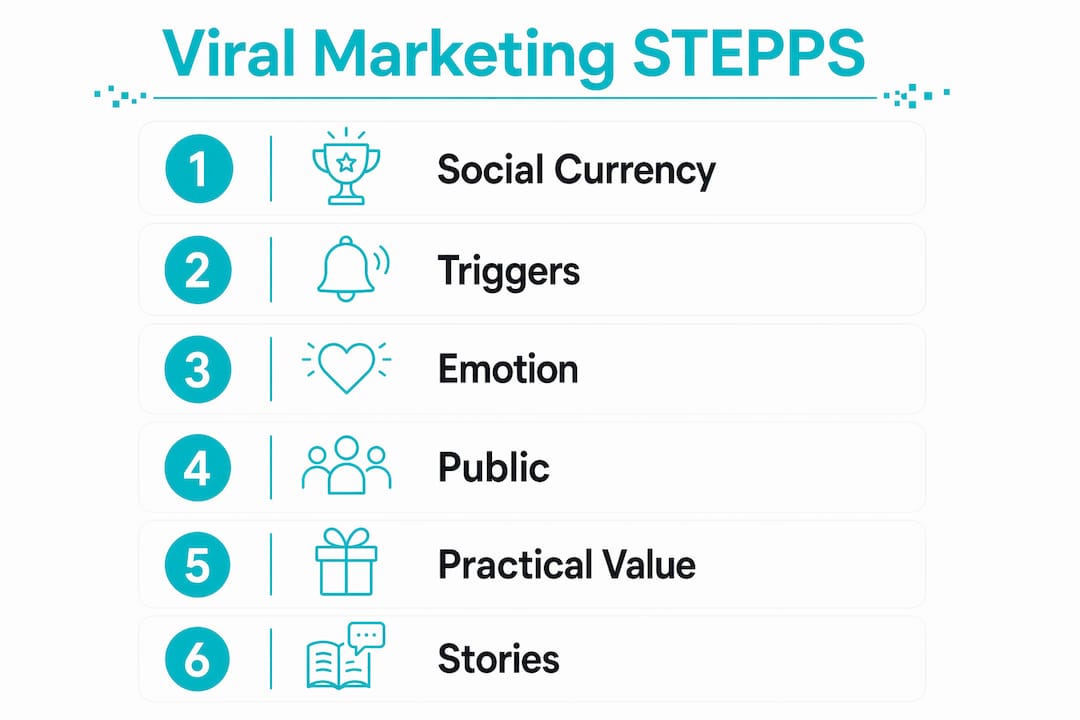
Jonah Berger's STEPPS framework identifies six share triggers that determine whether content spreads or stalls. Activating multiple drivers in a single campaign dramatically increases viral potential. The framework is not a checklist but a diagnostic tool. Use it to audit your content before launch.
- Social Currency: People share things that make them look good. Exclusive access, insider knowledge, or early adoption all signal status. Spotify Wrapped works because sharing your top artists signals personality and taste.
- Triggers: Content linked to everyday cues gets shared repeatedly. The "Got Milk?" campaign tied milk to peanut butter, a daily trigger. Every time someone opened a jar, the brand came to mind.
- Emotion: High-arousal emotions drive sharing. Awe, amusement, and anger all generate shares. Low-arousal emotions like sadness or contentment do not. Dove's "Real Beauty" campaign triggered awe and pride, which spread it globally.
- Public: Behaviors that are visible get imitated. The ALS Ice Bucket Challenge was designed to be performed publicly, making participation visible and creating social pressure to join.
- Practical Value: Useful content gets shared because sharing it helps others. How-to videos, checklists, and calculators all carry practical value. BuzzFeed's recipe videos spread because viewers wanted to share a useful idea with someone specific.
- Stories: People think in narratives, not data points. Wrapping a message inside a story makes it memorable and repeatable. Warby Parker's "Home Try-On" story spread because it was a genuinely interesting narrative about disrupting an industry.
"Effective virality activates multiple STEPPS drivers and includes a conversion path. Virality without a next step is just noise." — Brandwatch
The most successful viral campaigns hit at least three STEPPS drivers simultaneously. Dove's campaign hit Emotion, Public, and Social Currency at once. That overlap is what separates a campaign that trends for a day from one that generates lasting brand equity.
How do you measure viral marketing success?
The viral coefficient, known as the K-factor, is the key metric for quantifying virality. The formula is straightforward: K = (average invitations sent per user) multiplied by (the conversion rate of those invitations). A K-factor above 1 means each user generates more than one new user, producing self-sustaining exponential growth. A K-factor below 1 means the campaign is decaying and needs intervention.
Most campaigns never reach K greater than 1 organically. That is not a failure. A K-factor of 0.5 combined with a strong paid seed budget can still produce significant growth. The K-factor tells you how efficient your organic loop is, not whether the campaign is worth running.
| Metric | What it measures | Why it matters |
|---|---|---|
| Viral coefficient (K-factor) | Invitations per user × conversion rate | Determines if growth is self-sustaining |
| Earned Media Value (EMV) | Cost-equivalent of unpaid visibility | Translates shares into comparable ad spend |
| Referral conversion rate | % of referred users who take action | Connects sharing to business outcomes |
| Share velocity | Rate of shares over time | Identifies peak and decay phases |
Earned Media Value estimates unpaid visibility by calculating what equivalent reach would cost in paid media, using reach, CPM, and engagement rate as inputs. EMV is a proxy metric, not a revenue figure. Connect it to brand lift surveys or conversion data to avoid treating it as a vanity number.
Tracking both share rate and conversion rate is the only way to accurately diagnose campaign performance. Share counts alone tell you nothing about whether the campaign is driving business results. A campaign with 500,000 shares and zero referral conversions is a branding exercise, not a growth engine.
Pro Tip: Set up a dedicated referral tracking URL for every seeded piece of content. Without it, you cannot separate organic viral traffic from direct or paid traffic, and your K-factor calculation will be meaningless.
How to implement viral marketing campaigns that drive real results
Building a viral campaign requires four distinct phases: seed, spike, plateau, and tail. Each phase demands different tactics. Most brands only plan for the spike and ignore the other three, which is why most campaigns burn out without converting.
The seed phase is where the campaign lives or dies. Seed node selection determines how far content spreads before it ever reaches the general public. Choosing the wrong seed audience produces a short burst with no sustained growth. The right seed audience has three qualities: high network density, strong relevance to the content, and a history of sharing similar material.
- Identify micro-influencers in your niche with engaged, not just large, audiences. A fitness brand seeding with 20 micro-influencers who each have 15,000 highly engaged followers outperforms one macro-influencer with 500,000 passive followers.
- Use platform-native formats. Short-form video on TikTok and Instagram Reels spreads faster than repurposed YouTube content. Each platform has a native sharing behavior. Match your format to the platform's mechanics.
- Build a conversion path before you seed. Every viral campaign needs a clear next step: a landing page, a sign-up form, a product page. Seeding without a conversion path wastes the traffic spike.
- Time your seed release. Launch on a Tuesday or Wednesday morning when platform engagement is highest. Avoid Friday afternoons and weekends for B2B audiences.
- Plan for the tail phase. After the spike decays, repurpose the content into evergreen formats: blog posts, email sequences, or case studies. The tail phase often generates more qualified leads than the spike.
The plateau phase is where most brands panic and start boosting posts with paid spend. Resist that instinct. Paid amplification during the plateau signals to the algorithm that the content needs help, which can suppress organic reach. Instead, release a follow-up piece that extends the story and reactivates the original sharers.
Real-world viral campaign examples consistently show that the seed strategy matters as much as the creative. Dropbox's referral program, which gave both referrer and referee extra storage, hit a K-factor above 1 by making the sharing incentive directly tied to the product's core value. The content was not remarkable. The mechanism was.
Key Takeaways
Viral marketing succeeds when content activates multiple STEPPS drivers, targets the right seed audience, and connects every share to a measurable conversion path.
| Point | Details |
|---|---|
| Define virality precisely | Viral content spreads through motivated sharing, not just high view counts or paid reach. |
| Use the STEPPS framework | Activating three or more STEPPS drivers in one campaign significantly increases share likelihood. |
| Track the K-factor | A viral coefficient above 1 signals self-sustaining growth; below 1 requires seeding or paid support. |
| Seed before you spike | Choosing the right seed audience determines reach and longevity more than creative quality alone. |
| Connect shares to conversions | EMV and referral conversion rates together show whether virality is generating business value. |
Why virality without a strategy is just expensive noise
Viral marketing is the most powerful amplifier in a marketer's toolkit. It is also the most misunderstood. After working on campaigns across industries, the pattern I see most often is brands chasing the spike and ignoring everything before and after it. They invest heavily in creative, seed it carelessly, watch the views climb, and then wonder why revenue did not move.
The uncomfortable truth is that virality amplifies whatever you already have. If your product has a weak value proposition, a viral campaign will expose that weakness to a much larger audience, faster. I have seen brands go viral on a campaign that generated thousands of sign-ups and zero paying customers, because the conversion path was an afterthought.
The brands that win with viral marketing treat it as a full-funnel strategy, not a top-of-funnel stunt. They design the referral loop before they write the first line of copy. They know their K-factor target before they pick a platform. They measure EMV and then immediately ask what percentage of that earned reach converted into something tangible.
Seeding strategy is where I see the biggest gap between brands that go viral once and brands that build repeatable viral growth. Poor micro-influencer targeting produces a short-lived burst with no compounding effect. The right cohort, seeded at the right moment, creates a wave that keeps generating referrals weeks after the spike. That is the difference between a campaign and a growth engine.
— Matthew
How Viralmarketingstudio can build your next viral campaign
Viral campaigns that convert do not happen by accident. They require precise audience mapping, referral loop design, and performance tracking built in from day one.

Viralmarketingstudio specializes in exactly that. From campaign architecture and content creation to seeding strategy and conversion analytics, the team at Viralmarketingstudio builds campaigns designed to hit measurable business outcomes, not just view counts. Whether you need a full viral campaign built from scratch or a diagnostic audit of a campaign that underperformed, Viralmarketingstudio has the tools and experience to close the gap between reach and revenue. See the full range of campaign services and find the right fit for your growth goals.
FAQ
What is viral marketing in simple terms?
Viral marketing is a strategy where content spreads rapidly through social sharing, using network effects instead of paid distribution. The goal is to turn your audience into a voluntary distribution channel for your brand's message.
What is the viral coefficient and why does it matter?
The viral coefficient (K-factor) measures how many new users each existing user generates through sharing. A K-factor above 1 means the campaign grows on its own without additional paid input.
How does Jonah Berger's STEPPS framework help marketers?
STEPPS identifies six share triggers: Social Currency, Triggers, Emotion, Public, Practical Value, and Stories. Campaigns that activate three or more of these drivers are significantly more likely to achieve sustained viral spread.
What is Earned Media Value in viral marketing?
Earned Media Value estimates what unpaid shares and mentions would cost if purchased as paid media. It is a proxy metric and should always be paired with conversion data to avoid measuring vanity outcomes.
What is the biggest mistake brands make with viral campaigns?
The most common mistake is optimizing for share counts without tracking referral mechanics and conversion rates. High shares with no conversion path produce reach, not revenue.