
A marketing funnel is a structured framework that guides potential customers from first awareness to final purchase by delivering the right message at each stage of their buying journey. Without one, businesses spend money on broad campaigns that reach the wrong people at the wrong time. Understanding why businesses need marketing funnels is the difference between guessing at growth and building a system that compounds results. Platforms like Shopify and Coursera both confirm that funnels match messaging to customer stages, reducing drop-off and increasing the likelihood of conversion at every step.
Why businesses need marketing funnels to convert leads
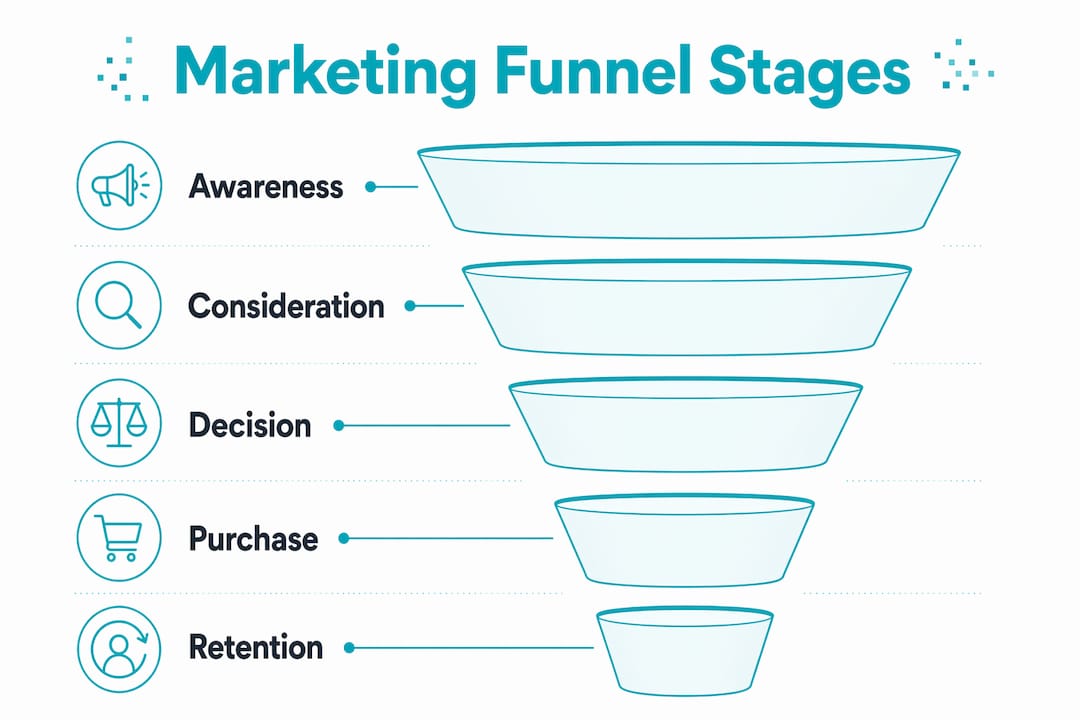
A marketing funnel, also called a purchase funnel or conversion funnel in industry practice, solves one of the most expensive problems in business: talking to the right person the wrong way. Most businesses lose prospects not because their product is weak, but because their messaging ignores where the buyer actually is in their decision process. The funnel divides that process into three core stages: awareness (top of funnel), consideration (middle of funnel), and decision (bottom of funnel). Each stage requires a completely different approach.
At the top of the funnel, buyers do not know your brand well. They respond to educational content, brand storytelling, and social proof. At the middle stage, they are comparing options and need technical details, case studies, and clear differentiators. At the bottom, they are ready to buy and respond to offers, guarantees, and direct calls to action. Sending a discount code to someone who has never heard of you wastes budget. Sending a brand awareness video to someone ready to purchase loses the sale.
The importance of marketing funnels shows up clearly in content and channel planning. Coursera identifies funnel marketing as a system that enables near-real-time optimization, unlike traditional long reporting cycles that delay decisions by weeks. That speed matters when ad costs shift daily and consumer attention is fragmented across platforms.
- Top of funnel: Blog posts, social media content, YouTube videos, and podcast appearances build awareness.
- Middle of funnel: Email sequences, webinars, comparison pages, and detailed product demos drive consideration.
- Bottom of funnel: Free trials, limited-time offers, testimonials, and direct sales calls close decisions.
Pro Tip: Never run a single ad campaign that tries to speak to all three stages at once. Segment your audience by funnel stage and write separate copy for each. The drop-off reduction alone will justify the extra effort.
How do you identify where your funnel is leaking?
The funnel's most underrated benefit is diagnostic power. Funnel diagnostics reveal exactly which stage is losing prospects, so you stop throwing budget at the wrong problem. Most business owners assume low sales mean they need more traffic. Often, the real issue is a broken middle or bottom stage that wastes the traffic they already have.

SMAQ describes this as funnel math: if 1,000 people visit your site, 50 opt in, and 2 buy, your traffic is not the problem. Your conversion from opt-in to purchase is. Fixing that stage costs far less than doubling your ad spend to compensate.
The Knowledge Academy frames lead qualification through funnels as the mechanism that turns cold prospects into loyal customers. Filtering by stage means your sales team spends time only on buyers who have already shown intent. That shift alone improves close rates without adding headcount.
- Audit traffic volume. Check whether enough people are entering the funnel. Low traffic is a top-of-funnel problem requiring content or paid reach.
- Check opt-in or lead capture rates. If traffic is healthy but leads are low, your landing page, offer, or messaging is misaligned with visitor intent.
- Measure lead-to-sale conversion. If leads exist but sales do not follow, the problem is in your nurture sequence, sales process, or offer structure.
- Calculate stage-by-stage drop-off. Map the percentage of prospects who move from each stage to the next. The biggest drop reveals your highest-priority fix.
- Test one variable at a time. Change one element per stage per test cycle. Changing multiple variables simultaneously makes it impossible to know what worked.
Pro Tip: Marketing problems often masquerade as traffic issues but are actually conversion bottlenecks. Before buying more ads, run a full funnel audit. You may find a simple page edit or email rewrite doubles your revenue without spending an extra dollar.
What funnel analytics actually tell you about your budget
Funnel analytics turn subjective marketing decisions into measurable ones. Tracking conversion rates at each stage shows you exactly where a dollar of investment produces the most return. Without this data, budget allocation becomes guesswork driven by preference rather than performance.
Rob T. Case's full-funnel conversion calculator demonstrates a concept called revenue leverage ranking. The idea is that improving a mid-funnel stage by a small percentage can generate more revenue than fixing the lowest-converting stage entirely. This is because mid-funnel improvements compound across all downstream stages. A 10% lift in email open rates affects every sale that follows.
One critical flaw in standard funnel reporting is last-click attribution. Last-click attribution undervalues the awareness channels that create demand upstream. A buyer who clicks a Google ad and purchases may have first discovered the brand through a podcast or Instagram post. Crediting only the final click misrepresents which channels actually drive growth and leads to cutting the campaigns that built the pipeline.
| Funnel metric | What it measures | Marketing implication |
|---|---|---|
| Traffic volume | Top-of-funnel reach | Low traffic signals a content or paid reach gap |
| Lead capture rate | Top-to-mid conversion | Poor rate means landing page or offer needs revision |
| Email open and click rate | Mid-funnel engagement | Low engagement signals messaging or segmentation issues |
| Lead-to-sale conversion | Mid-to-bottom conversion | Low rate points to nurture sequence or offer structure problems |
| Customer acquisition cost | Overall funnel efficiency | Rising cost signals a bottleneck somewhere in the funnel |
How do modern consumer habits change funnel strategy?
The traditional funnel assumed a linear path: awareness, then consideration, then purchase. That model no longer reflects how buyers actually behave. eMarketer reports that 66.6% of US consumers use social media for search. That figure means buyers can jump from discovery directly to purchase without ever passing through a traditional consideration stage.
AI-assisted discovery compounds this shift. Buyers now ask ChatGPT or Perplexity for product recommendations and receive curated answers that skip brand websites entirely. A business that only optimizes for Google search misses a growing share of discovery happening on TikTok, Instagram, and AI platforms. Heyflow confirms that customer journeys are non-linear and multi-touch, but funnels remain the best framework for coordinating messaging across those fragmented paths.
Treating your funnel as a flexible framework rather than a rigid sequence is the practical response to this reality. The stages still exist as buyer psychology, even when the path is not linear. A buyer who discovers your brand on TikTok and purchases the same day still moved through awareness and decision. The funnel describes their mental state, not their click path.
- Build presence on social platforms where your buyers search, not just where they scroll.
- Create bottom-of-funnel content (reviews, comparisons, pricing pages) that ranks for AI-generated answers.
- Use multi-touch attribution tools to credit every channel that contributed to a sale, not just the last one.
- Revisit your funnel structure quarterly as platform algorithms and consumer habits shift.
Key Takeaways
A marketing funnel is the single most effective system for converting prospects into customers because it aligns messaging, budget, and measurement with actual buyer behavior at every stage.
| Point | Details |
|---|---|
| Stage-specific messaging | Tailor content to awareness, consideration, and decision stages to reduce drop-off. |
| Bottleneck diagnostics | Audit each funnel stage before buying more traffic to find the real conversion problem. |
| Revenue leverage | Improving mid-funnel stages compounds gains across all downstream conversions. |
| Non-linear journeys | Treat the funnel as a buyer psychology framework, not a rigid click path. |
| Multi-touch attribution | Credit all channels that contribute to a sale, not just the final click. |
The funnel mistake I see business owners make most
Most business owners build a funnel once and treat it as finished. They set up a landing page, write an email sequence, and run ads. When results plateau, they assume the funnel is broken and rebuild from scratch. The real problem is almost always one underperforming stage that a single focused test could fix.
I have seen businesses double their revenue by changing one email subject line in a mid-funnel sequence. Not the product. Not the ad. One subject line. That kind of result is only visible when you track each stage separately and know which metric to watch. Without funnel analytics, you would never find it.
The other mistake is complexity for its own sake. A five-step funnel with clear messaging and consistent follow-up outperforms a twelve-step funnel with inconsistent copy every time. Start with the simplest version that covers awareness, consideration, and decision. Add complexity only when data shows a specific gap. If you want a practical starting point, the lead generation checklist from Viralmarketingstudio walks through the foundational steps without overcomplicating the process.
The businesses that win with funnels are not the ones with the most sophisticated tech stack. They are the ones that test consistently, read their data honestly, and fix one thing at a time.
— Matthew
How Viralmarketingstudio builds funnels that actually convert
Building a funnel that performs requires more than a template. It requires web design that loads fast and guides visitors toward a clear action, branding that builds trust before a buyer ever reads your copy, and business software that tracks every stage without manual reporting.
Viralmarketingstudio specializes in exactly this combination. The team builds conversion-focused web design and custom business software that integrates with your funnel at every stage. Whether you need a landing page that captures leads or an automated follow-up system that nurtures them to purchase, Viralmarketingstudio builds the infrastructure behind the conversion. Reach out to see which services fit your current funnel gaps.
FAQ
What are marketing funnels in simple terms?
A marketing funnel is a framework that maps the stages a prospect moves through before buying, from first awareness to final decision. Businesses use it to deliver the right message at each stage and reduce drop-off.
Why do businesses need marketing funnels?
Businesses need marketing funnels because they align messaging with buyer intent, reveal where prospects drop off, and make budget allocation measurable. Without a funnel, marketing spend is untargeted and results are unpredictable.
How do marketing funnels improve conversion rates?
Funnels improve conversion rates by filtering prospects through stages and delivering stage-specific content that matches their readiness to buy. Fixing a single bottleneck stage can produce significant revenue gains without increasing ad spend.
How has social media changed the marketing funnel?
eMarketer reports that 66.6% of US consumers use social media for search, which compresses traditional funnel stages and allows buyers to move from discovery to purchase in a single session. Businesses must build presence on social platforms and optimize for AI-assisted discovery.
What is the biggest mistake in funnel marketing?
The biggest mistake is treating the funnel as a one-time build rather than an ongoing system. Consistent stage-by-stage testing and data-driven adjustments produce far better results than rebuilding from scratch when performance drops.