
A marketing strategy is a long-term plan that connects your value proposition, target audience, and business goals into one coherent direction. It answers the fundamental questions every business owner must resolve before spending a dollar on advertising: who you serve, why they should choose you, and how you will measure success. Without a clear answer to "what is a marketing strategy," most entrepreneurs end up running disconnected campaigns that burn budget without building momentum. Sources like HubSpot, Salesforce, and The Hackett Group all define it the same way: strategy first, execution second.
What is a marketing strategy and what does it include?
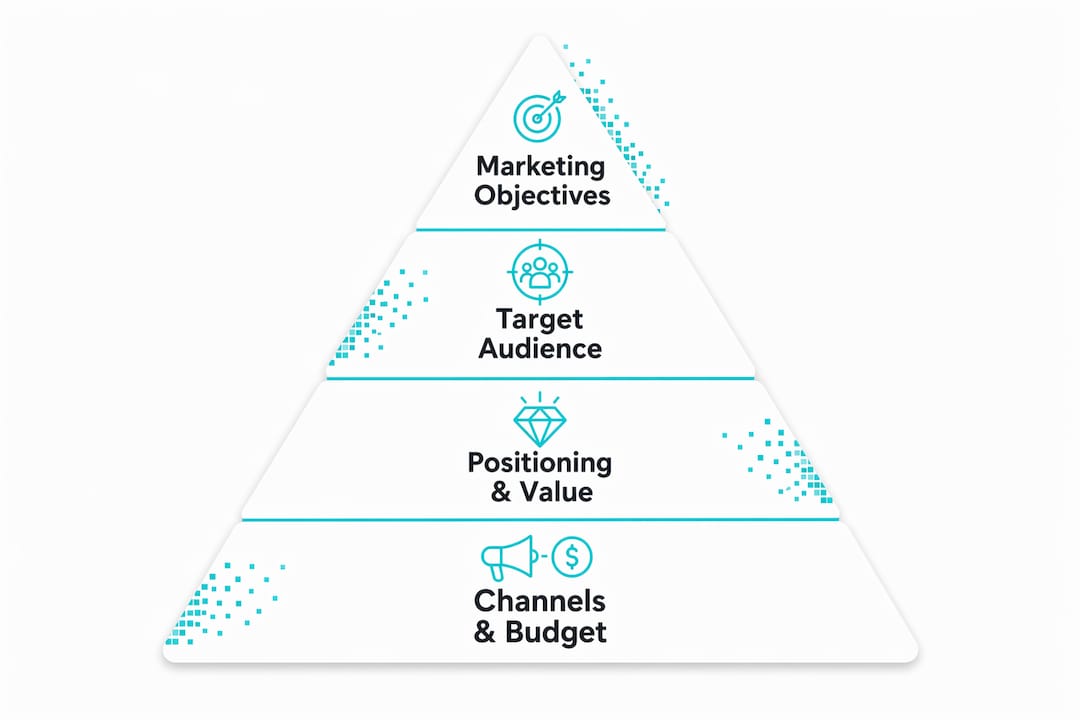
A marketing strategy is the document that defines your market position and guides every campaign, channel, and budget decision your business makes. HubSpot and Salesforce both emphasize structuring a strategy around five core elements: marketing objectives, target audience personas, positioning and value proposition, channel selection, and KPIs. Each element depends on the others. A strong value proposition is useless if it reaches the wrong audience. Precise channel selection means nothing without measurable goals attached.
Think of the strategy as a compass. Coursera describes it as a long-term vision for your value proposition and target market, not a list of step-by-step actions. That distinction matters enormously for entrepreneurs who tend to jump straight into execution. The strategy tells you where you are going. The plan and tactics tell you how to get there.

The five core components
| Component | What it defines |
|---|---|
| Marketing objectives | Specific, measurable goals tied to business growth |
| Target audience personas | Detailed profiles of your ideal customers based on research |
| Positioning and value proposition | Why your offer is different and better for your audience |
| Channel selection | Where you will reach your audience and why |
| KPIs | The metrics that tell you whether the strategy is working |
Pro Tip: Keep your strategy document to one or two pages. Coursera advises brevity to maintain clarity and avoid blending strategy with execution details. A shorter document forces sharper thinking.
How does marketing strategy differ from plans and tactics?
The confusion between strategy, plan, and tactics costs entrepreneurs real money. Salesforce defines the hierarchy clearly: strategy is the "why" and "what," the plan is the "how" and "when," and tactics are the specific campaign actions that execute the plan.
Here is what that looks like in practice. A software startup's strategy might be to capture small business owners in the accounting space by positioning around ease of use. The marketing plan translates that into a 12-month content and paid search program. The tactics are the individual blog posts, Google Ads campaigns, and email sequences that run each week. All three layers must align. When they do not, you get campaigns that generate clicks but no customers.
The most common mistake entrepreneurs make is building a plan without a strategy underneath it. They know what they want to do (run Instagram ads, launch a podcast) but cannot explain why those channels connect to their business goals or their audience's behavior. That is a tactics list, not a strategy.
- Strategy: Why we compete in this market and who we serve
- Plan: The 12-month roadmap of programs and budgets
- Tactics: The specific ads, posts, emails, and events that execute the plan
- Relationship: Every tactic should trace back to a strategic choice
Pro Tip: Before approving any new campaign, ask one question: which strategic objective does this serve? If no one can answer it in one sentence, the campaign is a tactic looking for a strategy. For more on startup growth tactics that connect to clear goals, that resource breaks down 20 approaches without requiring a large budget.
What frameworks help you build a marketing strategy?
Two frameworks do most of the heavy lifting for entrepreneurs building their first strategy: STP and the 4 Ps. Salesforce recommends both as tools for making strategic choices concrete and organized rather than abstract.
STP stands for Segmentation, Targeting, and Positioning. Segmentation divides the total market into groups with shared needs. Targeting picks the segment your business can serve best. Positioning defines how you want that segment to perceive your brand relative to competitors. A meal kit company using STP might segment by cooking skill level, target time-pressed professionals, and position around 15-minute recipes with premium ingredients.
The 4 Ps (Product, Price, Place, Promotion) translate positioning into market decisions. Product defines what you sell and how it solves the problem. Price signals value and determines margin. Place covers distribution and where customers buy. Promotion covers how you communicate the offer. Together, STP and the 4 Ps give you a complete picture from market choice to customer communication.
| Framework | Core questions | Strategic output |
|---|---|---|
| Segmentation (STP) | Who are the distinct groups in this market? | Defined market segments with shared needs |
| Targeting (STP) | Which segment fits our strengths best? | Chosen primary and secondary audiences |
| Positioning (STP) | How do we want to be perceived vs. competitors? | Clear differentiation statement |
| Product (4 Ps) | What exactly are we selling and why does it matter? | Product definition tied to audience need |
| Price (4 Ps) | What price signals the right value to our audience? | Pricing strategy aligned with positioning |
| Promotion (4 Ps) | Which channels and messages reach our audience? | Channel and messaging plan |
Entrepreneurs who skip these frameworks often end up with positioning that sounds good internally but means nothing to customers. Running through STP before writing a single ad forces you to make real choices about who you are and who you are not trying to reach. That clarity is what separates a marketing strategy for SMB growth from a collection of good intentions.
How do you measure whether your marketing strategy is working?
Measurement is where most marketing strategies break down. BCG reports that marketing measurement can produce contradictory results without aligned KPIs. The fix is separating strategic KPIs from tactical KPIs before you launch anything.
Strategic KPIs track progress toward your long-term business goals. Customer acquisition cost (CAC), brand awareness, and marketing qualified leads (MQLs) are strategic. They tell you whether the strategy is working over months and quarters. Tactical KPIs track execution quality: click-through rates, email open rates, and cost per click. They tell you whether a specific campaign is performing. Confusing the two leads to what BCG calls knee-jerk reactions to short-term dips that derail long-term growth.
BCG also identifies a concept called the "north star" KPI. This is the single metric that all teams agree represents shared success. For a SaaS company, it might be monthly recurring revenue from new customers. For a retail brand, it might be repeat purchase rate. Choosing a north star KPI creates a shared language across sales, marketing, and product teams. That alignment is rare and valuable.
Measurement best practices for entrepreneurs:
- Define strategic KPIs before the strategy launches, not after
- Set a north star KPI that connects marketing to revenue
- Review strategic KPIs quarterly, not weekly
- Use tactical KPIs to improve execution, not to judge strategy
- Balance short-term and long-term metrics to reflect sustainable growth
Pro Tip: Advanced marketers use a combination of marketing mix modeling (MMM), incrementality testing, and multi-touch attribution (MTA) for measurement. For most entrepreneurs, start with one clear north star KPI and two or three supporting metrics. Complexity before clarity creates confusion, not insight.
Key Takeaways
A marketing strategy is the foundation that makes every campaign, channel, and budget decision coherent and measurable rather than reactive and disconnected.
| Point | Details |
|---|---|
| Strategy before execution | Define your audience, positioning, and goals before choosing channels or running campaigns. |
| Five core components | Every effective strategy includes objectives, personas, positioning, channels, and KPIs. |
| Strategy vs. tactics | Strategy answers why and what; tactics answer how and when. Never confuse the two. |
| Use STP and 4 Ps | These frameworks turn abstract positioning into concrete market and channel decisions. |
| North star KPI | Pick one shared metric that connects marketing activity to business revenue. |
Why most entrepreneurs get strategy backwards
The most common pattern I see with entrepreneurs is building the plan before the strategy. They know they need a website, social media, and email. They hire someone to run ads. Six months later, they have data but no direction. The campaigns are not bad. The strategy is just missing.
A concise strategy document of one to two pages forces you to make hard choices. Who are you not targeting? Which channels are you not using? What does your brand stand for that a competitor cannot easily copy? Those are the questions that separate businesses that grow from businesses that stay busy.
The other trap I see constantly is treating KPIs as a report card rather than a compass. Entrepreneurs check weekly numbers and panic when a metric dips. Strategic KPIs are quarterly signals, not weekly grades. If your north star KPI is trending in the right direction over six months, a bad week on click-through rates is noise, not a crisis. The discipline to hold that perspective is what makes a strategy actually function as decision infrastructure.
My honest advice: write your strategy in plain language, keep it short, and revisit it every quarter. Adapt the tactics freely. Change the strategy only when the market or your business fundamentals shift. That rhythm builds the kind of clarity that makes every marketing decision faster and more confident.
— Matthew
How Viralmarketingstudio helps entrepreneurs build real strategies
Building a marketing strategy from scratch takes time, and most entrepreneurs are already running a business while trying to figure it out. Viralmarketingstudio works with business owners to clarify positioning, define target audiences, and build the tactical infrastructure that executes the strategy.

From web design and development to business software and automation, Viralmarketingstudio builds the systems that make a marketing strategy executable, not just theoretical. Whether you need a website that converts, an app that serves your customers, or software that runs your operations, the team at Viralmarketingstudio connects every deliverable back to your strategic goals. Reach out to discuss a custom strategy built around your business.
FAQ
What is the simplest marketing strategy definition?
A marketing strategy is a long-term plan that defines who you serve, how you differentiate, and how you measure success. It connects business goals to audience targeting and channel decisions.
What are the key elements of a marketing strategy?
The five core elements are marketing objectives, target audience personas, positioning and value proposition, channel selection, and KPIs. HubSpot and Salesforce both identify these as the foundation of an effective strategy.
How is a marketing strategy different from a marketing plan?
A marketing strategy defines the "why" and "what" of your market approach. A marketing plan details the "how" and "when," translating strategy into a calendar of programs and budgets.
How do you choose the right KPIs for a marketing strategy?
Separate strategic KPIs like CAC and MQLs from tactical KPIs like click-through rates. BCG recommends selecting one north star KPI that all teams share as a measure of collective success.
How long should a marketing strategy document be?
Coursera advises keeping a strategy document to one or two pages. A shorter document maintains strategic clarity and prevents it from becoming an execution plan in disguise.