
Inbound marketing is defined as a methodology that attracts customers by delivering valuable, relevant content aligned with their natural buying journey rather than interrupting them with unsolicited messages. Unlike traditional outbound tactics, inbound earns attention through four sequential stages: Attract, Convert, Close, and Delight. Each stage moves a prospect from stranger to loyal promoter. This approach sits at the core of what is digital marketing today, and it works because it meets buyers where they already are, searching for answers, comparing options, and forming preferences before they ever speak to a salesperson.
What is inbound marketing and how does it work?
Inbound marketing is a customer-centric growth system built on the idea that buyers research independently before engaging any sales team. Brands that provide genuinely useful content during that research phase win deals that outbound tactics never reach. The methodology does not rely on rented attention from ad platforms. It builds owned assets, such as blog posts, guides, and videos, that compound in value over time.
The practical mechanics of inbound marketing start with understanding your buyer's questions at each stage of their decision process. A business owner selling accounting software, for example, creates content answering "how to reduce payroll errors" rather than just promoting features. That content attracts the right audience through organic search. Once a visitor lands on the page, a well-placed call-to-action converts them into a known lead.

Pro Tip: Map every piece of content you create to a specific buyer question. If you cannot name the exact question a piece answers, it will not attract the right traffic.
What are the four core stages of inbound marketing?
The Attract, Convert, Close, Delight framework gives every inbound strategy a clear structure. Each stage has distinct tactics and goals.
-
Attract. This stage draws the right visitors to your website using SEO, blog content, and social media. The goal is not maximum traffic. It is qualified traffic from people who match your ideal customer profile. A well-written article targeting a specific search query does this work continuously after publication.
-
Convert. Once visitors arrive, you capture their contact information through gated content, landing pages, and calls-to-action. High-value gated content such as checklists, templates, or in-depth guides consistently outperforms generic "contact us" buttons in both conversion rate and lead quality. A free audit tool or a downloadable buyer's guide gives visitors a concrete reason to share their email.
-
Close. Raw leads rarely buy immediately. The Close stage uses marketing automation and CRM integration to nurture leads with timely, personalized content until they are ready to purchase. Automated email sequences triggered by specific behaviors, such as downloading a guide or revisiting a pricing page, keep your brand relevant without requiring manual follow-up for every prospect.
-
Delight. Closing a sale is not the finish line. The Delight stage turns customers into active promoters through ongoing support, feedback loops, and exclusive content. A customer who feels genuinely served refers others and leaves reviews. That word-of-mouth feeds the Attract stage organically, creating a self-reinforcing growth loop.
Pro Tip: Treat the Delight stage as a lead generation channel. A single satisfied customer who refers two peers costs you nothing and arrives pre-sold on your credibility.
How does inbound marketing differ from outbound marketing?
Outbound marketing interrupts. Inbound marketing earns. That single distinction explains why the two approaches produce such different results over time.
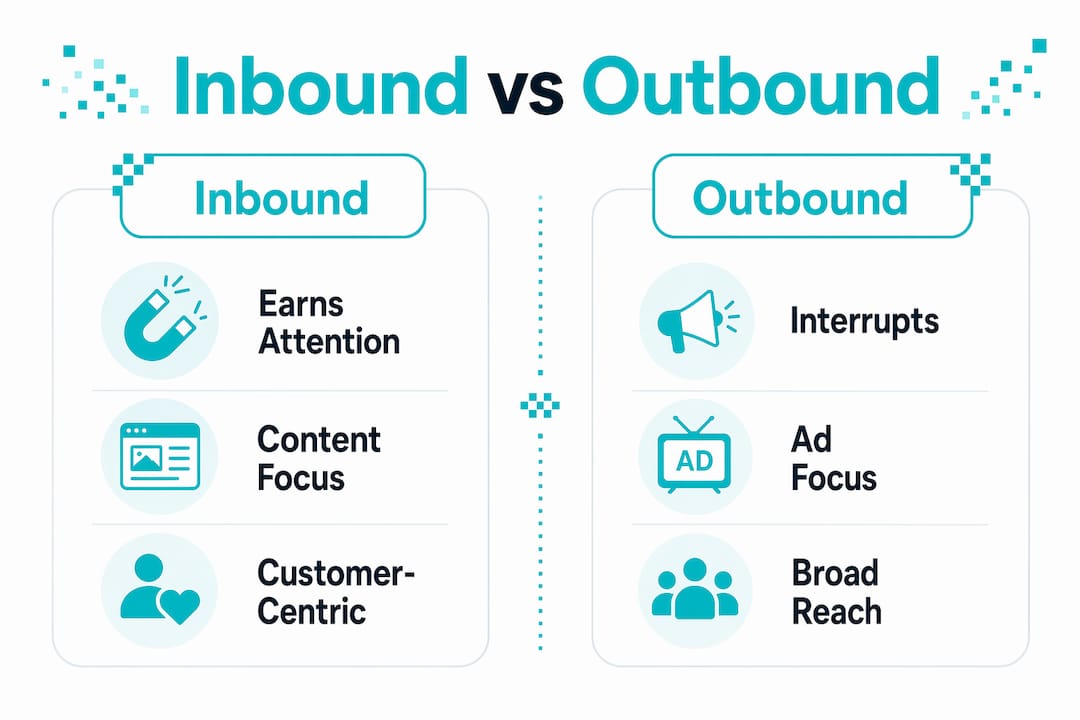
Outbound tactics include cold calls, unsolicited email blasts, display ads, and TV commercials. They reach a broad audience, most of whom have no current interest in the product. The moment spending stops, so does the traffic. Inbound techniques continue working after the initial investment ends. A blog post published today can generate qualified leads two years from now without additional spend.
The contrast becomes clearest when you look at what each approach builds:
- Outbound creates temporary exposure. It rents attention from platforms and media channels.
- Inbound creates permanent assets. Each piece of content is a long-term lead generation tool.
- Outbound targets demographics. It reaches people based on age, location, or income bracket.
- Inbound targets intent. It reaches people actively searching for a solution to a specific problem.
- Outbound measures reach and impressions. Scale is the primary metric.
- Inbound measures lead quality and conversion. Relevance is the primary metric.
Neither approach is universally wrong. Outbound works well for brand awareness campaigns with large budgets. Inbound works better for sustained, compounding lead generation. Most mature marketing programs use both, with inbound forming the foundation and paid media amplifying what already performs organically.
What strategic nuances maximize inbound marketing effectiveness?
Most businesses start inbound marketing by targeting broad, high-volume keywords. That is the wrong starting point. Intent-based keywords that reflect solution-seeking behavior generate higher-quality leads than informational keywords with massive search volumes. A keyword like "best CRM for small law firms" signals a buyer close to a decision. A keyword like "what is a CRM" signals someone at the very beginning of their research.
Prioritizing intent-based content is the single biggest lever most businesses underuse. The content you create for someone comparing options converts at a far higher rate than content written for someone who just discovered the problem exists. Both types of content have a place in an inbound marketing strategy, but the intent-aligned content should get the most attention and promotion.
Marketing automation prevents the most common failure point in inbound: losing warm leads who are not yet ready to buy. A prospect who downloads your guide and then hears nothing from you for three weeks will forget you exist. Automated nurture sequences, triggered immediately after conversion, keep the relationship active. CRM integration with automated workflows also enables real-time lead scoring, so your sales team focuses on the prospects most likely to close.
Paid media has a specific and limited role in an inbound program. Paid efforts work best when they amplify content that already performs well organically. Running ads to a blog post that already ranks on page one accelerates results without wasting budget on unproven content. This approach avoids the common mistake of using paid media as a substitute for inbound rather than a complement to it.
A critical misconception about inbound marketing is that it produces fast results. Lead growth becomes measurable only after consistent months of effort. Businesses that abandon their inbound program after 60 days because traffic has not spiked are measuring the wrong thing at the wrong time. The compounding nature of inbound means results accelerate significantly in months 6 through 12 and beyond.
How can business owners implement inbound marketing in practice?
A practical inbound program follows a clear sequence. Skipping steps produces weak results.
-
Set stage-specific goals. Define what success looks like at each stage of the funnel. Attract goals measure organic traffic and keyword rankings. Convert goals measure lead volume and form completion rates. Close goals measure sales-qualified leads and deal velocity. Delight goals measure retention, referrals, and customer satisfaction scores.
-
Build detailed buyer personas. A buyer persona is a research-based profile of your ideal customer, including their job role, primary challenges, preferred content formats, and decision criteria. Personas make content targeting precise. Without them, content tends to be generic and attracts the wrong audience. Learn more about content that targets buyer pain points to build personas that actually drive results.
-
Create high-value lead magnets. Generic calls-to-action underperform. Build gated assets that solve a specific problem your buyer persona faces right now. Examples include a free audit template, an industry benchmarking report, or a step-by-step implementation checklist. The more specific the asset, the higher the conversion rate and the better the lead quality.
-
Deploy automated nurture workflows. Once a lead converts, an automated sequence should begin within minutes. The sequence should deliver additional value related to the asset they downloaded, address common objections, and guide them toward a sales conversation at a natural pace. Use your lead generation checklist to make sure no step in this process gets skipped.
-
Track the metrics that matter. Vanity metrics like page views and social media followers tell you very little about inbound performance. Track lead quality scores, conversion rates at each funnel stage, cost per lead, and customer retention rates. Review these monthly and adjust content topics, formats, and distribution channels based on what the data shows.
-
Iterate based on buyer feedback. Talk to your customers regularly. Ask them what content helped them make their decision, what questions they had that went unanswered, and what would have made the buying process easier. That feedback directly informs your next content cycle and keeps your inbound program aligned with real buyer behavior rather than assumptions.
Key Takeaways
Inbound marketing works because it builds compounding, owned assets that attract, convert, and retain customers by meeting buyers at the exact moment they are searching for solutions.
| Point | Details |
|---|---|
| Four-stage framework | Attract, Convert, Close, and Delight form the complete buyer journey from stranger to promoter. |
| Intent-based content wins | Target keywords that reflect solution-seeking behavior, not just broad awareness topics. |
| Automation prevents lead loss | Automated nurture sequences keep warm leads engaged until they are ready to buy. |
| Inbound builds permanent assets | Unlike outbound, inbound content generates traffic and leads long after initial publication. |
| Patience is required | Measurable lead growth typically takes consistent months of effort before compounding kicks in. |
Why most inbound programs fail before they get good
The businesses I see struggle most with inbound marketing share one trait: they treat it like a campaign rather than a system. They publish a dozen blog posts, run a few social promotions, and then check the traffic numbers after six weeks. When the numbers are modest, they conclude that inbound "doesn't work for their industry" and pivot back to paid ads.
What they are actually experiencing is the normal early phase of any compounding system. The first three months of an inbound program are the hardest because the results are invisible. Content is indexing. Authority is building. Buyer trust is accumulating. None of that shows up in a weekly traffic report.
The marketers who get inbound right focus obsessively on buyer intent rather than content volume. They publish less and research more. They spend time in customer conversations, support tickets, and sales call recordings to find the exact language buyers use when they are close to a decision. Then they build content around that language. That approach produces leads that convert at a far higher rate than content written to satisfy a keyword tool.
Automation is the other piece most businesses underinvest in. A lead who downloads a guide and receives nothing for two weeks is a lost opportunity. The follow-up sequence is where inbound programs either pay off or fall apart. Getting that sequence right, with the right timing, the right content, and a clear path to a sales conversation, is what separates programs that generate revenue from programs that just generate traffic.
— Matthew
How Viralmarketingstudio can build your inbound foundation
Inbound marketing requires more than a content calendar. It needs a website built to convert, backend systems that capture and route leads correctly, and automation that works without manual intervention.
Viralmarketingstudio builds the technical infrastructure that makes inbound programs actually perform. From web design that converts visitors into leads to business software that connects your CRM, automation, and sales workflows, every service is built to support measurable growth. If your inbound strategy is sound but your digital infrastructure is holding it back, that is exactly the problem Viralmarketingstudio solves.
FAQ
What is inbound marketing in simple terms?
Inbound marketing is a method of attracting customers by creating content that answers their questions and solves their problems, rather than interrupting them with ads. It guides prospects through a buying journey from first discovery to loyal customer.
How long does inbound marketing take to produce results?
Inbound marketing typically requires consistent effort over several months before lead growth becomes clearly measurable. The results compound over time, meaning the program becomes significantly more effective in months 6 through 12 and beyond.
What are the best inbound marketing techniques for beginners?
The most effective starting techniques are SEO-optimized blog content targeting intent-based keywords, a high-value gated lead magnet, and an automated email nurture sequence triggered immediately after a lead converts.
How does inbound marketing differ from content marketing?
Content marketing is one of the primary tactics within inbound marketing. Inbound marketing is the broader methodology that includes content creation, SEO, lead capture, CRM integration, and customer retention across all four stages of the buyer journey.
Does inbound marketing work for small businesses?
Inbound marketing works particularly well for small businesses because it builds owned assets that generate leads without ongoing ad spend. The main investment is time and content quality rather than large media budgets.