
Social media marketing is defined as the strategic use of social media platforms to build brand awareness, engage customers, drive website traffic, and grow sales through content, community, and advertising. With over 5 billion active users spending an average of 143 minutes per day on social platforms, the opportunity for small businesses is enormous. Global social media advertising spending exceeded $275 billion by 2025 and is projected to surpass $480 billion by 2030. That scale tells you one thing clearly: businesses that ignore social media are leaving serious money on the table.
What is social media marketing and how does it work for small businesses?
Social media marketing combines organic content, paid advertising, community engagement, and social listening into one connected system. Each component serves a different purpose, and together they move a customer from first discovering your brand to making a purchase.
The core activities break down like this:
- Organic content creation: Publishing posts, videos, stories, and reels that educate, entertain, or inspire your audience without paying for placement.
- Paid advertising: Running targeted ad campaigns on platforms like Facebook, Instagram, LinkedIn, or TikTok to reach specific audiences based on demographics, interests, and behavior.
- Community engagement: Responding to comments, answering messages, and participating in conversations to build relationships with followers.
- Social listening: Monitoring mentions, hashtags, and conversations about your brand or industry to gather real-time consumer insight.
Platform selection matters more than most small business owners realize. Facebook reaches broad demographics. Instagram and TikTok dominate younger audiences. LinkedIn is the go-to for B2B outreach. Selecting a few key platforms where your customers are already active beats spreading yourself thin across every network.
The paid advertising side runs on an auction system. Platforms rank ads based on bid price, ad relevance, and estimated engagement. Ad relevance outweighs budget size in this ranking. A well-crafted ad with a lower bid can outperform a poorly targeted ad with a bigger budget. Average CPM costs range between $4 and $10 on most platforms, with LinkedIn commanding $25–$45 CPM due to its professional audience.

Pro Tip: Before you spend a dollar on ads, test your message organically. If a post gets strong engagement without paid promotion, that content is worth putting budget behind.
What are the key benefits of social media marketing?
The benefits of social media marketing are measurable and well-documented. 83% of marketers report increased brand exposure as the top benefit, followed by 71% citing increased website traffic, and 62% pointing to lead generation. These are not vanity metrics. They represent real business outcomes tied directly to revenue.
Trust is another major outcome. 81% of consumers believe social media increases brand trust and accountability. For a small business competing against larger brands, that trust factor is a genuine advantage. Consistent, authentic social media presence signals that your business is real, active, and responsive.
"Social teams are both the voice and ears of the brand, capturing nuanced consumer data that feeds into broader business decisions beyond marketing." — Sprout Social
Social media has also become a product discovery channel. 63% of Gen Z and 49% of millennials use social media to research products before buying. This means your social presence is now part of your sales funnel, not just your marketing plan.
| Benefit | What it means for your business |
|---|---|
| Brand exposure | More people recognize your name without paid outreach |
| Website traffic | Social posts and ads drive visitors directly to your site |
| Lead generation | Followers convert into contacts you can nurture toward a sale |
| Consumer trust | Active engagement signals credibility and accountability |
| Product discovery | Younger buyers find and vet your products through social platforms |
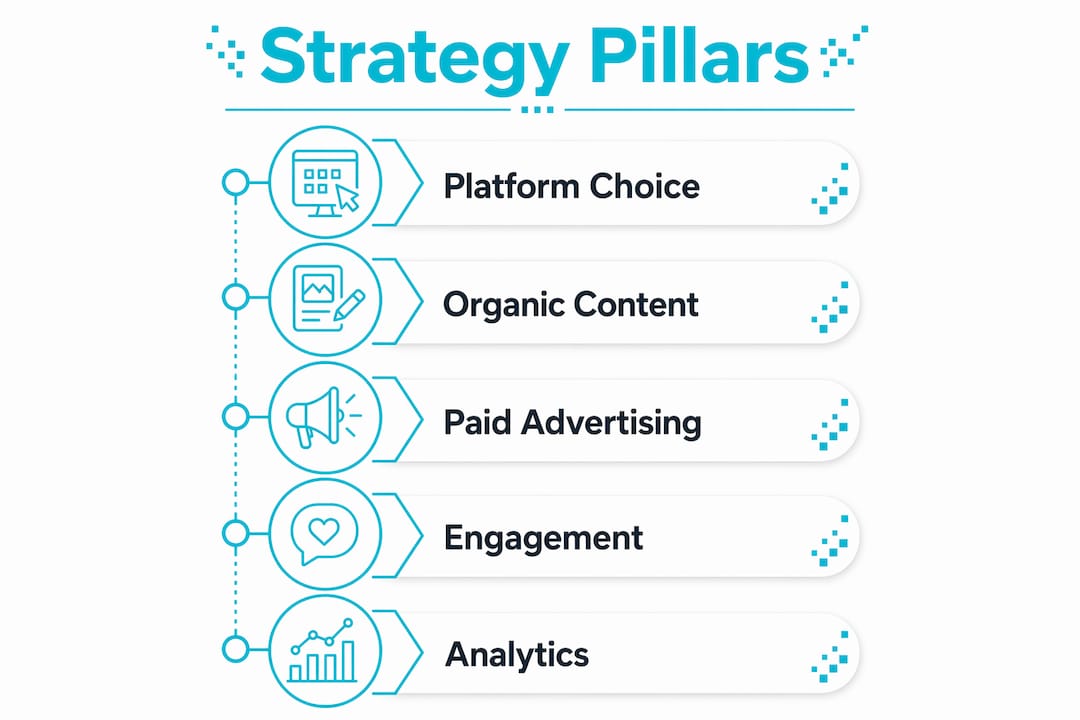
What are the essential pillars of an effective social media marketing strategy?
A social media marketing strategy without clear goals produces activity, not results. The foundation starts with SMART goals: Specific, Measurable, Achievable, Relevant, and Time-bound. "Get more followers" is not a goal. "Grow Instagram followers by 500 in 90 days through weekly Reels" is a goal.
The essential pillars of an effective strategy include:
- Audience research: Know which platforms your customers use, what content they engage with, and when they are most active.
- Content planning: Build a content calendar that mixes educational posts, promotional content, and community-driven conversations. A common ratio is 80% value-driven content to 20% promotional.
- Consistent posting schedule: Platforms reward consistency. Posting three times per week beats posting daily for two weeks and then going silent.
- Engagement management: Reply to every comment and message within 24 hours. Organic engagement builds trust more effectively than broadcast-only marketing because it shows real people are behind the brand.
- Analytics review: Check your metrics weekly. Track impressions, engagement rate, click-through rate, and conversions. Drop what is not working and double down on what is.
The organic versus paid balance is where most small businesses get it wrong. Social media marketing works best as a hybrid approach that combines organic content and paid ads. Organic builds long-term brand equity. Paid ads deliver short-term reach and conversions. Relying on only one limits your growth potential significantly.
Pro Tip: Use your top-performing organic posts as the creative for your paid ads. The audience has already validated the content, so your ad spend goes further.
How can small business owners start their social media marketing efforts?
Starting social media marketing does not require a big budget or a full marketing team. It requires a clear plan and consistent execution. Follow these steps to build a foundation that actually produces results.
- Pick two platforms maximum. Choose based on where your customers spend time, not where you personally prefer to scroll. A local restaurant belongs on Instagram and Facebook. A B2B software company belongs on LinkedIn.
- Set up complete profiles. Use a professional logo, write a clear bio that states what you do and who you serve, and include a link to your website. Incomplete profiles lose credibility immediately.
- Build a content calendar. Plan content at least two weeks in advance. Mix formats: short videos, static images, carousels, and text posts. Variety keeps your audience engaged and helps you learn what resonates.
- Use social listening tools. Monitor what people say about your brand, your competitors, and your industry. Integrating social listening with paid campaigns ensures your ads align with current audience interests, which increases engagement and ad effectiveness.
- Start paid ads small. Begin with $5–$10 per day on a single campaign. Test one audience, one creative, and one objective at a time. Continuous optimization of content relevance and audience targeting maximizes ROI far better than simply increasing your budget.
- Avoid the engagement trap. Posting content and never responding to comments is the fastest way to kill your social media growth. Engagement is a two-way conversation, not a broadcast.
Social media marketing is also a critical component of your broader lead generation strategy. Every follower who engages with your content is a potential lead. Build systems to capture that interest, whether through a lead magnet, a newsletter signup, or a direct message sequence.
Key takeaways
Social media marketing is the most cost-accessible channel available to small businesses, combining organic content and paid advertising to build brand awareness, generate leads, and convert followers into customers.
| Point | Details |
|---|---|
| Start with platform focus | Choose two platforms where your customers are active rather than spreading across every network. |
| Hybrid approach wins | Combine organic content and paid ads to build both short-term results and long-term brand equity. |
| Ad relevance beats budget | A relevant, well-targeted ad outperforms a high-budget, poorly targeted one on every major platform. |
| Engagement drives trust | Responding to comments and messages builds consumer trust more effectively than posting alone. |
| Measure what matters | Track impressions, engagement rate, click-through rate, and conversions weekly to guide decisions. |
Why most small businesses underestimate social media marketing
After working with small business owners across industries, I keep seeing the same mistake: treating social media as a megaphone instead of a conversation. Business owners post their promotions, their product photos, and their announcements. Then they wonder why nobody engages.
The brands that win on social media listen as much as they talk. They monitor comments, track what questions their audience asks, and use that data to shape their next piece of content. Successful brands use social feedback in real time to inform product decisions and shift strategy. That is not a marketing tactic. That is a business intelligence function.
I also see small business owners go all-in on organic content for six months, get frustrated with slow growth, and then abandon the channel entirely. The fix is not to quit. The fix is to add a modest paid budget to amplify the content that already works organically. The hybrid model is not optional for businesses that want to grow in 2026. It is the baseline.
AI tools have changed the content creation game, and I use them regularly for idea generation and drafting. But I have seen too many brands let AI strip the personality out of their content. Between 40% and 43% of marketers report challenges with authenticity when using AI in social media marketing. The tool should serve your voice, not replace it.
Social media is also your best customer service channel if you treat it that way. A public, thoughtful response to a complaint does more for your brand reputation than any ad campaign. Small businesses have a real advantage here because they can respond faster and more personally than large corporations ever will.
— Matthew
How Viralmarketingstudio helps small businesses grow through social media
Running a social media marketing program while managing every other part of your business is genuinely hard. Most small business owners know what they should be doing. Finding the time and expertise to do it consistently is the real challenge.
Viralmarketingstudio works with small businesses and entrepreneurs to build and execute social media marketing programs that produce real results. From content strategy and graphic design to paid ad campaigns and branding services, the team handles the execution so you can focus on running your business. Whether you need a full social media strategy or support with a specific campaign, Viralmarketingstudio builds solutions around your goals, your audience, and your budget. See the full range of marketing and business services available for small businesses ready to grow.
FAQ
What is the social media marketing definition?
Social media marketing is the practice of using social media platforms to promote a brand, engage customers, drive website traffic, and increase sales through a combination of organic content and paid advertising.
Which social media platforms are best for small businesses?
The best platforms depend on your audience. Facebook and Instagram work well for consumer-facing businesses. LinkedIn is most effective for B2B outreach. Focus on two platforms where your customers are already active.
How much does social media advertising cost?
Average CPM costs range between $4 and $10 on most platforms in 2026. LinkedIn commands $25–$45 CPM. Small businesses can start with as little as $5–$10 per day and scale based on results.
How do I measure social media marketing success?
Track impressions, engagement rate, click-through rate, and conversions. These four metrics give you a clear picture of reach, audience interest, traffic quality, and revenue impact.
How does social media marketing support lead generation?
Social media platforms drive followers into your sales funnel through content that builds trust and prompts action. Engaged followers convert into leads through direct messages, link clicks, and lead capture forms tied to your campaigns.